





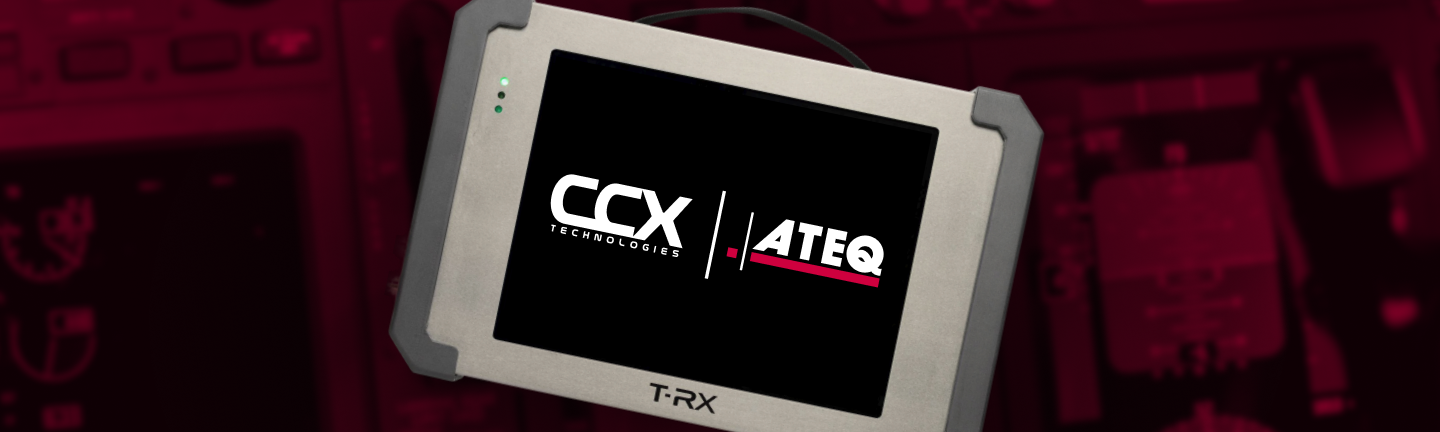
ATEQ Aviation Acquires T-RX Avionics Tester from CCX Technologies
Key Takeaways
- ATEQ Aviation has acquired the T-RX RP+ Avionics Radio and Pulse Tester from CCX Technologies, consolidating air data and radio frequency testing under a single manufacturer for the first time.
- The T-RX is a field-portable, tablet-based unit that tests more than 100 functions across 17 avionics systems – including ADS-B, TCAS, GPS, ELT, and transponders – in one device.
- When paired with ATEQ's ADSE 650 air data test set, the T-RX automatically transfers test data between the two units, producing a unified compliance report that satisfies both 14 CFR 91.411 and 91.413 requirements.
- A built-in vector network analyzer sets the T-RX apart from competing testers by enabling antenna diagnostics – VSWR, distance-to-fault, and cable loss – without a separate instrument.
- Pilot John International is an authorized distributor for both the T-RX RP+ and the ADSE series, and can help maintenance operations select the right configuration for their needs.
ATEQ Aviation has completed its acquisition of the T-RX Avionics Radio and Pulse Tester from CCX Technologies, bringing one of the aviation maintenance industry’s most capable all-in-one radio testing platforms under the ATEQ brand. The April 2026 acquisition builds on a distribution partnership the two companies announced in September 2024 and positions ATEQ as the provider of a tightly integrated avionics testing workflow – one that spans both radio frequency systems and air data testing on a single, connected platform.
For the MROs, airlines, and general aviation maintenance operations that already rely on ATEQ’s ADSE air data test sets for pitot-static and transponder compliance testing, the addition of the T-RX fills a significant gap: a field-portable, all-in-one radio tester that shares data directly with ATEQ’s air data equipment and feeds a unified compliance report.
About ATEQ Aviation
ATEQ Group, founded in 1975, is a global manufacturer of testing and measurement equipment with more than 800 employees across 40 countries. Within the aviation segment, ATEQ is best known for its ADSE series of air data test sets – portable pitot-static test units designed to support maintenance compliance with 14 CFR 91.411 and 91.413, the FAA regulations governing altimeter and transponder testing on IFR-certified aircraft.
The company’s aviation product line has grown in scope over the past decade as demand for integrated, field-portable test equipment has increased across commercial, corporate, and general aviation maintenance operations. The T-RX acquisition represents the most significant expansion of that portfolio to date.
What Is the T-RX Avionics Radio and Pulse Tester?
The T-RX RP+ Avionics Radio and Pulse Tester, developed by CCX Technologies, is a tablet-based test unit that consolidates the radio-frequency testing workload traditionally handled by multiple instruments into a single, field-portable device. Weighing just 5.07 lbs and housed in a rugged aluminum case, the T-RX is built for both ramp and hangar use.
The unit runs more than 100 tests across 17 avionics systems through a 10.4" sunlight-readable touchscreen – a practical feature for ramp environments where screen visibility is often a limiting factor with standard displays. Systems covered include VHF communication radios, VOR, ILS (localizer and glideslope), marker beacons, ADF, transponders (Modes A, C, and S), DME, TCAS/ACAS, ADS-B (both 1090ES receive and UAT 978 MHz), GPS signal simulation, ELT and ELT(DT), and weather radar. The inclusion of ELT(DT) – the newer digital testing mode for 406 MHz ELTs – keeps the T-RX current with evolving regulatory requirements for ELT testing.
One capability that sets the T-RX apart from many competing units is its integrated vector network analyzer (VNA) for antenna testing. Through the VNA function, technicians can measure the voltage standing wave ratio (VSWR), perform distance-to-fault (DTF) analysis to locate cable defects, and measure cable loss – diagnostics typically handled by a separate antenna analyzer. Combining this capability into the same device that handles radio system testing reduces the number of tools a technician needs to carry to a job.
The T-RX connects to shop networks via Wi-Fi or Ethernet and supports remote proctoring of test sessions through a standard web browser – a feature that allows supervisors or remote personnel to observe testing in real time without being physically present. At the conclusion of a test session, the unit generates a PDF report documenting the results, providing a ready-made compliance record for the aircraft maintenance log.
ATEQ’s ADSE Air Data Test Sets
ATEQ’s ADSE series air data test sets are the established half of the integrated testing picture. These units are self-contained pitot-static test systems designed to simulate the altitude and airspeed conditions required to verify the performance of altimeters, airspeed indicators, transponder encoders, and air data computers during scheduled maintenance events.
ADSE units simulate altitudes from -2,300 ft to 60,000 ft and airspeeds up to 650 knots (748 mph, or 1,204 km/h), covering the full operating envelope of most commercial and general aviation aircraft. The systems are RVSM-compliant – meeting the tighter altitude accuracy standards required for operations in Reduced Vertical Separation Minimum airspace between FL290 and FL410 – and are approved for use in 14 CFR 91.411 and 91.413 compliance testing.
Each ADSE unit pairs built-in pressure and vacuum pumps with an 8″ Windows-based touchscreen tablet for test control, eliminating the need for a separate laptop or controller. An internal battery provides approximately two hours of cordless operation, and the units support programmable test routines that can be saved and recalled for recurring maintenance events on specific aircraft types.
ATEQ offers the ADSE line in multiple configurations. The ADSE 550 is a lighter, single-channel unit designed for portability, making it the practical choice for general aviation maintenance shops and ramp-based line maintenance. The ADSE 650 is a multi-channel unit suited to high-throughput maintenance operations – MROs, airlines, and military maintenance facilities where multiple aircraft or systems are being serviced simultaneously.
How the T-RX and ADSE Work Together
The practical value of the ATEQ/T-RX combination becomes clearest in how the two systems exchange data. When used together, the T-RX transmits avionics test data to the ADSE 650 over Wi-Fi, automatically populating the air data test set’s records with transponder and radio system results from the T-RX session. This eliminates the manual data entry step that maintenance personnel would otherwise have to perform when consolidating results from separate test instruments – a step that introduces both time cost and transcription error risk.
The result is a unified compliance record that covers both 14 CFR 91.411 and 91.413 requirements in a single workflow, with a combined PDF report that documents all test results for the aircraft maintenance file. For avionics technicians working under time pressure on scheduled maintenance events, the reduction in administrative work has direct operational value.
Prior to the acquisition, ATEQ and CCX Technologies had already validated this integration during their 2024 distribution partnership, confirming that the T-RX and ADSE communicate reliably in field conditions and that the data hand-off between the two systems produces accurate, reportable output. The acquisition consolidates that validated workflow under a single manufacturer – with a single point of contact for support, calibration, and documentation.
What the Acquisition Means for Avionics Maintenance Operations
The consolidation of air data testing and radio frequency testing under one manufacturer addresses a persistent friction point in avionics maintenance: the management of multiple test instruments from different vendors, each with its own calibration schedule, documentation requirements, and support relationship. For maintenance directors and avionics department managers, fewer vendors means fewer renewal cycles to track and fewer service contacts to manage.
For the technicians performing the work, the integrated workflow means less time spent moving between instruments and manually reconciling results from separate systems – and more confidence that the compliance documentation generated at the end of a maintenance event accurately reflects everything that was tested. In a regulatory environment where maintenance records are subject to FAA audit, that clarity has real value.
The T-RX’s portability – a lightweight tablet unit with a 10-hour battery and built-in Wi-Fi – also extends the reach of the integrated workflow beyond the hangar. AOG situations, remote ramp repairs, and line maintenance events that previously required returning the aircraft to a fully equipped hangar can now be handled with the same testing capability in a unit small enough to carry in a field kit.
Available from PJi
Pilot John International® (PJi®) is an authorized distributor for a wide range of aviation test equipment, including ATEQ’s ADSE series air data test sets and the T-RX RP+ Avionics Radio and Pulse Tester. Our aviation specialists can help maintenance operations identify the right configuration for their aircraft types, regulatory requirements, and operational environment. Contact us by phone, email, or live chat for more information.
Frequently Asked Questions
Where do I send my T-RX for calibration or repairs?
Customers who previously sent their T-RX units to CCX Technologies' facility in New Jersey for calibration or repair may be wondering where to send their equipment following the acquisition. Some have assumed that service would now be routed to ATEQ's headquarters in France – but that's not the case. ATEQ has confirmed that it is establishing a U.S. service location in Michigan, which will serve as the primary destination for T-RX calibration and repair going forward. More details on the transition timeline are expected as ATEQ completes its setup.
Will the T-RX be rebranded under the ATEQ name?
Not at this time. ATEQ has indicated its intent to retain the T-RX name and product identity as-is. The acquisition is focused on supporting and growing the platform – not repackaging it. Customers should expect the same product they know, now backed by ATEQ's global infrastructure and support network.
Which ADSE models are currently compatible with the T-RX?
At this time, the integrated data transfer workflow between the T-RX and ATEQ's air data test sets is only supported on the ADSE 650.