How to Buy Aircraft Tires Without Breaking the Bank
Key Takeaways
- Aircraft tires are engineered to withstand far greater loads, speeds, and stress cycles than any road tire – made from conductive rubber compounds, inflated to high pressures with dry nitrogen, and built for repeated high-impact use.
- General aviation operators typically have greater tire purchasing flexibility than commercial operators, who are often bound to specific models by manufacturer-maintained manuals. Cost management for commercial fleets depends more on maintenance discipline, retreading, and bulk purchasing.
- Proper inflation and storage are the most impactful – and lowest-cost – ways to extend tire service life. The FAA's Advisory Circular AC 20-97B provides detailed guidance, and both Goodyear and Michelin publish aviation-specific tire care resources for operators.
- Retreading is standard practice in commercial and military aviation: nearly 80% of aircraft tires in service in the US are retreads, tires can be retreaded multiple times over their service life, and the industry saves over $100 million annually through retreading programs.
- Bundling tire purchases with GSE, consumables, and other recurring procurement through a single supplier like PJi can reduce per-unit costs, simplify vendor management, and improve supply reliability.
Aircraft tires are vital components that ensure safety and performance during takeoff, landing, and taxiing. Though they play no role once the aircraft is airborne, these tires absorb enormous forces at touchdown and support the aircraft's full weight during every ground operation – making their quality and condition a direct factor in airworthiness.
Finding competitively priced aircraft tires can be challenging. Operators are often constrained by manufacturer guidelines and the unique specifications of their fleet. While options may seem limited, exploring different suppliers, maximizing tire service life through proper maintenance, and leveraging programs like retreading and bulk purchasing can meaningfully reduce costs.
In this article, we'll highlight how Pilot John International® (PJi®) can simplify the process and offer practical strategies for saving money on high-quality aircraft tires.
The Basics of Aircraft Tires
To make informed purchasing decisions, it helps to understand what aircraft tires are, where they came from, and what makes them fundamentally different from the tires used on ground vehicles. This context shapes how operators approach tire selection, care, and cost management.
The Origins of Aircraft Tires
The Wright Flyer, the very first airplane, relied on rails, human power, wind, and a dolly system rather than wheels or tires for its short-distance flights. This worked for experimental purposes but fell short in terms of safety and operational scalability.
Horatio Phillips, another aviation pioneer, introduced tires to his aircraft design in 1904. This innovation marked a turning point, improving the safety and repeatability of takeoffs and landings and setting the stage for modern aircraft tire development.
The evolution of aircraft tires advanced rapidly throughout the early 1900s. Solid rubber tires gave way to air-filled (pneumatic) designs, significantly improving performance and shock absorption. Goodyear pioneered the first commercially produced tires specifically designed for aircraft, laying the foundation for the modern aviation tire industry. Since those early developments, aircraft tires have become indispensable to powered flight.
What Makes Airplane Tires Unique Compared to Other Tires?
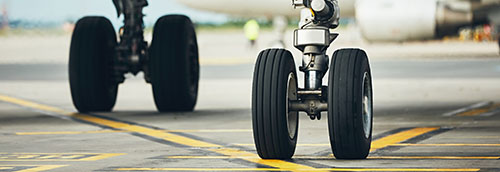
When shopping for airplane tires, you'll notice some surface-level similarities with automotive tires – both are round, rubber-based, and air-filled in most applications. But the engineering demands placed on aircraft tires are in a different category entirely. Key differentiators include:
- Durability in Extreme Conditions – Aircraft tires must support hundreds of thousands of pounds at high landing speeds while withstanding repeated cycles of compression, heat, and stress. They are built to far higher durability standards than any road tire.
- Size and Inflation Pressure – Aircraft tires are considerably larger and inflated to significantly higher pressures than car tires – commercial airliner tires, for example, can be inflated to 200 PSI or more – enabling them to handle the loads and speeds of aviation operations.
- Conductive Rubber Compounds – Aircraft tires are made from conductive rubber, which safely dissipates the static electricity generated by friction during takeoff and landing, preventing potentially dangerous electrical buildup.
- Nitrogen Inflation – Aircraft tires are typically filled with dry nitrogen rather than standard air. Dry nitrogen minimizes moisture, reduces the risk of wheel corrosion and oxidation of the inner liner, and provides more stable pressure across extreme temperature variations – a critical property at altitude and during high-speed ground operations.
How to Find Competitive Pricing on Aircraft Tires for Sale
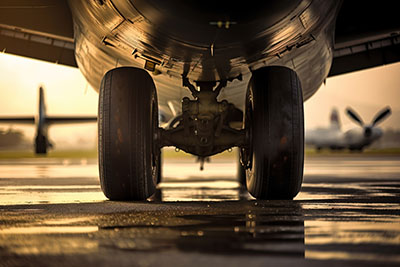
The degree of purchasing flexibility available to an operator depends largely on the type of aircraft in their fleet. General aviation operators often have more latitude, as many aircraft can safely accept a range of compatible tire models, making it easier to comparison-shop. Commercial air transport operations face stricter requirements: manufacturers frequently specify exact tire models in maintenance manuals, which limits substitution and makes cost management more dependent on other strategies – including maintenance discipline, bundled purchasing, and retreading programs.
Prioritize Effective Aircraft Tire Maintenance
Proper maintenance is one of the most cost-effective ways to extend tire service life and reduce the frequency and cost of replacements. The FAA's Advisory Circular AC 20-97B provides detailed guidance on tire installation, inflation, inspection, and removal – and following it closely pays dividends over time.
Tire pressure management is particularly important. For aircraft that fly one or more times daily, pressure should be checked daily using a calibrated gauge when the tires are cool. For less frequently flown aircraft, check before every flight. Newly installed tires should be monitored daily for the first several days, as initial inflation can cause internal materials to stretch by 6% to 10%, temporarily affecting pressure retention.
Storage conditions also affect tire longevity. Tires should be kept in a cool, dry environment – between 0°C and 30°C – away from direct sunlight and sources of ozone, such as electric motors, battery chargers, and fluorescent lighting, which accelerate rubber degradation. Major manufacturers, including Goodyear and Michelin, publish detailed care and maintenance guides that complement FAA guidance and are worth incorporating into your regular maintenance program.
Bundle Tire, GSE, and Service Purchases
Consolidating purchasing activity is another practical way to reduce per-unit costs. Many operators place tire orders reactively – one or two tires at a time – which leaves potential volume discounts untapped. Bundling tire orders with ground support equipment, consumables, and other recurring purchases allows suppliers like PJi to offer more competitive pricing across multiple categories.
Beyond the direct pricing benefit, consolidating procurement through a single trusted supplier simplifies vendor management, reduces administrative overhead, and can improve lead times for routine replenishment. Operators who plan ahead and batch their orders around scheduled maintenance intervals typically see the strongest savings.
Retreading Aircraft Tires
Retreading is one of the most financially and environmentally sound strategies available to aviation operators. According to industry data, nearly 80% of all aircraft tires in service in the US are retreads, and the commercial and military aviation industries collectively save more than $100 million annually through retreading programs. Aircraft tires can typically be retreaded multiple times over their service life – in some cases up to seven times – dramatically extending the return on each tire casing.
Retreaded tires are not a compromise on safety: all major commercial airlines and military operators rely on them as standard practice, and retreads are held to the same rigorous performance and airworthiness standards as new tires.
PJi offers a comprehensive retreading program and will also purchase your used tire casings – whether or not you choose to retread them – providing an additional avenue for cost recovery while reducing waste.
The Bottom Line
Aircraft tire costs are one of the more controllable line items in an aviation maintenance budget, provided operators approach procurement strategically. Maintaining tires properly to maximize service life, consolidating orders to capture volume pricing, and taking advantage of retreading programs are all proven strategies for reducing expenditure without compromising safety or compliance.
At Pilot John International, we're here to help you make the most of your aircraft tire investment. Whether you're looking to bundle orders, retread existing tires, or sell used casings, contact our knowledgeable aviation specialists for guidance. Ready to explore your options? Browse our extensive selection of aircraft tires for sale today!