Everything You Need to Know About Aircraft Hydraulic Fluid
Key Takeaways
- Aircraft hydraulic systems operate on Pascal’s Law – pressure applied at any point in a closed fluid system is transmitted equally throughout, letting compact hoses and tubes generate and deliver enormous force to landing gear, brakes, flight control surfaces, and thrust reversers.
- Unlike pneumatic systems, hydraulic fluid resists compression – eliminating response lag and ensuring near-instantaneous action when pilots adjust control surfaces, deploy landing gear, or apply brakes during critical phases of flight.
- Aircraft hydraulic fluid falls into three categories – mineral oil-based, synthetic hydrocarbon, and phosphate ester-based – with phosphate ester fluids like Skydrol dominating commercial aviation for their fire resistance, chemical stability, and thermal performance.
- Aircraft hydraulic systems deliver three core advantages that make them ideal for aviation – reliability built on well-understood physics with few failure modes, cost-effectiveness rooted in simpler service and repair, and real-time response enabled by hydraulic fluid’s resistance to compression.
- Beyond commercial transport, aircraft hydraulic fluid selection spans the full aviation spectrum – mineral oil-based fluids remain common in general aviation and older airframes, while synthetic hydrocarbon fluids deliver the enhanced pressure and thermal performance required by military and other high-performance aircraft.
- PJi stocks all major aircraft hydraulic fluid brands in a wide range of formulations, with global shipping, flexible financing, and real-person support to help operators source the right fluid for their aircraft.
Hydraulic systems are tucked deep within an aircraft’s structure, invisible to passengers and crew alike. Technicians have to open access panels to troubleshoot and maintain them – but what happens inside those panels is fundamental to every flight.
Despite their low profile, hydraulic systems and the aircraft hydraulic fluid that flows through them are among the most critical elements of modern aviation. The operating principle is straightforward: applying pressure at one point in a closed fluid system transmits that pressure throughout – and in aircraft, that pressure controls brakes, flaps, landing gear, and more, reliably and in real time.
In this article, we’ll cover the principles behind aircraft hydraulic systems, the role hydraulic fluid plays within them, the most common fluid types, and the questions operators and technicians ask most often.
Aircraft Hydraulic Systems and Fluid Fundamentals
Understanding aircraft hydraulics starts with two intertwined ideas: the engineering principle that enables these systems to generate enormous force from compact components, and the fluid that makes it all possible. Together, hydraulic systems and aircraft hydraulic fluid form the backbone of countless aircraft functions – from steering and stopping to deploying landing gear. Here’s how each piece works.

Hydraulic Systems
In the mid-1600s, French physicist and mathematician Blaise Pascal articulated a principle that remains foundational to engineering today. As NASA describes it, Pascal’s Law states that when pressure increases at any point in a confined fluid, it increases equally at every other point in the container.
In a closed hydraulic system, that principle becomes enormously useful. As long as the system’s components can contain the applied pressure, that pressure travels throughout – through cylinders, pistons, tubes, hoses, pumps, and motors – with no meaningful loss. More sophisticated systems use cylinders of different sizes to multiply and transmit force.
For aircraft, that translates into a major practical advantage: compact components like hoses and tubing can fit into tight airframe spaces while still delivering the substantial force required to operate heavy systems such as landing gear and flight control surfaces.

Hydraulic Fluid
Hydraulic fluid is what makes hydraulic systems work – the medium through which energy is transferred and force applied. One of its defining characteristics is its resistance to compression. Unlike pneumatic systems, which rely on compressible air or gas, hydraulic fluid transmits force almost instantaneously, with no perceptible lag between the pilot’s input and the system’s response.
That incompressibility also matters because aircraft experience significant pressure changes throughout a flight. A fluid that compresses or behaves erratically under varying conditions introduces unpredictability into systems that must perform flawlessly every time.
Hydraulic fluids vary widely by formulation, base chemistry, and intended application. Skydrol – one of the most widely used aircraft hydraulic fluids in commercial aviation – is a good example of just how carefully these fluids are engineered. It’s fire-resistant, chemically stable, and thermally stable. In an environment where fire risk must be minimized, maintenance intervals must be predictable, and operating temperatures can be extreme, those properties aren’t incidental – they’re essential.
Aircraft Systems Powered by Hydraulic Fluid
Hydraulic systems generate substantial force through compact, lightweight components – and aircraft hydraulic fluid is the medium that delivers that force precisely where it’s needed. The following systems all depend on hydraulics to operate safely and effectively across the full flight envelope.
Landing Gear
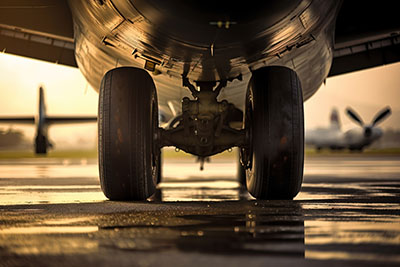
Modern airliners can weigh several hundred thousand pounds on takeoff and landing, with every pound of that load funneled through the landing gear. Retractable gear reduces aerodynamic drag once the aircraft is in flight, but it must deploy and stow reliably at any altitude and airspeed – and only hydraulic systems deliver the force-to-size ratio needed to make that happen consistently within a tight wheel well.
Brakes
Aircraft brakes need to deliver an immediate, controllable stopping force during landing, taxiing, and rejected takeoffs. Hydraulic braking is the dominant approach in aviation for a simple reason: the near-instantaneous response and high force output of a hydraulic system are exactly what’s required to bring a fast-moving aircraft to a controlled stop within the available runway.
Flight Control Surfaces
Ailerons, rudders, elevators, and flaps govern an aircraft’s attitude and trajectory – but on anything larger than a light aircraft, the aerodynamic forces acting on these surfaces are simply too great for purely manual control. Hydraulic systems give pilots the mechanical advantage they need to move large, heavy control surfaces quickly, precisely, and without physical strain.
Thrust Reversers
After touchdown, thrust reversers redirect engine thrust forward to help decelerate the aircraft – shortening landing distance, reducing brake wear, and improving directional stability during the rollout. Deploying and holding a thrust reverser means overcoming the enormous forces produced by an active jet engine, and hydraulic systems are uniquely capable of supplying – and sustaining – that level of power on demand.
Key Advantages of Aircraft Hydraulic Systems
Hydraulic systems offer several advantages that make them especially well-suited to aircraft applications.
Reliability is perhaps the most important. For systems that have to function flawlessly at 35,000 feet, in extreme temperatures, under high loads – every single time – hydraulics deliver because they operate on well-understood physical principles with relatively few failure modes. When properly designed, built, and maintained, hydraulic systems are among the most dependable in aerospace engineering.
Cost-effectiveness follows from that simplicity. The same characteristics that make hydraulic systems reliable also tend to make them more straightforward to service and repair, which contributes positively to lifecycle costs.
Fast response time rounds out the picture. Hydraulic fluid’s resistance to compression means the system reacts in real time – flight control surfaces adjust immediately, landing gear deploys on command, and brakes engage without hesitation.
Common Types of Aircraft Hydraulic Fluid
Aircraft hydraulic fluids generally fall into three broad categories, each defined by its base chemistry and engineered for different aircraft applications. The right choice depends on aircraft type, operating environment, and the manufacturer’s approved fluid list – but understanding the three main families is a useful starting point for any operator, technician, or supply chain team responsible for keeping aircraft mission-ready.
Mineral Oil-Based Hydraulic Fluid
Mineral oil – a byproduct of petroleum refining – is one of the most common hydraulic fluid bases across many industries, and aviation is no exception. Many general aviation aircraft and older commercial airframes still rely on mineral oil-based hydraulic fluid, which is widely available, well-characterized, and compatible with a broad range of standard hydraulic components.
Synthetic Hydrocarbon Hydraulic Fluid
Synthetic hydrocarbon hydraulic fluid is engineered for applications that exceed the performance window of conventional mineral oils. It’s commonly found in certain military aircraft and high-performance airframes, where operating under extreme pressures and temperatures requires a more capable, thermally stable formulation.
Phosphate Ester-Based Hydraulic Fluid
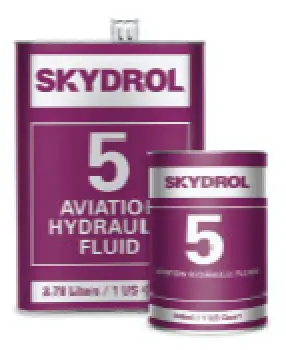
Phosphate ester-based hydraulic fluid delivers superior fire resistance compared to mineral oil-based alternatives – a meaningful advantage in aircraft, where a hydraulic line failure near a heat source could have catastrophic consequences. Skydrol, manufactured by Eastman Chemical Company, is the most widely recognized phosphate ester hydraulic fluid in commercial aviation and is used across a broad range of commercial transport aircraft worldwide.
The Bottom Line
Aircraft hydraulic fluid keeps the world’s aircraft moving – literally. From the smallest general aviation trainer to the largest commercial widebody, every hydraulic-driven landing gear cycle, brake application, control surface input, and thrust reverser deployment depends on the right fluid running through the right system.
Pilot John International® (PJi®) stocks all major brands of aircraft hydraulic fluid in a wide range of formulations – from mineral oil-based fluids like MIL-PRF-5606 and MIL-PRF-83282 for general aviation to Skydrol phosphate ester hydraulic fluid for commercial and business aviation. We also carry a comprehensive inventory of ground support equipment (GSE), aircraft parts, specialized tooling, and other aircraft consumables – backed by global shipping and flexible financing and trade-in options.
Customer service at PJi is supported by automation – never replaced by it. When you reach out, you’ll connect with a knowledgeable aviation specialist who will take the time to understand your operation and help you source the right fluid for your aircraft. Contact our team by phone, email, or live chat today!
Frequently Asked Questions
What is aircraft hydraulic fluid made of?
Aircraft hydraulic fluid is engineered around one of three base chemistries: mineral oil, synthetic hydrocarbon, or phosphate ester. Each base is blended with an additive package that fine-tunes properties like fire resistance, thermal stability, viscosity behavior, anti-erosion performance, and seal compatibility. The right formulation for any given aircraft is determined by the manufacturer’s approved fluid list.
Is aircraft hydraulic fluid flammable?
It depends on the specific fluid. Reducing flammability has been a long-standing priority in the development of aircraft hydraulic fluid, and many modern formulations – particularly phosphate ester hydraulic fluid like Skydrol – are specifically engineered to be fire-resistant. Older petroleum-based fluids posed a real fire risk if a hydraulic line ruptured near a heat source, and not all fluid types in current service share the same fire-resistant properties.
What color is aircraft hydraulic fluid?
Color varies by formulation and manufacturer – there’s no universal industry standard. Skydrol, for example, is a distinctive purple when freshly produced, but that color can fade or shift over time as the fluid ages in service. Routine fluid condition monitoring is one way technicians track that change as part of regular maintenance.
Can different hydraulic fluids be mixed?
No – and this point can’t be overstated. Aircraft hydraulic fluids are precisely formulated for the systems they’re designed to serve, and mixing fluids from different chemical families can degrade hoses, seals, and other components while introducing inconsistent system performance. Always use the hydraulic fluid specified by the aircraft manufacturer – when that guidance is followed, fluid selection is straightforward.
How often does aircraft hydraulic fluid need to be changed?
Change intervals vary by aircraft type, hydraulic system design, operating conditions, and the specific fluid in use – there’s no universal schedule. Operators should follow the aircraft maintenance manual and the fluid manufacturer’s recommendations, including any condition-based thresholds for water content, acidity, or particulate levels. Some modern formulations – such as Skydrol PE-5 – are specifically engineered to extend service life and reduce the frequency of fluid changes.
How are aircraft hydraulic systems maintained and tested?
While an aircraft is in service, its engines and auxiliary power unit (APU) power the hydraulic system. During ground maintenance, an external power source is required to operate and test those same systems. That’s the role of hydraulic power units (HPUs), also known as hydraulic mules. HPUs enable technicians to pressurize and cycle hydraulic systems for testing, troubleshooting, and verification – covering everything from landing gear retraction cycles to flight control surface functional checks.
What is the shelf life of aircraft hydraulic fluid?
Most aircraft hydraulic fluids have a shelf life of about 4 to 10 years when stored correctly in sealed, unopened containers. Mineral-based hydraulic fluids like MIL-PRF-5606 typically last around 4 to 5 years, while phosphate ester fluids such as Skydrol may have shelf lives up to 10 years. Exposure to moisture, contamination, heat, or damaged packaging can shorten the fluid’s usable life and affect aircraft hydraulic system performance.
To maximize shelf life, aviation hydraulic fluid should be stored in a cool, dry environment away from direct sunlight and temperature extremes. Because many aircraft hydraulic fluids can absorb moisture, containers should remain tightly sealed until use. If a fluid has been stored for several years, some manufacturers recommend retesting it to confirm it still meets performance specifications before use in aircraft maintenance operations.