






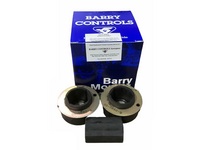
Barry Mounts 94110-40 Engine Mount – Air Plains, Alliance, Beechcraft, Cessna, & Twin Commander


The Barry Mount 94110-40 is a robust aircraft engine isolator, designed to ensure stability and vibration reduction across a wide range of aircraft, including Air Plains, Alliance, Beechcraft, Cessna, and Twin Commander models. This high-quality engine mount is essential for pilots and mechanics looking to maintain smooth engine performance, reduce cabin noise, and extend the lifespan of engine components.
The 94110-40 is compatible with multiple aircraft models and engine types. For Air Plains, supported models include the 180 and 182 series, specifically the IO-520-D and IO-550-D engines, which require four mounts per engine. Alliance aircraft, including the H-295 and H-395, use the GO-480-G1D6 and GO-480-G1A6 engines, also requiring four per engine. Beechcraft enthusiasts will find the Barry Mount compatible with various 65, 70, and A65 models, paired with IGSO-480 and IGSO-540 engine variants, among others. Cessna owners of models such as the 175, 180, and 182 series, as well as Twin Commander operators with the 500A and 680 series, also benefit from the reliable isolation provided by this mount.
Crafted to meet rigorous aviation standards, the Barry Mount 94110-40 provides consistent engine vibration control, contributing to safer, smoother flights. Whether you’re flying a Cessna 182 or a Twin Commander 680, count on Barry Mount’s precision engineering to maintain engine alignment and absorb the shocks that come with powerful flight operations. With this isolator installed, pilots and mechanics alike can ensure that the aircraft remains flight-ready, preserving the integrity of critical engine parts. Choose the Barry Mount 94110-40 for top-tier performance and peace of mind during every flight.
Specifications
- Part Number: 94110-40
- Type: Aircraft Engine Isolator
- Compatible Aircraft:
- Air Plains: 180(ALL) / 182H-R
- Alliance: H-295(U10D) / H-395(L-28A OR U-10B)
- Beechcraft: 65 / 65-80 / 65-88 / 65-A80 / 65-B80 / 70 / A65 / E50 / F50 / G50 / J50
- Cessna: 175 / 180A-H / 182 / 185 / 188 / 210 / and more
- Twin Commander: 500A / 560A / 560E / 560F / 680 / 680E / and more
- Engine Compatibility:
- Air Plains: IO-520-D, IO-550-D (4 per engine)
- Alliance: GO-480-G1D6, GO-480-G1A6 (4 per engine)
- Beechcraft: IGSO-480 series, IGSO-540 series, GSO-480 series (4 per engine)
- Cessna: GO-300, O-470, IO-470, IO-520 series (4 per engine)
- Twin Commander: IO-470, GO-480, IGO-540, GSO-480, IGSO-540 series (4 per engine)
- Quantity Required: 4 mounts per engine
- Function: Reduces vibration, maintains engine alignment, and extends engine component life
- Construction: Precision-engineered to aviation standards
- Application: Ideal for reducing cabin noise and vibration, enhancing flight comfort, and improving engine reliability
Aircraft Engine Mount List
- Air Plains: 180(ALL) / 182H-R
- Engine Model: IO-520-D (4 Per Engine), IO-550-D (4 Per Engine)
- Alliance: H-295(U10D) / H-395(L-28A OR U-10B)
- Engine Models: GO-480-G1D6 (4 Per Engine), GO-480-G1A6 (4 Per Engine)
- Beechcraft: 65 / 65-80 / 65-88 / 65-A80 / 65-B80 / 70 / A65 / E50 / F50 / G50 / J50
- Engine Model: IGSO-480-A1A6 (4 Per Engine) , IGSO-480-A1B6 (4 Per Engine), IGSO-480-A1E6 (4 Per Engine), IGSO-540-A1A (4 Per Engine), IGSO-540-A1D (4 Per Engine), IGSO-480-A1E6 (4 Per Engine), GSO-480-A1A6 (4 Per Engine), GSO-480-B1B6 (4 Per Engine), IGSO-480-A1B6 (4 Per Engine)
- Cessna: 175 / 180A-H / 182 / 185 / 188 / 210 / 175A / 175B / 175C / 180A / 180B / 180C / 180D / 180E / 180F / 180G / 180H / 182A / 182B / 182C / 182D / 182E / 182F / 182G / 182H / 182J / 182K / 182L / 182M / 182N / 182P / 182Q / 182R / 185A / 185B / 185C / 185D / 185E / 210-5(205) / 201-5A(205A) / IO-470E / 210A / 210B / 210C / 310B / 310C / 310D / A185F / A188 / A188A
- Engine Model: GO-300-A(4 Per Engine), GO-300-C (4 Per Engine), O-470-A(4 Per Engine), O-470-J(4 Per Engine), O-470-K(4 Per Engine), O-470-L (4 Per Engine), IO-470-F (4 Per Engine), O-470-R (4 Per Engine), IO-470-E (4 Per Engine), GO-300-C(4 Per Engine), GO-300-D(4 Per Engine), GO-300-E (4 Per Engine), O-470-K(4 Per Engine),O-470-L(4 Per Engine), O-470-R(4 Per Engine), O-470-S (4 Per Engine), O-470-U (4 Per Engine),IO-470-F (4 Per Engine), IO-470-S (4 Per Engine), O-470-M (4 Per Engine), IO-470-D (4 Per Engine), IO-520-D (4 Per Engine)
- Twin Commander: 500A / 560A / 560E / 560F / 680 / 680E / 680F / 680FL / 680FL/P / 720
- Engine Model: IO-470-M (4 Per Engine), GO-480-D1A (4 Per Engine), GO-480-C1B6(4 Per Engine), GO-480-G1B6(4 Per Engine), IGO-540-B1A(4 Per Engine), IGO-540-B1C(4 Per Engine), GSO-480-A1A6(4 Per Engine), GSO-480-B1A6(4 Per Engine), IGSO-540-B1A(4 Per Engine), IGSO-540-B1C(4 Per Engine)
| General Information | |
|---|---|
| Part # | 94110-40 |
| Manufacturer | Barry Mounts Hutchinson |
| Shipping Information | |
|---|---|
| Product Weight | 2 lbs. |
| Product Dimensions | 3.5 x 3.5 x 3.5 in. |
| Schedule B | 8487900080 |
| ECCN | 9A991.d |
Customers also viewed
AIRCRAFT COMPATIBILITY
| Compatible Aircraft* | |
|---|---|
| Alliance |
Courier H-295 (U10D)
NOTE
Four 94110-40 are required on aircraft with GO-480-G1D6 and -G1A6 engines.
,
Courier H-395 (L-28A or U-10B)
NOTE
Four 94110-40 are required on aircraft with GO-480-G1D6 engines.
|
| Cessna |
175 Skylark
NOTE
Four 94110-40 are required on aircraft with GO-300-A and -C engines.
,
180
NOTE
Four 94110-40 are required on aircraft with O-470-A, -J, and -K engines.
,
182
NOTE
Four 94110-40 are required on aircraft with O-470-L engines.
,
185
NOTE
Four 94110-40 are required on aircraft with IO-470-F engines.
,
188 AgWagon 230
NOTE
Four 94110-40 are required on aircraft with O-470-R engines.
,
210
NOTE
Four 94110-40 are required on aircraft with IO-470-E engines.
,
310
NOTE
Four 94110-40 are required on aircraft with IO-470-D engines.
|
| Hawker Beechcraft |
Queen Air
NOTE
Four 94110-40 are required on aircraft with IGSO-480-A1B6 and -A1E6 engines.
,
Twin-Bonanza
NOTE
Four 94110-40 are required on aircraft with GSO-480-A1A6 and -B1B6 engines.
|
| Twin Commander |
560A
NOTE
Four 94110-40 are required on aircraft with GO-480-D1A, -C1B6, and -G1B6 engines.
,
560E
NOTE
Four 94110-40 are required on aircraft with GO-480-C1B6 and -G1B6 engines.
,
560F
NOTE
Four 94110-40 are required on aircraft with IGO-540-B1A and -B1C engines.
,
680
NOTE
Four 94110-40 are required on aircraft with GSO-480-A1A6 and -B1A6 engines.
,
680E
NOTE
Four 94110-40 are required on aircraft with GSO-480-B1A6 engines.
,
680F
NOTE
Four 94110-40 are required on aircraft with IGSO-540-B1A and -B1C engines.
,
680FL
NOTE
Four 94110-40 are required on aircraft with IGSO-540-B1A and -B1C engines.
,
680FL/P
NOTE
Four 94110-40 are required on aircraft with IGSO-540-B1A and -B1C engines.
,
720
NOTE
Four 94110-40 are required on aircraft with GSO-480-B1A6 engines.
|
PRODUCT REVIEWS
QUESTIONS & ANSWERS
An aircraft engine mount, also known as a vibration isolator, helps absorb engine vibration and reduce the transfer of vibration into the airframe. This improves ride quality, helps lower cabin noise, and reduces vibration-related stress on surrounding components. Barry Mounts engine mounts are commonly used to support smoother engine operation and better long-term durability.
Many aircraft applications require four engine mounts per engine, although the exact quantity may vary depending on the aircraft model, installation, and engine configuration. If you’re unsure how many mounts are required for your specific aircraft engine, please contact our aviation specialists for assistance.
Engine mounts are not universal parts; each mount design is specifically tailored to support a particular engine's weight, stiffness requirements, and preload for a specific application. Using the correct mount helps prevent excessive engine movement, vibration issues, and premature wear on surrounding structures. A properly matched engine isolator also supports consistent alignment and reduces the likelihood of vibration-related squawks.
Barry Mounts’ general aviation engine vibration isolators utilize metal washers bonded to an elastomer, along with a through-bolt interface, to maintain secure engine support. This fail-safe construction is designed to help restrain the engine even if the elastomer were damaged or compromised under extreme conditions. At the same time, it still allows the mount to absorb vibration during regular operation, supporting smoother performance and reduced airframe stress.
Worn or deteriorated engine mounts can contribute to increased vibration, more cabin noise, and excessive engine drift. Over time, that movement can lead to wear or damage on adjacent structures, such as the cowling or prop spinner area. If maintenance teams notice unusual vibration or evidence of drift-related contact, evaluating the engine mount condition is one key item to consider.
Barry Mounts recommends inspecting installed engine mounts during annual or 100-hour inspections, as part of routine aircraft maintenance. Inspections can typically be performed with the mounts installed and supporting the engine weight. Regular inspections help catch cracking, bond separation, or drift-related concerns before they escalate into larger issues.
Common inspection criteria include checking the elastomer for cracking or deterioration, verifying the elastomer-to-metal bond, and looking for visible corrosion or damage on exposed metal washers. Excessive drift evidence (like surrounding structure damage) can also point to issues with the mount. If bond separation exceeds acceptable limits or deterioration is significant, replacement is typically required.
According to Barry Mounts, engine mounts should be removed and inspected when certain maintenance events occur, such as engine removal for overhaul, sudden propeller/engine stoppage, exposure to excessive heat, or reports of excessive vibration. Removal allows technicians to inspect areas that are not visible while the device is installed and perform additional checks. This helps confirm the mounts are still airworthy after major stress events.
Yes. Routine cleaning is typically simple, using a clean rag to remove dirt and hydrocarbon residue. Soap and water or isopropyl alcohol may be used, but other solvents should be avoided because they can damage the elastomer or the elastomer-to-metal bond. If lubricants or solvents are spilled on the mounts, removing them promptly helps protect the material.
Barry Mounts’ inspection guidance indicates that when a mount is rejected during inspection, the isolator should be replaced as an assembly, and mixing new and used components is not allowed. The guidance also recommends replacing mounts as a set, rather than installing single new mounts alongside older ones. This helps maintain consistent stiffness and vibration isolation across the engine mounting system.
Some Barry Mounts vibration isolators incorporate molded shims within one of the molded assemblies to create a stiffer side. This helps support engine weight while the aircraft is on the ground. It’s one reason orientation, correct application, and proper installation practices matter – mount stiffness is part of how vibration isolation is tuned for the aircraft.
Barry Mounts has long supported general aviation and holds PMA approvals for a wide range of engine mounts, including the 94110-40, which helps ensure the part meets regulatory requirements for approved replacement use. Always confirm approvals and applicability for your specific aircraft model and serial range.
Hutchinson Aerospace, the manufacturer of Barry Mounts, warrants that the 94110-40 engine mount is free from defects in material and workmanship under proper and normal use. Warranty coverage is commonly referenced as 500 flight hours or 12 months, whichever comes first. As with most aircraft components, warranty eligibility may depend on factors such as proper storage, installation, and operating conditions. For planning purposes, it’s best to confirm the current warranty terms at the time of purchase.
The most reliable method is to confirm compatibility using an approved aircraft application listing and then verify against the aircraft’s maintenance documentation when needed. Many compatibility tables and supplier references include model and serial-number ranges, which can affect fitment. Confirming the match upfront helps prevent returns and supports proper vibration isolation performance once installed.


