






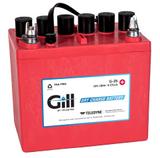
The Teledyne Gill 7243-16 Sealed Aircraft Battery brings the next generation of super capacity valve-regulated lead-acid (VRLA) technology to modern aviation. Designed to handle the toughest demands, this battery is more than an upgrade—it’s a commitment to exceptional safety, reliability, and long-lasting performance. Its sealed, non-spillable VRLA design ensures powerful, maintenance-free operation, meeting the high standards expected by aviation maintenance professionals.
TSO Authorized, rigorously tested to DO-160E standards, and FAA-PMA certified, the Teledyne 7243-16 adheres to the highest benchmarks of safety and quality, providing consistent power on every flight. With a first capacity inspection required at 18 months or 1,800 hours, this battery significantly reduces maintenance demands, allowing more time in the air and less on the ground. Supported by a 2-year warranty, it delivers dependable performance, even in the most challenging flight conditions.
Perfect for pilots who need a reliable and enduring power source, the Teledyne 7243-16 is designed as an upgrade from the Teledyne Gill G-241 Dry Charged Battery. It offers superior cranking power and energy retention, all in a lighter, more efficient design. The advanced VRLA technology also makes it non-spillable, enhancing safety and ease of handling, particularly in unpredictable flight environments.
Whether for commercial, private, or military aviation, the 7243-16 provides unmatched confidence in your power source. It performs reliably across extreme temperatures, ensuring your aircraft systems remain powered from the coldest altitudes to the hottest tarmacs.
Equip your aircraft with the trusted power of the Teledyne Gill 7243-16 and experience the enhanced performance and reliability of advanced lead-acid technology, tailored for today’s aviation needs.
| General Information | |
|---|---|
| Part # | 7243-16 |
| Manufacturer | Teledyne Gill |
| Spec Sheet 1 | View Spec Sheet |
| MSDS 1 | View Safety Data Sheet |
| Shipping Information | |
|---|---|
| Product Weight | 33 lbs. |
| Product Dimensions | 9 x 10 x 10 in. |
| Schedule B | 8507200090 |
| ECCN | 9A991.d |
| Specifications | |
|---|---|
| 30 Minute Emergency Rate, C/2, A | 25 |
| Model | 7243-16 |
| Nominal Voltage, V | 24 |
| One Hour Capacity, C1, Ah | 16 |
| Power Performance | 23°C (75°F): Ipp, A - 1100, Ipr, A - 480, -18°C (0°F): Ipp, A - 640, Ipr, A - 300, -30°C (-22°F): Ipp, A - 495, Ipr, A - 250 |
| Weight, Lb. Maximum | 29.90 |
Customers also viewed
AIRCRAFT COMPATIBILITY
| Compatible Aircraft* | |
|---|---|
| Cessna | 152 , 172Q - Cutlass , 172R - Skyhawk , 172S - Skyhawk SP , 182 , 182S - Skylane , 182T - Skylane |
| Cirrus | SR20 , SR22 , SR22T |
| Diamond Aircraft | DA40 Diamond Star , DA42 |
| Grumman American | AA-5 Traveler , AA-5A Cheetah , AA-5B Tiger |
| Maule | M-4-180V , M-5-180C , M-5-235C , M-6-180 , M-6-235 , M-7-235 , M-7-235A , M-7-235B - Super Rocket , M-7-235C - Orion , M-7-260 - Super Rocket , M-7-260C - Orion , M-8-235 , MT-7-235 - Super Rocket , MT-7-260 , MX-7-160 , MX-7-160C , MX-7-180 , MX-7-180A , MX-7-180AC , MX-7-180B , MX-7-180C , MX-7-235 , MXT-7-160 , MXT-7-180 , MXT-7-180A |
| Mooney | Acclaim M20TN , Eagle M20S , M20M , Mark 201 M20J , Mark 231 M20K , Ovation M20R , PFM M20L |
| Piper | Archer II , Archer III , Archer TX , Malibu Matrix - PA-46R-350T , Warrior II , Warrior III |
| Rockwell Commander | 114B , 114TC |
PRODUCT REVIEWS
This item does not have any reviews yet.
QUESTIONS & ANSWERS
Yes. Gill aircraft batteries do not have any “memory effect,” so interrupting the charge will not harm them. Just be sure to turn off your battery charger when pausing the process. For optimal performance, it’s best to finish charging your battery within the same day.
Gill does not recommend onboard battery charging. Always remove the battery from the aircraft before charging.
If properly serviced, your battery can provide several years of reliable service. However, Gill recommends changing your battery every two-and-a-half to three years.
On a newly charged 24V battery like the 7243-16, the voltage should read 26 to 26.4 volts.
Store the battery in a cool, dry place with a stable temperature, ideally around 80°F (27°C). Avoid areas with high humidity or extreme temperatures, as these conditions can adversely affect the battery’s health. Ensure the storage area is well-ventilated and away from flammable materials. Additionally, store the battery in an upright position to prevent any potential leakage.
Before storage, wipe the battery with a dry cloth to remove any dirt or moisture that could lead to terminal corrosion and ensure the battery is fully charged. A fully charged battery is less susceptible to sulfation, a condition that can diminish performance. Even during storage, it’s important to check the battery’s voltage periodically. If the voltage drops below 75% of its state of charge, recharge the battery to prevent deep discharge, which can shorten its lifespan.
Yes, the battery is designed to perform in low-temperature environments, with specific cold cranking performance metrics provided for temperatures as low as -30°C (-22°F).
Gill 7000 Series LT valve-regulated lead-acid batteries, including the 7243-16, can be stored for up to 24 months without an inspection if stored between 40°F and 80°F.
Gill 7000 Series LT valve-regulated lead-acid batteries are shipped fully charged and ready for installation. However, it’s advisable to verify the battery’s state of charge upon receipt to ensure optimal performance. If the battery has lost charge during transit or storage, recharging it before installation is recommended.
Gill 7000 Series LT valve-regulated lead-acid batteries are warranted for a period of 12 months or 600 hours of operation, whichever occurs first after the date of installation. Teledyne Battery Products (TBP) will replace, at no charge, any battery manufactured or supplied by it which, within the applicable 12 months or 600-hour period, is found to the satisfaction of TBP to be defective in material or workmanship.
While the battery is sealed and requires less maintenance than traditional flooded lead-acid batteries, regular inspections and capacity checks are recommended to ensure continued airworthiness.


