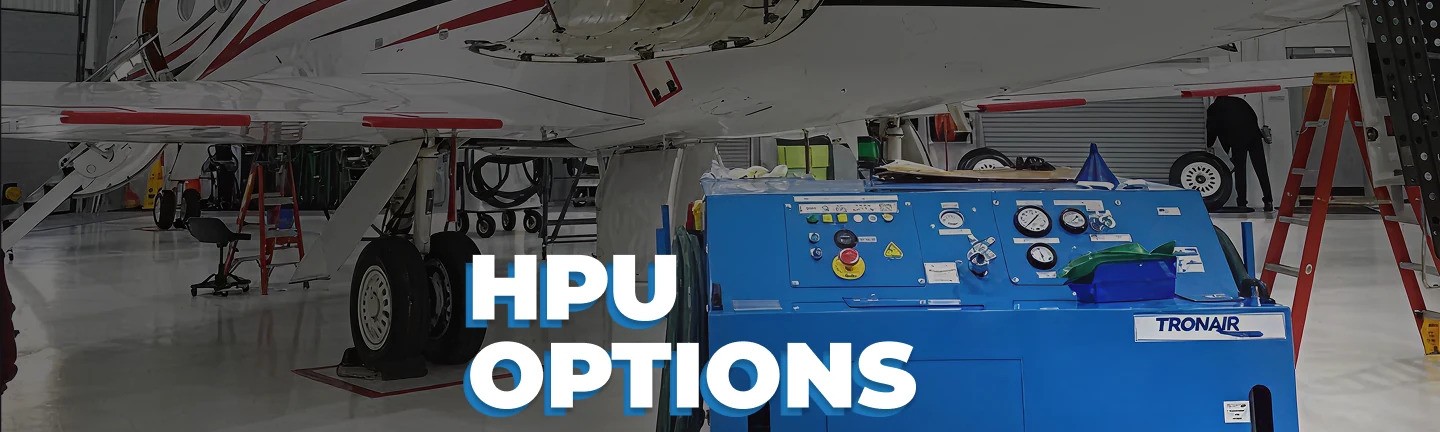
Tronair 56 vs. 57 Series HPU: Which Is Right for Your Aircraft?
Key Takeaways
- Aircraft HPUs supply pressurized hydraulic fluid to aircraft systems during ground maintenance – enabling leak checks, system drains, filtration, and fluid replenishment without requiring engines or onboard power.
- Tronair organizes its HPU lineup into three frame sizes: A-Frame for small aircraft and rotorcraft, B-Frame for all business aviation, and C-Frame – which includes the 56 and 57 Series – for business through regional commercial aircraft.
- Both the 56 and 57 Series are C-Frame HPUs, but the 57 Series delivers higher hydraulic output. A 57 Series can serve any aircraft the 56 Series would support, but the reverse is not true – never substitute a lower-capability HPU for a higher-requirement aircraft.
- All Tronair HPUs are CE and CSA marked, designed for single-operator use, and available with an optional towing and trailer package for easy ramp and hangar mobility.
- PJi is an authorized Tronair distributor and service center – contact the team by phone, email, or live chat to confirm which 56 or 57 Series model fits your fleet.
Aircraft hydraulic power units (HPUs) are essential pieces of ground support equipment – but selecting the right unit for your aircraft's specific hydraulic requirements is just as important as having one at all. Tronair offers one of the most trusted HPU lineups in aviation, and two of its most widely used models – the 56 Series and the 57 Series – are often compared side by side.
In this article, we'll explain how HPUs support aircraft hydraulic systems, break down Tronair's frame size structure, and clarify the key differences between the 56 and 57 Series so you can choose the right unit for your fleet.
How Are Hydraulics Used in Aircraft, and How Does an HPU Support Them?
Aircraft hydraulic systems power a broad range of functions. On smaller aircraft, hydraulics typically operate wheel brakes, retractable landing gear, and certain propeller systems. On larger platforms, they extend to flight control surfaces, wing flaps, spoilers, and more – making the integrity of the hydraulic system essential to airworthiness.
According to the FAA, a basic hydraulic system includes a reservoir, pump, filter, selector valve, relief valve, and actuator. When an aircraft is on the ground, its onboard hydraulic system must be tested, serviced, and verified without running the engines. That's where an HPU comes in.
A hydraulic power unit is a self-contained piece of mobile GSE that supplies pressurized hydraulic fluid to the aircraft's systems during ground maintenance. HPUs are commonly used to check for hydraulic system leaks, drain and filter the system, and refill it with clean, properly specified fluid – all without powering up the aircraft.
Why Choose a Tronair HPU?
Tronair HPUs are recognized worldwide as reliable, durable, and precise pieces of aviation ground support equipment. Used across commercial, regional, military, business aviation, and rotorcraft environments, Tronair HPUs meet all requirements for global operation and carry CE and CSA markings.
Tronair designs its HPUs with straightforward operating procedures to minimize training time and reduce the risk of user error. Their low-profile, low-weight construction allows a single operator to maneuver the unit across a hangar floor or tow it across the ramp with the optional towing and trailer package – an important practical advantage in busy maintenance environments.
Tronair HPU Frame Sizes: A, B, and C
Tronair organizes its HPU lineup into three frame sizes, each suited to a different range of aircraft types and hydraulic demands:
- A-Frame – Series 50, 51: Designed for rotorcraft and small business aircraft
- B-Frame – Series 52, 53, 54, 5J: Covers rotorcraft and all business aircraft
- C-Frame – Series 55, 56, 57: Supports all aircraft types, from business aviation through regional commercial platforms
The 56 and 57 Series are both C-Frame units, making them the appropriate choice for operators supporting larger aircraft or mixed fleets that include regional jets alongside business aviation platforms.
What's the Difference Between the 56 Series and 57 Series?
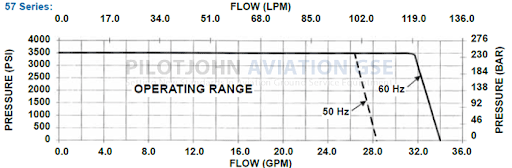
While both are C-Frame units designed for similar aircraft categories, the 57 Series delivers higher hydraulic power output than the 56 Series. The operating charts for each series show the flow rate and pressure capabilities for each series.
The key principle to understand when selecting between these two series is straightforward: a higher-capability HPU can always serve lower-requirement aircraft, but a lower-capability HPU cannot serve aircraft that require more power than it can deliver.
In practical terms, a Tronair 57 Series HPU can be used on any aircraft whose hydraulic requirements fall within or below its maximum output – including aircraft that a 56 Series would also support. However, a 56 Series HPU cannot substitute for a 57 Series when servicing aircraft that require the higher output of the 57 Series. If your fleet includes aircraft at the upper end of regional commercial requirements, the 57 Series provides the broader coverage and added capability to handle those demands.
The operating range charts for each series are available below and provide the specific flow rate and pressure specifications for comparison with your aircraft's maintenance manual requirements.
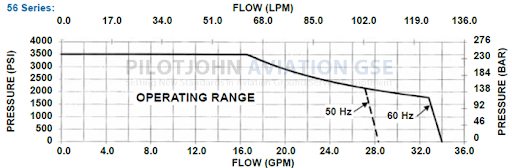
Tronair 56 Series HPUs
Tronair 57 Series HPUs
The Bottom Line
Choosing between the Tronair 56 and 57 Series comes down to your aircraft's hydraulic system requirements. Both are capable, CE/CSA-marked C-Frame HPUs built for business and regional commercial aviation – but the 57 Series offers higher output capacity, making it the right choice for operators whose fleets include aircraft at the upper end of those demands.
Pilot John International® (PJi®) is an authorized Tronair distributor and GSE service center. Our aviation specialists can help you identify the correct HPU for your specific aircraft and operational requirements. Contact us today by phone, email, or live chat for expert guidance and support.