What to Look for in an Aircraft Towbar
Key Takeaways
- Aircraft towbars attach to the nose landing gear and provide the controlled connection needed to safely reposition aircraft on the ground – allowing ground crews to move planes without using the aircraft's own power systems or manually pushing against the airframe.
- Shear bolts are a critical built-in safety feature: engineered to break before the nose gear or towbar does when towing loads exceed safe limits, they protect far more valuable assets and are inexpensive to replace.
- Towbar types include custom, portable, multi-head, snap-back, and narrow and wide-body configurations – each suited to different aircraft sizes, nose gear designs, and operational environments.
- There is no universal aircraft towbar. OEM approval confirms that a specific towbar has been qualified as safe and compatible for a given aircraft model – and is a non-negotiable standard when selecting towing equipment.
- PJi carries new and certified pre-owned towbars and towbar heads for a broad range of aircraft, with trade-in options and maintenance and repair services available through its authorized service center.
Aircraft towbars are among the most essential and underappreciated tools in ground handling. Simple in design yet critical in function, they provide the controlled, safe connection between a tug and an aircraft's nose gear – making it possible to reposition, service, and move aircraft without engaging the aircraft's own power systems.
In this article, we'll break down what aircraft towbars are, how they work, the different types available, and what to look for when selecting the right towbar for your operation.
What Is an Aircraft Towbar and Why Is It Necessary?
Aircraft have a fundamental limitation on the ground: they can't maneuver independently with much precision or safety. Even with smaller, lighter personal aircraft, pushing or pulling in the wrong areas can damage the airframe or landing gear. Towbars solve this problem by providing a secure, controlled attachment point at the nose gear – allowing ground crews to maneuver the aircraft predictably, protect it from damage, and work safely around other people and equipment.
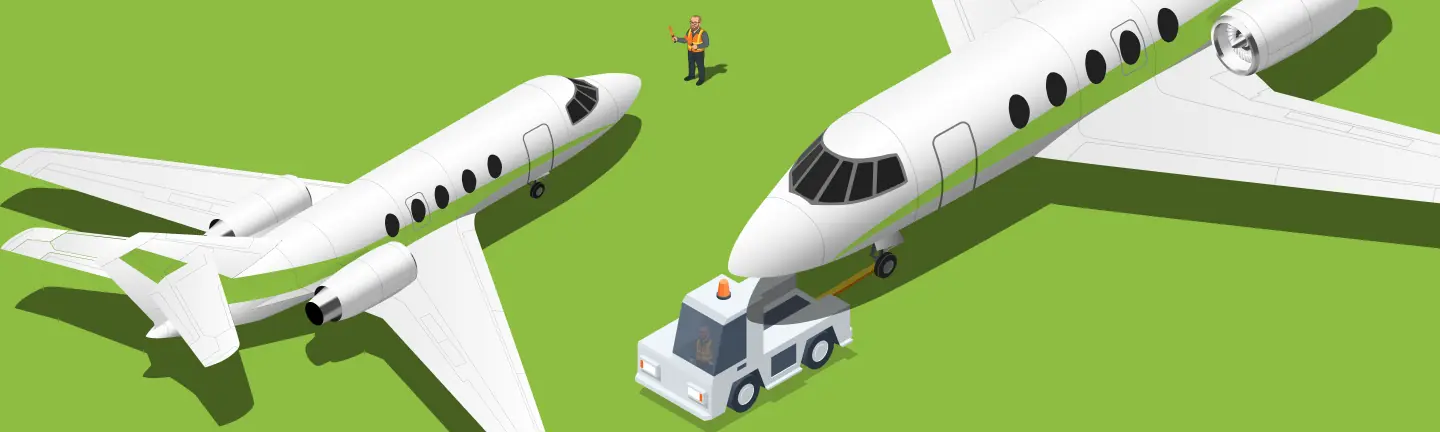
For light aircraft, a handheld towbar is often sufficient. For larger jets and business aircraft, the towbar is used in combination with a powered aircraft tug. Together, the tug and towbar form the standard ground handling solution for moving aircraft that can't or shouldn't be taxied under their own power.
Towbarless tugs – such as the Eagle eJP-10 – are an alternative that lifts the nose wheel and moves the aircraft without a towbar. These are a practical solution where available, but the majority of airfields and airports still rely on conventional towbar-and-tug setups. Having the right towbar for the aircraft being serviced is essential, regardless.
Shear Bolts: An Important Built-In Safety Feature
Most aircraft towbars incorporate shear bolts or shear pins – small fasteners designed to break at a predetermined load. When a towing operation applies excessive stress to the nose gear (such as exceeding the aircraft's maximum nose gear turning angle), the shear bolt fails before the towbar or nose gear does. This sacrificial mechanism is inexpensive to replace and prevents damage to two far more valuable assets.
Shock protection is a related consideration. Some towbar designs also incorporate spring-loaded assemblies or shock-absorbing features that cushion sudden loads during pushback and towing operations, further protecting the aircraft's landing gear.
Types of Aircraft Towbars
Towbars come in several configurations to accommodate different aircraft types, sizes, and operational requirements:
- Custom towbars are manufactured to be compatible with a specific aircraft model, ensuring optimal fit and function.
- Portable towbars are lightweight, compact designs suited for smaller, lighter aircraft. Many can be stowed in a luggage compartment for easy transport on the plane.
- Multi-head towbars accept interchangeable towbar heads corresponding to specific aircraft nose gear designs. They're widely used in business aviation environments where a single towbar handles multiple aircraft types.
- Snap-back towbars are engineered to flex when the aircraft's safe nose gear turning radius is exceeded, providing an additional layer of protection against oversteering.
- Narrow- and wide-body towbars are built for large commercial aircraft and designed to handle the heavier loads and specific nose-gear geometries of airliners.
The Importance of OEM Approval and Aircraft Compatibility
Because aircraft nose gear specifications vary significantly from one model to the next, there is no universal aircraft towbar. A towbar that works safely on one aircraft may not be suitable – or even physically compatible – with another. Getting this wrong introduces a real safety risk to both the aircraft and ground personnel.
Two qualities define a dependable aircraft towbar:
- Durability and reliability – Towbars are mechanically straightforward, which means the quality of materials and construction is everything. A towbar built from high-grade materials with proven manufacturer reputation will outlast and outperform cheaper alternatives, particularly in high-cycle environments.
- OEM approval – An OEM-approved towbar has been qualified by the aircraft manufacturer as safe and compatible for use with that specific aircraft. This isn't an area where cutting corners is advisable. OEM approval confirms that the towbar meets the nose gear load ratings, geometry, and safety requirements established by the airframe designer.
The Bottom Line
Selecting the right aircraft towbar comes down to knowing your aircraft, understanding the towing environment, and prioritizing OEM-approved equipment built to last. Whether you need a custom towbar for a specific jet, a multi-head unit for a mixed business aviation fleet, or a portable towbar for light aircraft, the right choice makes ground handling safer, smoother, and more efficient.
Pilot John International® (PJi®) offers a comprehensive selection of new and certified pre-owned aircraft towbars and towbar heads for a wide range of aircraft, along with trade-in options and full-service maintenance and repair capabilities. Our aviation specialists can help you identify the right towbar and head configuration for your specific aircraft and operation. Contact us today by phone, email, or live chat to get started.