






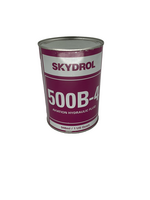
500B4-1GL - Skydrol 500B-4 Aviation Hydraulic Fluid, 1 Gallon


Create yours now for free.
The 500B4-1GL is a specific part number of the series Eastman 500B4-1GAL. For more generalized information on this item series or for more options, click here.

Need a Quote?
| Alternate Models | |
|---|---|
| 500B4-1GL | Alternate Model Number |
| General Information | |
|---|---|
| Part # | 500B4-1GL |
| Manufacturer | Eastman |
| MSDS 1 | View Safety Data Sheet |
| Shipping Information | |
|---|---|
| Product Weight | 9.6 lbs. |
| Product Dimensions | 7 x 4 x 10.5 in. |
| Schedule B | 3819000000 |
| ECCN | EAR99 |
Customers also viewed
Customers who bought this item also purchased



AIRCRAFT COMPATIBILITY
PRODUCT REVIEWS
This item does not have any reviews yet.
QUESTIONS & ANSWERS
Skydrol 500B-4 aviation hydraulic fluid has a shelf life of up to 10 years, provided it remains in its original, unopened container and is stored correctly. To preserve fluid integrity and packaging, storage conditions should be kept between 32°F and 104°F (0°C to 40°C), away from direct heat and moisture.
Packaging should be undamaged and kept under cover to protect both the primary (drum, pail, or can) and secondary (carton) layers. Always consult the product’s Certificate of Analysis (COA) for the specific expiration date associated with your batch.
Mixing Skydrol 500B-4 with other hydraulic fluids, including different Skydrol formulations, is not recommended unless approved by the aircraft manufacturer. While some phosphate ester fluids may appear chemically similar, differences in additive packages can lead to reduced performance or seal incompatibility. Always consult OEM guidance or Eastman technical support before combining fluids.
Skydrol 500B-4 is compatible with a wide range of materials, including most fluorocarbon elastomers (Viton), butyl rubber, and specific nylon and epoxy coatings. However, it is not compatible with Buna-N (nitrile), natural rubber, or silicone-based materials. Proper seal material selection is essential to prevent leaks or premature degradation in hydraulic systems.
Skydrol 500B-4 offers enhanced fire resistance compared to petroleum-based hydraulic fluids. It features a high autoignition temperature and self-extinguishing properties, making it suitable for high-performance and commercial aircraft applications. Nonetheless, it is still essential to observe proper handling and cleanup procedures in the event of a spill.
Used Skydrol 500B-4 should be disposed of as hazardous waste in accordance with federal, state, and local environmental regulations. Do not dump Skydrol into drains or onto the ground. Partnering with a certified waste disposal service ensures environmentally responsible and compliant disposal.
Yes, Skydrol 500B-4 can cause moderate to severe irritation if it comes into contact with skin or eyes. Prolonged or repeated exposure may also lead to dermatitis. Always wear chemical-resistant gloves, safety glasses, and protective clothing when handling this fluid to reduce the risk of exposure.
Skydrol 500B-4 is hygroscopic, meaning it readily absorbs moisture from the air. Excess water in the fluid can reduce lubricity and lead to corrosion or degraded system performance. Use dry nitrogen blanketing when transferring fluid and always keep containers tightly sealed to prevent water ingress.
For cleaning up Skydrol 500B-4 spills, use absorbent materials (such as clay or cellulose pads) and ventilate the area thoroughly. Clean tools and surfaces using Skydrol-compatible degreasers or warm water with alkaline cleaners. Avoid using solvents that could react with phosphate ester fluids or damage nearby surfaces.
No, Skydrol 500B-4 is a phosphate ester-based hydraulic fluid, not a mineral oil-based or synthetic hydrocarbon fluid like MIL-PRF-5606 or MIL-PRF-83282 types. It is specifically formulated to meet commercial aircraft OEM requirements and should only be used in systems approved for phosphate ester fluids.
Skydrol 500B-4 is engineered for operation in temperatures ranging from -40°F to 160°F (-40°C to 71°C). This makes it highly suitable for both high-altitude cold starts and high-temperature engine bay conditions. However, aircraft designers may impose additional system-specific limits, so always check your OEM documentation.
Overheating Skydrol 500B-4 can lead to fluid breakdown, increased acidity, and deposits within the hydraulic system. These byproducts can damage seals and valves, reducing system reliability. Always operate within recommended temperature ranges and monitor for signs of overheating.
Skydrol 500B-4 has a distinctive and often strong odor, which some users may find unpleasant. In poorly ventilated areas, the vapor may cause headaches or irritation. Use the product in well-ventilated environments and employ PPE to reduce fume exposure during servicing.


