






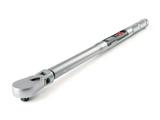
Tekton TRQ62103 - 3/8 in. Split Beam Torque Wrench


Every tool in a working shop has a job. The micrometer click wrench is the precision instrument — dual direction, ±3%, wound back to minimum before it goes in the drawer, built for the fastener you visit once and document carefully. The Tekton TRQ62103 is built for the job you do fifty times a day. It is a 3/8 inch drive 72-tooth flex head split beam torque wrench covering 20–100 ft-lb — a fundamentally different mechanism from any micrometer wrench, and a deliberately better choice for high-frequency repetitive torque work in a production maintenance environment.
The split beam uses a deflecting anchor beam, not a compressed spring, to sense torque. When applied force reaches the set value, the anchor beam separates from the main beam and produces a clean, unmistakable click. There is no spring compression at rest. Store it at any setting. Leave it there. Pick it up tomorrow — it is still accurate. No backing down to minimum. No calibration drift from a forgotten reset. In a shop where the same torque value is applied dozens of times per shift, that is time saved and one fewer failure mode removed from the workflow.
When your TRQ62103 needs recertification, Pilot John International's ISO 17025-accredited calibration laboratory issues a NIST-traceable certificate accepted by FAA Part 145 repair stations, Part 91/135 operators, and AS9100/ISO 9001 quality programs. One distributor, one accredited lab, for the life of the tool.
Key Features
- Split Beam Mechanism — Deflecting anchor beam, not a compressed spring; no internal tension at rest; no storage discipline required to maintain calibration
- Set, Lock, Leave — Smooth thumbscrew setting; flip-up cover with internal teeth locks the value during use; leave at any setting when done
- 20–100 ft-lb Range on 3/8 in. Drive — The working range for repetitive shop fastener applications; same range as the TRQ51402 micrometer wrench for direct application comparison
- 10° Flex Head — Clears obstructions on the fasteners this wrench visits repeatedly without repositioning; 72-tooth ratchet, 5° swing arc
- Dual ft-lb / Nm Scale — Conversion built into the wrench body; no chart needed when the AMM specifies metric
- All-Steel Construction — No plastic components; no wear-out failure mode under daily repetitive use
- ±4% Accuracy CW — Calibrated to ASME B107.300-2021; tested at 20, 60, and 100 ft-lb; serialized certificate of calibration included
- 2 ft-lb Minimum Increment — Sufficient resolution for repetitive production torque values
- 15.6 in. Effective Length — Compact enough for the panel and cowling work this wrench is designed for
- Lifetime Warranty — No receipts, no time limits; Tekton makes it right
Specifications
- Drive Size: 3/8 in.
- Torque Range: 20–100 ft-lb
- Mechanism: Split Beam
- Calibration Standard: ASME B107.300-2021
- Calibration Test Points: 20, 60, 100 ft-lb
- Accuracy: ±4% clockwise
- Measuring Direction: Clockwise only
- Ratchet Teeth: 72
- Swing Arc: 5° per tooth
- Head Style: 10° Flex
- Minimum Increment: 2 ft-lb
- Effective Length: 15.6 in.
- Overall Length: 18.8 in.
- Weight: 2.1 lb.
- Scale Units: ft-lb (dual scale ft-lb / Nm)
- Construction: All-steel, no plastic parts
- Certificate: Serialized, included
- Country of Origin: Taiwan
- Warranty: Lifetime
Split Beam vs. Micrometer — Choosing the Right Tool for the Job
The TRQ62103 and the TRQ51402 micrometer wrench cover the same 20–100 ft-lb range on 3/8 inch drive. They are not interchangeable — they are purpose-built for different tasks. The micrometer wrench is the right choice when a fastener requires documented bidirectional torque compliance, when accuracy must be ±3% or better, or when the task is low-frequency and high-consequence. The split beam is the right choice when the same clockwise torque value is applied many times per shift, when setting speed and storage simplicity reduce error risk, and when the wrench will be used hard enough that no-storage-ritual durability is a practical requirement. Many shops carry both.
ISO 17025 Calibration Available at PJi
Pilot John International is an ISO 17025-accredited calibration laboratory. Split beam wrenches are not immune to calibration drift — the catch, anchor beam pivot, and set screw interface all wear with high-cycle use. PJi recertifies the TRQ62103 with NIST-traceable documentation accepted by FAA Part 145 repair stations, Part 91/135 operators, and AS9100 / ISO 9001 quality programs. For a wrench in daily production use, establishing a usage-appropriate recertification interval with your tool control coordinator is the right call.
| General Information | |
|---|---|
| Part # | TRQ62103 |
| Manufacturer | Tekton |
| Specifications | |
|---|---|
| Accuracy | ±4% CW |
| Calibration Standard | ASME B107.300-2021 |
| Calibration Test Points | 20, 60, 100 ft-lb |
| Certificate | Serialized, Included |
| Construction | All-steel, no plastic parts |
| Country of Origin | Taiwan |
| Drive Size | 3/8 in. |
| Effective Length | 15.6 in. |
| Head Style | 10° Flex |
| Measuring Direction | Clockwise Only |
| Mechanism | Split Beam |
| Minimum Increment | 2 ft-lb |
| Overall Length | 18.8 in. |
| Ratchet Teeth | 72 |
| Scale Units | ft-lb (dual scale ft-lb / Nm) |
| Swing Arc | 5° per tooth |
| Torque Range | 20-100 ft-lb |
| Warranty | Lifetime |
| Weight | 2.1 lb. |
Customers also viewed
AIRCRAFT COMPATIBILITY
This item is for use on all aircraft.
PRODUCT REVIEWS
This item does not have any reviews yet.
QUESTIONS & ANSWERS
A micrometer click wrench uses a compressed internal spring to sense torque — when the spring releases at the set value, you hear the click. That spring must be relieved by winding the wrench back to its minimum setting before storage, or it fatigues and calibration drifts over time. A split beam wrench uses a deflecting anchor beam instead. There is no internal spring tension at rest. The wrench can be stored at any torque setting without any risk of calibration drift — no storage ritual required. The trade-off is that split beam wrenches are clockwise only and typically rated to ±4% accuracy rather than ±3%. For high-volume repetitive clockwise torque work, the split beam is often the more practical and durable daily-use tool.
Yes — this is one of the defining advantages of the split beam design. Because there is no compressed internal spring, the wrench is at rest in a neutral state regardless of where the thumbscrew is set. You can leave it at 80 ft-lb overnight, for a week, or indefinitely, and pick it up with the same accuracy it had when you put it down. This is not true of micrometer click wrenches, which must be backed down to their minimum setting before storage to prevent spring fatigue and calibration drift.
Both cover 20-100 ft-lb on 3/8 inch drive, but they are built for different workflows. Choose the TRQ51402 micrometer wrench when the application requires bidirectional torque documentation, ±3% accuracy, or the task is low-frequency and high-consequence. Choose the TRQ62103 split beam when the same clockwise torque value is applied many times per shift, when fast thumbscrew setting is faster than rotating a micrometer handle, and when a wrench that requires no storage discipline reduces your error exposure in a busy shop. Many shops carry both and reach for each at the appropriate time.
Yes. Pilot John International is an ISO 17025-accredited calibration laboratory and can issue a NIST-traceable recertification certificate with full test documentation for the TRQ62103. That certificate is accepted by FAA Part 145 repair stations, Part 91/135 operators, and ISO 9001/AS9100 quality management systems. For a wrench in daily production use, we recommend establishing a usage-appropriate recertification interval rather than defaulting to a fixed annual schedule.


