






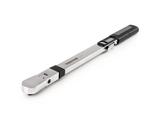
Tekton TRQ82123 - 1/2 in. Electronic Torque Wrench


There is a question that experienced aviation maintenance professionals ask about every significant torque specification: is a click sufficient, or does this fastener require a record? For most aircraft hardware, a calibrated mechanical click wrench and a logbook entry are the complete answer. But there is a specific category of work where the click is not enough — where the AMM requires torque followed by a defined angle of rotation, where QA demands objective timestamped data, where the fastener's consequence category makes attestation an insufficient substitute for measurement. The Tekton TRQ82123 is the correct instrument for that category. It is a 1/2 inch drive 90-tooth 15° flex head dual-direction electronic torque wrench covering 30–300 ft-lb — the most capable torque instrument in the Tekton catalog — and it does not produce a click. It produces a record.
Three measurement modes make the TRQ82123 the only tool in this catalog that can execute yield-controlled fastener procedures as written in modern AMMs. Torque mode applies a target value from the LCD readout in real time — no threshold guessing. Angle mode uses an onboard gyroscope to accumulate degrees of rotation across multiple ratchet strokes — a 120° angle in three 40° increments with no count loss. Torque + Angle mode executes both in a single uninterrupted workflow: tighten to torque target, transition directly into angle measurement, complete both to the click. For engine mount hardware, primary structural joints, and propeller retention fasteners where the CMM or AMM specifies an initial torque followed by a defined rotation, no mechanical wrench executes that procedure as written. The TRQ82123 does.
The 15° flex head gives clearance around primary structural geometry where a fixed-head wrench requires an extension and lever-arm correction math. The onboard crowfoot offset calculator handles those situations too — enter the offset up to ±15 in. (381 mm), the displayed target adjusts automatically in all three modes, the fastener receives the correct value. The 50-record timestamped history, over-torque event log, and cycle-count calibration reminder complete a documentation infrastructure that turns a torque event into a retrievable QA record without external hardware.
When the TRQ82123 needs recertification, Pilot John International's ISO 17025-accredited calibration laboratory provides NIST-traceable certification covering torque accuracy at 30, 180, and 300 ft-lb in both directions and angle accuracy, with full measurement uncertainty documentation and traceability chain records. For a $395 instrument servicing primary structural fasteners under FAA-regulated maintenance programs, the calibration certificate should be issued by an accredited laboratory. PJi's ISO 17025 accreditation is that credential.
Key Features
- Real-Time Electronic Torque & Angle Display — Backlit LCD with bold fonts shows live torque as force is applied; peak measurement displayed, held, and timestamped after release; no click ambiguity at 300 ft-lb
- ±2% Torque Accuracy, ±1° Angle Accuracy — ISO 6789-calibrated, tested at 30, 180, and 300 ft-lb in both directions; tightest accuracy specification in the Tekton catalog at the highest torque range
- Torque + Angle Mode for Yield-Controlled Fasteners — Executes initial torque and angle-of-rotation in a single uninterrupted workflow; onboard gyroscope accumulates rotation across multiple ratchet strokes (5°–360° range); the only tool in this catalog capable of this procedure as written in modern turbine and structural AMMs
- 30–300 ft-lb on 1/2 in. Drive — Covers primary structural, engine mount, landing gear trunnion, propeller retention, and cargo system hardware at the top of the mechanical torque range
- 15° Flex Head, 90-Tooth, 4° Swing Arc — 8 teeth engaged simultaneously; maximum head articulation in the Tekton line; clears primary structural geometry where fixed-head wrenches require extension adapters
- Onboard Crowfoot Offset Calculator — Enter length offset up to ±15 in. (381 mm); displayed target adjusts automatically in all three measurement modes; no manual formula for off-axis fastener work
- Four Native Unit Scales — ft-lb, in-lb, Nm, kg-m; Boeing, Airbus, ATR, Embraer, and mixed-fleet operations without conversion; scale switches without a chart or a second tool
- 50-Record Timestamped History — Every qualifying torque event logged with peak measurement; retrievable from onboard memory for QA documentation; over-torque events above 110% logged separately and preserved
- 10 Programmable Presets — Store mode, target, and unit for recurring tasks; repetition counter leads through multi-fastener sequences and counts to completion
- Calibration Reminder by Date and/or Cycle Count — Usage-triggered tool control intervals without manual tracking; total cycle count available in onboard Information menu
- Triple Sensory Feedback — LED color shift (yellow to green), tone pattern change (intermittent to continuous), handle vibration — three simultaneous channels at target; sound and vibration silenceable, lights always active
- Dual Direction CW/CCW — Both directions ISO-calibrated in all three measurement modes
- Annual Service Kit Available — TRQ9x023 service kit includes Super Lube grease for ratchet head maintenance; Tekton recommends annual ratchet relubrication for sustained accuracy
- Includes — 1/2 in. (F) x 3/8 in. (M) drive reducer, HDPE case, serialized certificate of calibration; 3x AA batteries not included
- 27.1 in. / 4.51 lb. — Appropriately substantial for controlled leverage and stability at 300 ft-lb on primary structural fasteners
- Lifetime Warranty — No receipts, no time limits; Tekton makes it right
Specifications
- Drive Size: 1/2 in.
- Torque Range: 30–300 ft-lb
- Mechanism: Electronic / Digital
- Calibration Standard: ISO 6789 (Torque)
- Calibration Test Points: 30, 180, 300 ft-lb
- Torque Accuracy: ±2% CW and CCW
- Angle Accuracy: ±1° (90° rotation @ 30°/sec)
- Angle Range: 5°–360°
- Measurement Modes: Torque, Angle, Torque + Angle
- Unit Scales: ft-lb, in-lb, Nm, kg-m
- Minimum Increment: 1
- Head Style: 15° Flex
- Ratchet Teeth: 90
- Swing Arc: 4° per tooth
- Pawl Engagement: 8 teeth simultaneous
- Direction: Dual (CW/CCW)
- Display: Backlit LCD, bold fonts
- Sensory Feedback: LED lights, sound, handle vibration
- Presets: 10 saved presets (mode, target, unit)
- History: Last 50 timestamped records
- Cycle Counters: Basic, Repetitions, Total
- Calibration Reminder: Date and/or cycle count
- Over-Torque Warning: >110% max torque — logged and counted
- Length Offset: Up to ±15 in. (381 mm), all modes
- Auto-Shutoff: 2, 5, 10, 30, 60, or 120 min (selectable)
- Power: 3x AA batteries (not included)
- Includes: 1/2 in. (F) x 3/8 in. (M) reducer, HDPE case, certificate
- Overall Length: 27.1 in.
- Weight: 4.51 lb.
- Country of Origin: Taiwan
- Service Kit: TRQ9x023 (sold separately)
- Warranty: Lifetime
TRQ82123 vs. TRQ52403 — When Electronic Is Not Optional
Both wrenches cover 300 ft-lb on 1/2 inch drive. They are not interchangeable — they are the right tool for different procedure types. The TRQ52403 micrometer wrench ($150) is the correct choice when the AMM specifies a torque value and that torque is the complete procedure — ±3%, ISO 6789-calibrated, bidirectional, with a documented certificate. The TRQ82123 electronic wrench ($395) is the correct choice when: the AMM specifies torque-plus-angle and a mechanical wrench cannot execute the procedure as written; when QA requires a timestamped torque record rather than technician attestation; when four unit scales must be available without a conversion chart; when the over-torque event log is a QA documentation requirement; or when the calibration reminder must be keyed to cycle count rather than calendar date. If none of those conditions apply to your application, the TRQ52403 is the simpler, lower-cost, and equally capable solution. If any of them apply, the TRQ82123 is the only correct answer in this catalog.
ISO 17025 Calibration at PJi — The Correct Standard for This Instrument
The TRQ82123 is the most expensive and most capable instrument in the Tekton line. The calibration program behind it should reflect that. Pilot John International's ISO 17025-accredited calibration laboratory recertifies the TRQ82123 covering torque accuracy at 30, 180, and 300 ft-lb in both directions, angle accuracy at the specified rotation rate, and the integrity of the digital measurement chain from sensor to display — with full measurement uncertainty documentation and NIST traceability chain records. That package meets the requirements of FAA Part 145 repair stations, EASA Part 145 maintenance organizations, Part 91/135 operators, and AS9100 / ISO 9001 quality programs that require laboratory accreditation evidence behind every calibration certificate. For a $395 instrument servicing primary structural fasteners under FAA-regulated programs, "who calibrated it and under what accredited standard" is a legitimate audit question. PJi's ISO 17025 accreditation answers it.
| General Information | |
|---|---|
| Part # | TRQ82123 |
| Manufacturer | Tekton |
| Specifications | |
|---|---|
| Angle Accuracy | ±1° (at 90° rotation @ 30°/sec) |
| Angle Range | 5°-360° |
| Auto-Shutoff | 2, 5, 10, 30, 60, or 120 min |
| Calibration Reminder | Date and/or Cycle Count |
| Calibration Standard | ISO 6789 (Torque) |
| Calibration Test Points | 30, 180, 300 ft-lb |
| Certificate | Serialized, Included |
| Country of Origin | Taiwan |
| Cycle Counters | Basic, Repetitions, Total |
| Direction | Dual (CW/CCW) |
| Display | Backlit LCD, Bold Fonts |
| Drive Size | 1/2 in. |
| Head Style | 15° Flex |
| History | Last 50 Timestamped Records |
| Includes | 1/2 in. (F) x 3/8 in. (M) reducer, HDPE case, certificate |
| Length Offset | Up to ±15 in. (381 mm) |
| Measurement Modes | Torque, Angle, Torque + Angle |
| Mechanism | Electronic / Digital |
| Minimum Increment | 1 |
| Over-Torque Warning | >110% max torque — logged and counted |
| Overall Length | 27.1 in. |
| Pawl Engagement | 8 teeth simultaneous |
| Power | 3x AA batteries (not included) |
| Presets | 10 Saved Presets |
| Ratchet Teeth | 90 |
| Sensory Feedback | Lights, Sound, Vibration |
| Swing Arc | 4° per tooth |
| Torque Accuracy | ±2% CW and CCW |
| Torque Range | 30-300 ft-lb |
| Unit Scales | ft-lb, in-lb, Nm, kg-m |
| Warranty | Lifetime |
| Weight | 4.51 lb. |
Customers also viewed
AIRCRAFT COMPATIBILITY
This item is for use on all aircraft.
PRODUCT REVIEWS
This item does not have any reviews yet.
QUESTIONS & ANSWERS
They cover the same ceiling on the same drive size but execute different procedure types. The TRQ52403 micrometer wrench is the correct and lower-cost choice when the AMM specifies a torque value and that torque is the complete procedure — it delivers ±3% ISO 6789 accuracy in both directions with a documented certificate. The TRQ82123 is the correct choice when the AMM specifies torque-plus-angle and a mechanical wrench physically cannot execute the procedure as written; when the QA program requires a timestamped torque record rather than technician attestation; when four unit scales must be natively available; when the over-torque event log is part of the quality record; or when calibration reminders must be keyed to cycle count. For applications where none of those conditions apply, the TRQ52403 is the right tool at a lower price. For applications where any of them apply, the TRQ82123 is the only correct answer in this catalog.
Yield-controlled fastener procedures specify an initial torque value followed by a defined additional angle of rotation — for example, torque to 80 ft-lb then rotate an additional 120 degrees. In torque + angle mode, the TRQ82123 guides the technician through both steps in a single uninterrupted workflow without changing modes or switching tools: the display shows real-time torque during the tightening phase, confirms when the torque target is reached, then immediately begins measuring angle of rotation using the onboard gyroscope, which accumulates total rotation across multiple ratchet strokes so a 120-degree specification can be completed in several smaller strokes without losing count. The procedure is complete when both values are achieved. The entire event is stored in the timestamped history buffer as a single record.
Any time the peak torque measurement exceeds 110% of the wrench's maximum torque setting, the TRQ82123 generates an on-screen warning, counts the event in a dedicated over-torque counter, and preserves the highest over-torque value recorded for future reference. For a Part 145 repair station quality system, this log is a tool condition indicator — a wrench that has recorded multiple over-torque events may have experienced internal stress that warrants early recalibration or removal from service for inspection. The log is retrievable from the wrench's Information menu and can be included in calibration documentation at recertification. Combined with the total cycle count, it provides objective evidence of the wrench's service history that a QA director or calibration lab can use to determine appropriate recertification intervals.


