






Tekton TRQ98901 - 2-Piece Electronic Torque Wrench Set


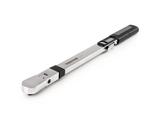
Every other set in this catalog is a collection of mechanical instruments. The TRQ98901 is different in kind, not just in specification: it is a 2-piece electronic torque wrench set pairing the TRQ81122 (3/8 in., 10–100 ft-lb) and TRQ82123 (1/2 in., 30–300 ft-lb) — the two electronic instruments that together cover the full documented torque spectrum for structural, powerplant, and landing gear aviation maintenance, from 10 ft-lb to 300 ft-lb, without a mechanical click wrench in the workflow. This is not a coverage decision. It is a program decision: the choice to make data-backed, timestamped, electronically documented torque events the standard across the two drive sizes that handle the most consequential fastener work on the flight line.
Both instruments share the same electronic architecture. Three measurement modes — Torque, Angle, and Torque + Angle — make both wrenches capable of yield-controlled fastener procedures as written in modern AMMs: initial torque applied to the live LCD display, then immediate transition into angle measurement via the onboard gyroscope that accumulates rotation across multiple ratchet strokes without count loss. No mode change. No tool change. No mechanical click wrench can execute that procedure. Both instruments in the TRQ98901 can. Every qualifying event on each wrench is stored in a 50-record timestamped history buffer, with over-torque events logged separately, cycle counts accumulating in onboard memory, and calibration reminders keyed to date, cycle count, or both. The onboard crowfoot offset calculator adjusts displayed targets automatically up to ±15 in. (381 mm) in all three modes. Four native unit scales — ft-lb, in-lb, Nm, kg-m — cover every AMM specification language without conversion.
Pilot John International's ISO 17025-accredited calibration laboratory recertifies both instruments at a single scheduled service event — covering torque accuracy, angle accuracy, and the digital measurement chain on each wrench — issuing two NIST-traceable certificates on the same date. Synchronized calibration expiry. Complete documented electronic program. No staggered intervals, no separate tracking.
Set Contents and Aviation Applications
- TRQ81122 — 3/8 in. Drive, 10–100 ft-lb — Engine mount hardware, propeller flange fasteners, landing gear leg bolts, accessory gearbox components, exhaust and fuel system hardware, structural fasteners requiring documented torque events, and any mid-range procedure where the AMM specifies torque-plus-angle or where QA requires timestamped torque records rather than mechanical click attestation; calibration test points at 10, 60, and 100 ft-lb; 10 teeth engaged; 20.0 in. overall, 2.71 lb.
- TRQ82123 — 1/2 in. Drive, 30–300 ft-lb — Main and nose landing gear primary attachment fasteners, turboprop and turbofan engine primary mount hardware, propeller hub and retention fasteners on high-power installations, wing primary structural joints, cargo door primary attachment hardware, and any high-consequence procedure requiring yield-controlled fastener installation with documented torque and angle values executed in a single uninterrupted workflow; calibration test points at 30, 180, and 300 ft-lb; 8 teeth engaged; 27.1 in. overall, 4.51 lb.
Shared Capabilities — Both Wrenches
- Real-Time Electronic Torque & Angle Display — Backlit LCD with bold fonts; live torque as force is applied; peak measurement held and timestamped after release on both instruments
- ±2% Torque Accuracy, ±1° Angle Accuracy — ISO 6789-calibrated across the full stated range in both directions; tightest accuracy specification in the Tekton catalog on both instruments simultaneously
- Torque + Angle Mode — Executes initial torque and angle-of-rotation in a single uninterrupted workflow; onboard gyroscope accumulates rotation across multiple ratchet strokes (5°–360°); the only instrument class in this catalog capable of yield-controlled AMM procedures as written
- Onboard Crowfoot Offset Calculator — ±15 in. (381 mm) in all three modes on both wrenches; displayed target auto-adjusts, no manual formula
- Four Native Unit Scales — ft-lb, in-lb, Nm, kg-m on both instruments; covers every AMM specification language without conversion
- 50-Record Timestamped History Per Wrench — Objective torque event data retrievable from onboard memory for QA documentation on both instruments
- 10 Programmable Presets Per Wrench — Mode, target, and unit; repetition counter for multi-fastener sequences
- Calibration Reminder by Date and/or Cycle Count — Usage-triggered tool control on both instruments without manual tracking
- Over-Torque Event Log — Events above 110% of maximum logged separately on both wrenches; highest value retained per instrument
- Triple Sensory Feedback — LED color shift (yellow to green), tone pattern change (intermittent to continuous), handle vibration simultaneously at target; sound and vibration silenceable, lights always active
- 90-Tooth Flex Head, 15° Flex, 4° Swing Arc — Dual CW/CCW, both directions ISO-calibrated in all three modes
- Lifetime Warranty — No receipts, no time limits on both instruments
Specifications
- TRQ81122: 3/8 in. drive — 10–100 ft-lb — 10 teeth engaged — 20.0 in. — 2.71 lb. — cal. test points: 10, 60, 100 ft-lb
- TRQ82123: 1/2 in. drive — 30–300 ft-lb — 8 teeth engaged — 27.1 in. — 4.51 lb. — cal. test points: 30, 180, 300 ft-lb
- Calibration Standard: ISO 6789 Torque (both wrenches)
- Torque Accuracy: ±2% CW and CCW (both wrenches)
- Angle Accuracy: ±1° at 90° rotation @ 30°/sec (both wrenches)
- Measurement Modes: Torque, Angle, Torque + Angle (both wrenches)
- Unit Scales: ft-lb, in-lb, Nm, kg-m (both wrenches)
- Head Style: 15° Flex, 90-Tooth, 4° swing arc (both wrenches)
- Presets: 10 per wrench / History: Last 50 timestamped records per wrench
- Calibration Reminder: Date and/or cycle count (both wrenches)
- Over-Torque Warning: >110% max torque, logged and counted (both wrenches)
- Length Offset: Up to ±15 in. (381 mm), all modes (both wrenches)
- Auto-Shutoff: 2, 5, 10, 30, 60, or 120 min (both wrenches)
- Power: 3x AA per wrench (6x AA total, not included)
- Includes: 3/8 in. (F) x 1/4 in. (M) reducer, 1/2 in. (F) x 3/8 in. (M) reducer, 2 individual HDPE cases, 2 serialized certificates of calibration
- Country of Origin: Taiwan
- Warranty: Lifetime (both wrenches)
Electronic vs. Mechanical — Why Both Drive Sizes Matter in Electronic Format
The TRQ81122 and TRQ82123 are available individually. The TRQ98901 set is the correct purchase when both instruments are needed simultaneously — which is the case for any shop building a complete electronic torque program for 3/8 and 1/2 inch drive work. The 3/8 inch electronic wrench handles mid-range structural, powerplant, and accessory work requiring documented records or angle-of-rotation procedures. The 1/2 inch electronic wrench handles the primary structural and high-torque yield-controlled fastener work that sits above the 3/8 inch range. Both are needed. Both calibrate from the same ISO 17025-accredited lab on the same service date. The set is the program.
| General Information | |
|---|---|
| Part # | TRQ98901 |
| Manufacturer | Tekton |
| Specifications | |
|---|---|
| Angle Accuracy | ±1° at 90° rotation @ 30°/sec (both wrenches) |
| Angle Range | 5°-360° (both wrenches) |
| Auto-Shutoff | 2, 5, 10, 30, 60, or 120 min (both wrenches) |
| Calibration Reminder | Date and/or cycle count (both wrenches) |
| Calibration Standard | ISO 6789 Torque (both wrenches) |
| Cases | 2 individual HDPE cases (one per wrench) |
| Certificates | 2 serialized certificates of calibration (one per wrench) |
| Cycle Counters | Basic, Repetitions, Total (both wrenches) |
| Direction | Dual CW/CCW (both wrenches) |
| Display | Backlit LCD, bold fonts (both wrenches) |
| Head Style | 15° Flex (both wrenches) |
| History | Last 50 timestamped records per wrench |
| Included Accessories | 3/8 in. (F) x 1/4 in. (M) reducer |
| Length Offset | Up to ±15 in. (381 mm), all modes (both wrenches) |
| Measurement Modes | Torque, Angle, Torque + Angle (both wrenches) |
| Over-Torque Warning | >110% max torque — logged and counted (both) |
| Pawl Engagement | 10 teeth (TRQ81122) / 8 teeth (TRQ82123) |
| Power | 3x AA batteries per wrench, 6x AA total (not included) |
| Presets | 10 saved presets per wrench |
| Ratchet Teeth | 90 (both wrenches) |
| Sensory Feedback | Lights, sound, vibration (both wrenches) |
| Set Contents | 2 electronic torque wrenches |
| Swing Arc | 4° per tooth (both wrenches) |
| Tekton Recertification | Available for both wrenches |
| Torque Accuracy | ±2% CW and CCW (both wrenches) |
| TRQ81122 Dimensions | 20.0 in. overall / 2.71 lb. |
| TRQ82123 Dimensions | 27.1 in. overall / 4.51 lb. |
| Unit Scales | ft-lb, in-lb, Nm, kg-m (both wrenches) |
| Warranty | Lifetime (both wrenches) |
| Wrench 1 | TRQ81122 — 3/8 in. drive, 10-100 ft-lb |
| Wrench 2 | TRQ82123 — 1/2 in. drive, 30-300 ft-lb |
Customers also viewed
AIRCRAFT COMPATIBILITY
This item is for use on all aircraft.
PRODUCT REVIEWS
This item does not have any reviews yet.
QUESTIONS & ANSWERS
Three reasons. First, program synchronization: both electronic instruments start their calibration life on the same date from the same ISO 17025-accredited distributor and can be recertified at the same service event, maintaining a single synchronized expiry across the complete electronic program. Second, calibration data alignment: when the QA program requires timestamped torque records from both instruments on the same maintenance task, having both calibrated to the same standard on the same date produces a cleaner audit trail. Third, program architecture: the set purchase establishes the electronic torque program as a defined, documented acquisition — one transaction, two instruments, two certificates, a complete coverage span from 10 ft-lb to 300 ft-lb across the two most consequential drive sizes in aviation maintenance.
Any AMM or CMM procedure specifying yield-controlled fastener installation — where an initial torque value is followed by a defined angle of rotation to achieve final clamping force — requires the Torque + Angle mode available on both instruments in this set. A mechanical click wrench physically cannot execute that procedure as written; it produces a click at the torque threshold but provides no mechanism for measuring the subsequent angle of rotation. Additionally, any QA program requiring timestamped objective torque records rather than technician attestation, any task where the over-torque event log is a quality record requirement, and any application where calibration reminders must be keyed to cycle count rather than calendar dates all benefit specifically from electronic instrumentation. For procedures where neither condition applies, mechanical micrometer wrenches remain the simpler and lower-cost solution.
Each electronic torque wrench requires 3x AA batteries, so the complete set requires 6x AA batteries total. Batteries are not included with either instrument. The auto-shutoff on each wrench can be set to 2, 5, 10, 30, 60, or 120 minutes to preserve battery life between uses. Both instruments should be powered off when not in active use, and the auto-shutoff setting should be configured to match the typical interval between fastener applications in the shop's workflow.
Mechanical torque wrench calibration verifies accuracy at defined test points across the stated range in both directions — a defined and relatively straightforward process. Electronic torque wrench calibration must additionally verify angle accuracy at the specified rotation rate and the integrity of the complete digital measurement chain from the load cell and gyroscope through signal processing to the display. The calibration uncertainty associated with the angle measurement system is separate from and additive to the torque uncertainty. Pilot John International's ISO 17025-accredited laboratory covers all measurement parameters on both instruments in this set — torque at the stated test points, angle accuracy, and digital chain verification — with measurement uncertainty statements and full NIST traceability documentation included in the certificate package. That complete documentation is what FAA and EASA regulated programs require when they ask for laboratory accreditation evidence, not just calibration results.


