






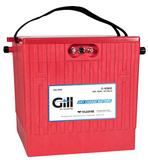
The Teledyne Gill 7638-44T Sealed Aircraft Battery represents the next evolution in extreme cranking valve-regulated lead-acid (VRLA) technology. Engineered to meet the rigorous demands of modern aviation, this battery is more than an upgrade—it’s a commitment to superior safety, reliability, and enduring performance. Its sealed, non-spillable VRLA design ensures powerful, maintenance-free operation, perfectly suited to the needs of aviation maintenance professionals.
TSO Authorized, rigorously tested to DO-160E standards, and FAA-PMA certified, the Teledyne 7638-44T sets the standard for safety and quality, providing dependable power for every flight. With a first capacity inspection required only after 18 months or 1,800 hours, this battery significantly reduces maintenance downtime, keeping your aircraft ready for takeoff. Supported by a 2-year warranty, it delivers consistent performance in even the most challenging flight conditions.
The Teledyne 7638-44T is the ideal choice for pilots seeking a reliable, long-lasting power source for their aircraft. Designed as a direct upgrade from the Teledyne Gill G-6381E Dry Charged Battery, it offers superior cranking power and energy retention in a more efficient and lightweight package. The advanced VRLA design also ensures the battery is non-spillable, enhancing safety and ease of handling, especially in unpredictable or turbulent flight situations.
Whether in commercial, private, or military aviation, the 7638-44T provides unparalleled confidence in your power source. It performs reliably across extreme temperatures, ensuring your aircraft systems stay powered from the coldest altitudes to the hottest runways.
Equip your aircraft with the trusted power of the Teledyne Gill 7638-44T and experience the next level of aviation performance with advanced lead-acid technology, designed to meet the toughest demands of today’s aviation landscape.
| General Information | |
|---|---|
| Part # | 7638-44T |
| Manufacturer | Teledyne Gill |
| Shipping Information | |
|---|---|
| Product Weight | 92 lbs. |
| Product Dimensions | 18 x 17 x 17 in. |
| Schedule B | 8507200090 |
| ECCN | 9A991.d |
| Specifications | |
|---|---|
| 30 Minute Emergency Rate, C/2, A | 70 |
| Model | 7638-44T |
| Nominal Voltage, V | 24 |
| One Hour Capacity, C1, Ah | 44 |
| Power Performance | 23°C (75°F): Ipp, A - 1857, Ipr, A - 1247, -18°C (0°F): Ipp, A - 1677, Ipr, A - 1051, -30°C (-22°F): Ipp, A - 1411, Ipr, A - 948 |
| Weight, Lb. Maximum | 88.63 |
Customers also viewed
AIRCRAFT COMPATIBILITY
| Compatible Aircraft* | |
|---|---|
| Cessna | Citation 560 XL , Citation 560 XLS , Citation 650 , Citation CJ1 , Citation CJ2 , Citation CJ3 , Citation CJ4 , Citation Encore 560 , Citation I 500 , Citation I/SP 501 , Citation II 550 , Citation III , Citation Longitude 700 , Citation M2 , Citation SII , Citation Sovereign 680 , Citation Ultra 560 , Citation V , Citation VI , Citation VII , Citation X 750 |
PRODUCT REVIEWS
This item does not have any reviews yet.
QUESTIONS & ANSWERS
The Teledyne Gill 7638-44T uses absorptive glass mat (AGM) separators to immobilize the electrolyte, eliminating free liquid inside the battery. This design enhances vibration resistance and allows the battery to operate in various orientations without risk of leakage. It also improves internal efficiency, helping deliver consistent power output and longer service life in demanding aviation environments.
The 7638-44T is classified as a nonspillable battery, meaning it meets regulatory requirements that allow it to be shipped without hazardous material restrictions. This simplifies logistics and reduces shipping costs for operators and maintenance facilities. It also minimizes handling risks, making it easier to store and transport safely compared to traditional flooded batteries.
This aircraft battery is designed to maintain its charge over extended storage periods when properly managed. Under recommended conditions, it can retain usable voltage for months, with inspection intervals based on storage temperature and environment. Proper storage practices help preserve battery health and reduce the likelihood of deep discharge or capacity loss before installation.
Yes, the 7638-44T can often be recovered from deep discharge using controlled constant-current or constant-voltage charging procedures. The maintenance manual outlines recovery processes that can restore capacity if performed correctly. This recoverability adds value by extending usable life and reducing premature battery replacement costs.
Like all VRLA batteries, the 7638-44T performs best within a controlled temperature range, ideally around 80°F. Higher temperatures can shorten battery life, while lower temperatures may temporarily reduce available capacity. However, capacity typically recovers once the battery returns to normal operating temperatures, ensuring reliable performance across varying environments.
The battery is engineered to deliver stable discharge rates that support both one-hour and emergency load requirements. Its ability to maintain voltage above critical thresholds ensures reliable power to essential aircraft systems. This consistency is crucial for maintaining electrical system integrity during normal operations and emergency scenarios.
Using the correct charging method – typically constant-voltage charging – helps prevent overcharging and undercharging, both of which can reduce battery life. Proper charging ensures the internal chemistry remains balanced and prevents issues such as sulfation or grid corrosion. Following recommended charging practices is key to maximizing performance and extending service intervals.
Although sealed, the battery contains sulfuric acid and lead components, so proper safety precautions are essential. Technicians should wear protective equipment and avoid damaging the battery casing to prevent exposure. Adequate ventilation is also important during charging, as small amounts of hydrogen gas may be released.


