






CPDLC Ground Testing Made Practical with the Laversab ARTS-7000
Key Takeaways
- CPDLC has moved from a nice-to-have to a baseline requirement in much of the world's controlled airspace, including most of Europe above FL285.
- A failed Logon, Provider Abort, or syntax mismatch can ground an aircraft until the data link is verified end-to-end.
- Traditional CPDLC verification has meant OEM service-center trips, fixed lab benches, or live-network testing windows – none of them fast, cheap, or portable.
- The Laversab ARTS-7000 with the CPDLC option (P/N 121-0132) brings full FANS 1/A and ATN B1 ground testing to the ramp, the hangar, or anywhere the aircraft sits.
- Portable CPDLC ground testing means faster fault isolation, shorter AOG windows, and cleaner sign-offs for MROs, avionics shops, and flight departments alike.
What CPDLC Is, in Plain English
Controller Pilot Data Link Communications – CPDLC for short – is a text-based messaging system that lets air traffic controllers and flight crews exchange clearances, requests, and reports digitally instead of over voice radio. Think of it as a structured, aviation-specific chat protocol layered on top of VHF Data Link Mode 2 (VDL2), SATCOM, or HF data link, with strict syntax that keeps misinterpretation out of the loop.
In practical terms, a controller can uplink a level change, route amendment, or frequency hand-off as a text message; the crew reviews it on the MCDU, hits WILCO (or UNABLE or STANDBY), and the response routes right back through the data link. There is no shared frequency, no stepped-on calls, no read-back errors. ICAO Doc 4444 and Doc 10037 define the standard message sets, and two coexisting protocol stacks – FANS 1/A (the legacy, character-oriented protocol used heavily in oceanic airspace) and ATN B1 (the bit-oriented continental standard adopted across Europe) – carry the traffic depending on region and equipage.
How CPDLC Actually Works in the Cockpit and on the Ground
When a data-link-equipped aircraft approaches an airspace boundary, the FMS or CMU initiates a Logon to the appropriate Data Link Service Provider (DSP) – typically SITA or ARINC – which then routes the connection to the relevant ATC ground system through Eurocontrol's IFPS or the FAA's Data Comm infrastructure. Once the Logon is accepted and the aircraft appears on the Logon List, controller-initiated messages can flow freely.
Behind the scenes, the avionics stack relies on tight handshakes: the CMU or ATSU formats messages per ARINC 622 or ATN standards, validates VDL2 connectivity, monitors for Provider Aborts (PAs), and confirms each message is acknowledged. A single timing error, mismatched flight ID, corrupted route string, or out-of-date airspace database – and the link fails. That is where on-the-ground data link verification stops being optional.
The Importance of CPDLC Ground Testing
CPDLC ground testing – the practice of verifying data link functionality before the aircraft leaves the ramp – exists for one simple reason: you cannot afford to find out the link is broken at FL370 in Maastricht airspace. EASA's continental mandate and Eurocontrol's Link 2000+ program already require ATN B1 CPDLC capability for IFR flights above FL285 in most European airspace, and the FAA's Data Comm program continues to expand across the U.S. NAS. An aircraft that loses CPDLC en route does not just inconvenience the crew – it forces a fallback to voice, increases controller workload, and, in some sectors, can trigger rerouting or holding penalties.
Pre-flight ground verification catches the failure modes that bench-only testing routinely misses: antenna degradation, CMU/FMS configuration drift, expired routing tables, software mismatches between subscribers and providers, and the dozens of small misconfigurations that creep in after a software load, an avionics swap, or a long downtime. A proper CPDLC functional check on the ground confirms the Logon completes cleanly, the message set is current, the syntax validates, and the aircraft is genuinely ready to talk to ATC by data link.
Why Traditional CPDLC Verification Falls Short on the Ramp
The historical options for verifying CPDLC have all carried compromises. Sending the aircraft to an OEM service center means downtime, transit costs, and scheduling delays – often weeks. Lab-grade datalink simulators exist, but they live in fixed installations at avionics houses, not on flight lines. Live testing against the production ATC network ties up DSP airtime, requires scheduling windows, and is not always available to operators outside major hubs.
For most MROs, FBOs, and flight departments, this has meant CPDLC issues get diagnosed through trial and error – fly it, see if it fails, troubleshoot, repeat. That cycle is expensive, slow, and a poor fit for a system now baked into the dispatch criteria for an expanding share of long-haul and continental routes.
The Laversab ARTS-7000 CPDLC Option: Shop-Grade Testing, Ramp-Side
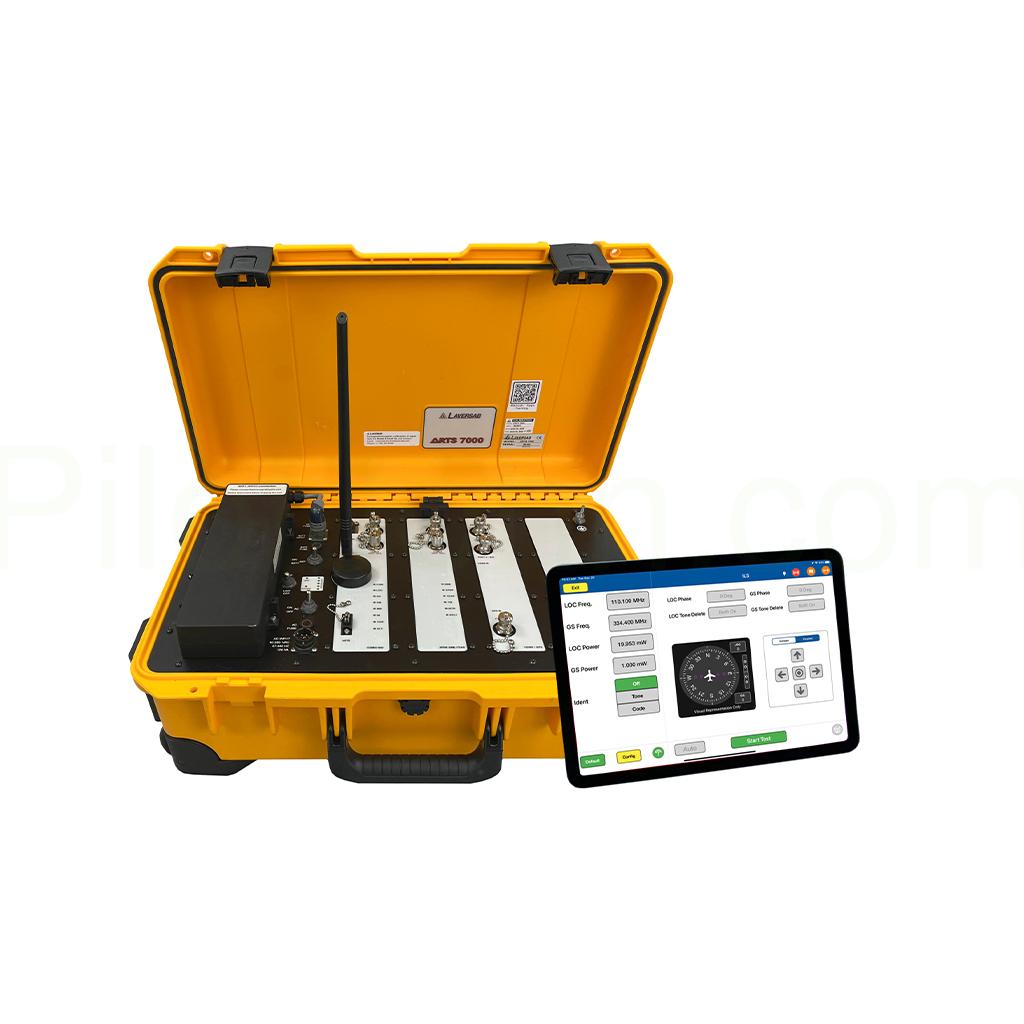
The Laversab ARTS-7000 is a portable ramp test set already adopted across the industry for ATC transponder, TCAS, ADS-B, and Mode S verification. With the addition of the CPDLC option (P/N 121-0132), the same ruggedized handheld now performs full FANS 1/A and ATN B1 datalink testing – including Logon validation, uplink and downlink message exchange, syntax verification, and Provider Abort scenarios – directly on the aircraft, without sending anything anywhere.
What sets the ARTS-7000 apart for CPDLC ground testing is the combination of portability and protocol depth. The unit simulates the ground-side data link service so the avionics see a complete, valid exchange – not a partial loopback. Technicians can drive Logon attempts, push controller messages, verify ATSU responses, and capture error conditions inside the same workflow they already use for transponder and ADS-B sweeps. A test that used to mean shipping a CMU to a vendor now happens during the same hangar visit as the airframe check.
What This Means for MROs, Avionics Shops, and Flight Departments
For maintenance organizations, ramp-based CPDLC testing compresses the troubleshooting cycle from days to minutes. Avionics shops can validate a CMU swap or software load before signing the aircraft off, rather than relying on the operator to surface a problem in revenue service. Flight departments can fold CPDLC functional checks into pre-departure procedures for high-value missions, especially before long oceanic legs or European entries.
The downstream effect is fewer Provider Abort surprises, cleaner pilot reports, and meaningfully less AOG exposure tied to data link issues. As ATN B1 expands and FANS 1/A continues to carry oceanic traffic, operators with portable CPDLC verification already in their toolkit will be the ones with the cleanest dispatch records.
The Bottom Line
CPDLC is no longer optional in the airspaces where most business and commercial operators fly, and the cost of a failed data link mid-flight is high enough that pre-departure verification has moved from best practice to baseline. Building a repeatable CPDLC ground testing workflow into your maintenance and dispatch rhythm is the single most effective hedge against datalink-related AOGs and routing penalties.
Pilot John International® (PJi®) is your trusted source for the Laversab ARTS-7000 and the CPDLC ground testing option, along with the full Laversab ramp test set lineup. Our team works directly with Laversab to procure current-revision units, manage option upgrades for existing testers, and answer the technical questions that come up before the order – not after.
Call us, drop us an email, or start a live chat to get pricing, lead time, or technical confirmation on the ARTS-7000 CPDLC option for your shop. We'll make sure you get the right configuration for your fleet and your test bench.
Frequently Asked Questions
What does CPDLC ground testing actually verify?
A proper CPDLC ground test confirms that the aircraft's CMU or ATSU can complete a Logon, exchange valid uplink and downlink messages with the data link service provider, and process Provider Aborts correctly. It also validates that message syntax, flight identification, and routing parameters are current and configured for the airspace the aircraft will operate in.
Is CPDLC testing required by regulation, or just recommended?
For continental European operations above FL285, ATN B1 CPDLC capability is mandated under Eurocontrol's Link 2000+ program and EASA's data link rules. Functional verification isn't called out as a discrete regulatory step in most cases, but operators are responsible for ensuring the equipment is operational at dispatch – which in practice means a documented functional check.
How is the ARTS-7000 different from a lab-bench CPDLC ground testing simulator?
The ARTS-7000 is a handheld, ramp-portable unit, while traditional CPDLC simulators are fixed lab equipment that requires sending the aircraft – or its CMU – to a service center. The ARTS-7000 delivers comparable protocol coverage for FANS 1/A and ATN B1 in a form factor that goes to the airplane, not the other way around.
Can the CPDLC option be added to an existing ARTS-7000 I already own?
Yes – the CPDLC option (P/N 121-0132) is available as an upgrade to existing ARTS-7000 units in addition to being orderable on new purchases. PJi can confirm compatibility with your unit's current revision and walk you through the upgrade path.
What's the difference between FANS 1/A and ATN B1 in CPDLC ground testing?
FANS 1/A is the legacy character-oriented protocol used primarily in oceanic and remote airspace, typically over satellite. ATN B1 is the newer bit-oriented standard used in European continental airspace, and the ARTS-7000 CPDLC option supports both – which matters because many long-haul aircraft need to be verified against both stacks.
How long does a typical ground test take with the ARTS-7000?
Once the unit is connected to the aircraft, a complete Logon-through-message-exchange sequence typically runs in minutes, not hours. Exact time depends on how many message types you're validating and whether you're chasing a specific fault.
Will CPDLC ground testing become more important as datalink mandates expand?
Almost certainly. Mandates have already expanded across European airspace, the FAA continues to roll out Data Comm to more U.S. towers and centers, and ICAO is pushing for broader CPDLC adoption in oceanic and regional FIRs. Operators who build ground testing into their workflow now will be ahead of the curve as those rules tighten.