







Create yours now for free.

Need a Quote?
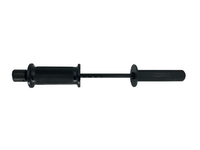
The Kell-Strom PWC30499-50 is a spline gauge for use on select Pratt & Whitney aircraft engines.
| General Information | |
|---|---|
| Part # | PWC30499-50 |
| Manufacturer | Kell-Strom |
| Shipping Information | |
|---|---|
| Product Weight | 0.15 lbs. |
| Product Dimensions | 12 x 2 x 2 in. |
| Schedule B | 8205599000 |
| ECCN | EAR99 |
Customers also viewed
Customers who bought this item also purchased

AIRCRAFT COMPATIBILITY
| Compatible Aircraft* |
|---|
PRODUCT REVIEWS
This item does not have any reviews yet.
QUESTIONS & ANSWERS
Spline gauges experience repeated mechanical contact with mating parts, causing them to wear down gradually over time. Wear tolerance establishes a permissible wear limit beyond which the gauge is no longer reliable for accurate inspection. To maintain measurement integrity, the PWC30499-50 must be periodically checked for dimensional wear. Once the gauge exceeds its wear limit, it must be retired or replaced to avoid false acceptances or rejections.
The frequency of wear checks depends on usage, environmental conditions, and inspection volume. In low-usage settings, a gauge might be checked annually for size and every two years for form. In high-usage environments, more frequent inspections of individual spline flank deviations are advisable, since wear may not occur uniformly. Adjusting calibration intervals based on observed wear trends helps extend the gauge’s useful life without compromising accuracy.
Common wear includes rounding or loss of shape at the spline flanks, contamination or corrosion altering dimensions, micro-chipping, or wear at contact edges. Additionally, uneven wear can cause form deviations, even when the overall size appears acceptable, which is why form inspection is crucial. Any damage, burrs, or discrepancies found during daily handling should trigger an immediate reevaluation of the gauge.
To protect its precision surfaces, the PWC30499-50 should be stored in a clean, dry, padded case or tool cabinet to prevent knocks, dust, and moisture. Avoid placing heavy objects on top of it or stacking tools. Always ensure mating parts and spline surfaces are clean before testing to reduce abrasive wear. Gentle handling and cleanliness help extend its usable lifespan.
Not necessarily – spline gauges must match the exact spline profile (e.g., involute geometry, tooth count, pressure angles) of the part being inspected. While generic spline gauges exist, using a gauge mismatched in profile may yield misleading measurements or false rejects. Always use the correct gauge matching engine or component specifications; the PWC30499-50 is tailored for the spline geometry specified in Pratt & Whitney (or OEM) documentation.
Planners review wear inspection reports and measure deviations from the original form. When the gauge’s measured wear exceeds its allowed tolerance – or when combined size and form errors approach compliance limits – the gauge should be retired. Tracking wear trend data over time helps predict when replacement is needed, allowing procurement to acquire spares before a tool becomes unusable. Maintaining a small inventory of backup gauges also helps avoid downtime when one instrument is retired.


