






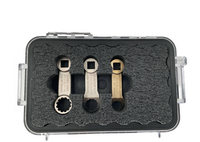
TM1-1520-280-23-6 - McNally 1006845 Blade Clamp Kit


Create yours now for free.
The TM1-1520-280-23-6 is a specific part number of the series McNally 1006845. For more generalized information on this item series or for more options, click here.

Need a Quote?
| Alternate Models | |
|---|---|
| 4920-01-654-4140 | NSN |
| TM1-1520-280-23-6 | TM Part Number |
| General Information | |
|---|---|
| Part # | TM1-1520-280-23-6 |
| Manufacturer | McNally |
| Shipping Information | |
|---|---|
| Product Weight | 88 lbs. |
| Product Dimensions | 42 x 21 x 15 in. |
| Schedule B | 8205700090 |
| ECCN | 9B610.a |
Customers also viewed
AIRCRAFT COMPATIBILITY
| Compatible Aircraft* |
|---|
PRODUCT REVIEWS
This item does not have any reviews yet.
QUESTIONS & ANSWERS
Helicopter rotor blades are large and heavy, and they can be easily damaged if handled improperly during maintenance or removal. A blade clamp kit helps stabilize and support the blade during lifting, positioning, and transport, reducing the risk of bending, surface damage, or injury. By controlling blade movement, technicians can work more safely and efficiently around the aircraft. This is especially important during inspections, blade changes, or storage operations.
The McNally 1006845 blade clamp kit is designed to simplify blade handling tasks that traditionally require more manpower and setup time. By securely holding the blade without complex rigging or repeated adjustments, maintenance teams can complete blade-related tasks faster. Fewer handling issues also mean fewer delays caused by accidental damage or rework. The result is a more streamlined maintenance process with less aircraft downtime.
Blade clamp kits are especially valuable in high-tempo maintenance environments such as military flight lines, depot-level maintenance facilities, and MRO operations. These settings often involve frequent blade removal, transport, or repositioning, where consistent handling procedures matter. Using a dedicated clamp helps standardize blade handling across shifts and crews. This consistency improves both safety and efficiency in busy maintenance operations.
Wide-chord rotor blades have a larger surface area and greater structural length, making them more susceptible to bending or uneven loading during handling. Improper support can introduce stress that affects blade integrity or balance. A properly designed blade clamp distributes loads evenly and maintains the blade's alignment during movement. This helps protect the blade’s structural and aerodynamic characteristics throughout maintenance.
Manual blade handling exposes technicians to pinch points, shifting loads, and awkward lifting positions. A blade clamp secures the blade mechanically, reducing the need for direct manual control. This lowers the risk of strains, dropped components, or uncontrolled blade movement. Improving safety during blade handling also helps reduce the likelihood of maintenance-related injuries.
When rotor blades are moved between maintenance areas or placed into storage, stability is critical to prevent damage. A blade clamp keeps the blade rigidly supported and properly oriented during transport. This reduces the chance of flexing, contact damage, or accidental impacts. It also allows blades to be staged or stored more predictably within maintenance facilities.
The National Stock Number (NSN 4920-01-654-4140) allows maintenance and procurement teams to identify the exact blade clamp kit across military and government supply systems. Using the NSN reduces confusion caused by varying part descriptions or vendor listings. It also helps speed up ordering, approval, and inventory tracking. For regulated environments, an NSN ensures the correct, approved tooling is sourced every time.
Improvised methods often rely on slings, straps, or manual support that can shift under load or introduce uneven stress. A purpose-built blade clamp is engineered specifically to hold rotor blades securely and evenly. This improves repeatability and reduces the risk of damage caused by inconsistent handling. Over time, dedicated tooling typically saves both labor hours and repair costs.
Blade clamps with no wearable parts reduce long-term maintenance and inspection requirements for the tool itself. There are fewer components that need replacement, adjustment, or tracking over time. This improves tool reliability and lowers lifecycle costs. For maintenance teams, it means a dependable fixture that’s always ready when blade handling tasks arise.


