






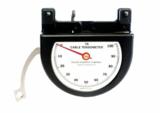
Pacific Scientific T5-2002-103-00 Cable Tensiometer – 30-160 lbs, 30-200 lbs, 30-150 lbs


The Pacific Scientific T5-2002-103-00 is the mid-to-upper-range model in the T5-2002 sub-series — the only sub-series in the T5-2000 line that covers all seven standard aircraft cable diameters from 1/16" through 1/4". With three operating ranges — 30–160 lbs for 1/16", 3/32", and 1/8" cables; 30–200 lbs for 5/32" and 3/16" cables; and 30–150 lbs for 7/32" and 1/4" cables — the T5-2002-103-00 covers the mid-range primary control cable tensions most commonly encountered on general aviation singles, twins, and turboprops, while spanning the full breadth of cable sizes used across those platforms. For maintenance facilities that service a diverse fleet and need one instrument to handle every cable size from the smallest secondary runs to the largest primary control cables, this is the model to have on the bench.
Mid-Range Tensions. Maximum Cable Coverage.
The T5-2002 sub-series is defined by its seven-size cable coverage — a capability that the T5-2001 sub-series, which tops out at 3/16", does not offer. Within the T5-2002 family, the -103-00 fills the mid-range slot: above the light-range -2002-101-00, and below the heavier -2002-104-00. That positioning makes it the right tool when primary flight control cable tensions on your aircraft are specified in the 30–200 lb zone, regardless of whether those cables are 1/16" secondary runs or 1/4" primary control cables. Each T5-2002-103-00 ships factory-calibrated with its own individual calibration chart that maps every dial reading to actual tension in pounds for each cable size and range. There is no secondary math, no additional equipment, and no conversion step beyond matching the dial number and cable size to the chart. Zero temperature error means accuracy is maintained from extreme cold to high heat without any preliminary adjustments — the instrument is ready to use the moment it comes out of the case.
Seven Cable Sizes. One Instrument. No Compromises.
- All seven standard cable sizes covered — 1/16", 3/32", 1/8", 5/32", 3/16", 7/32", and 1/4"
- Three operating ranges — 30–160 lbs, 30–200 lbs, and 30–150 lbs matched to cable size groups
- Individual factory calibration chart — direct dial-to-pounds conversion for every cable size and range
- Zero temperature error — calibration-stable from extreme cold to high heat, no adjustment required
- Pointer lock brake lever — lock the reading before removing the instrument in confined or low-visibility areas
- One-handed operation — complete a cable tension check in seconds with no assistance
- No batteries or electronics — fully mechanical, always ready
- Complete kit — risers #1, #2C, #3; calibration certificate; foam-lined zippered hard case
Technical Specifications
- Tension Range (Low): 30 – 160 lbs
- Tension Range (Mid): 30 – 200 lbs
- Tension Range (High): 30 – 150 lbs
- Cable Sizes (Low Range): 1/16", 3/32", 1/8"
- Cable Sizes (Mid Range): 5/32", 3/16"
- Cable Sizes (High Range): 7/32", 1/4"
- Indicator: Black dial indicating
- Calibration: Factory-calibrated; individual chart included
- Temperature Stability: Zero temperature error; operates from -53°C to 71°C
- Pointer Lock: Yes — brake lever rod
- Risers Included: #1, #2C, #3
- Case: Foam-lined zippered hard case
- Origin: Made in the USA
- Warranty: 1 year on new units
Typical Applications
- Primary flight control cable tension verification on GA singles, twins, and turboprops
- Multi-aircraft MRO facilities needing mid-range tension coverage across all seven cable sizes
- Aileron, elevator, and rudder cable rigging where tensions fall in the 30–200 lb range
- Secondary and trim cable tension checks across larger 7/32" and 1/4" cable diameters
- Post-repair and return-to-service cable tension verification
Pacific Scientific T5-2002-103-00 Calibration
The T5-2002-103-00 should be recalibrated on a scheduled basis — annually at minimum, and immediately following any overload event, mechanical shock, or drop. Pilot John International operates an ISO 17025-accredited calibration laboratory capable of recalibrating Pacific Scientific T5 series tensiometers to original manufacturer specifications, issuing a fully traceable calibration certificate upon completion. Whether your maintenance program operates under FAA oversight, a DOD contract, or an ISO 9001 quality management system, PJi's calibration services provide the traceability and documentation your compliance requirements demand. Learn more about PJi's ISO 17025 Calibration Services →
| General Information | |
|---|---|
| Part # | T5-2002-103-00 |
| Manufacturer | Pacific Scientific |
| Manual 1 | View Manual |
| Shipping Information | |
|---|---|
| Product Weight | 1.8 lbs. |
| Product Dimensions | 11 x 7 x 3 in. |
| Schedule B | 9027893500 |
| ECCN | EAR99 |
| Specifications | |
|---|---|
| Cable Sizes (High Range) | 7/32", 1/4" |
| Cable Sizes (Low Range) | 1/16", 3/32", 1/8" |
| Cable Sizes (Mid Range) | 5/32", 3/16" |
| Calibration | Factory-Calibrated; Individual Calibration Chart Included |
| Calibration Certificate | Included |
| Case | Foam-lined zippered hard case included |
| Indicator Type | Black Dial Indicating |
| Manufactured | USA |
| Pointer Lock | Yes — brake lever rod for retained readings |
| Risers Included | #1, #2C, #3 |
| Temperature Stability | Zero temperature error; operates in extreme heat and cold |
| Tension Range (High) | 30 – 150 lbs |
| Tension Range (Low) | 30 – 160 lbs |
| Tension Range (Mid) | 30 – 200 lbs |
| Total Cable Sizes | Seven (1/16" through 1/4") |
Customers also viewed
Customers who bought this item also purchased
AIRCRAFT COMPATIBILITY
This item is for use on all aircraft.
PRODUCT REVIEWS
This item does not have any reviews yet.
QUESTIONS & ANSWERS
The Pacific Scientific T5-2002-103-00 Cable Tensiometer is designed to measure tension in aircraft control cables ranging from 1/16" to 1/4" in diameter. With its precision dial indicator and interchangeable risers, it ensures accurate readings essential for maintaining control system integrity and flight safety. This tool is standard equipment in aircraft maintenance facilities for cable installation, adjustment, and periodic inspection.
For the most accurate results, always use the correct riser specified on the calibration card that comes with the instrument. The calibration card matches the tensiometer’s serial number and provides conversion data from dial readings to pounds of tension. Using a mismatched riser or calibration chart can result in incorrect readings and potentially damage the instrument.
Yes. The instrument can be used on both coated and uncoated aircraft cables, provided the riser accommodates the total outer diameter of the coated cable. When using coated cables, it’s essential to note the riser type specified on the calibration chart or certification label to maintain traceability and accuracy.
The T5-2002-103-00 is factory-calibrated for standard preformed aircraft cables with 7×7 or 7×19 strand construction, as specified in MIL-DTL-83420. It’s designed primarily for flexible wire rope, though it can be recalibrated for non-flexible cables that meet MIL-DTL-87161 standards. This ensures compatibility with control cable systems used in both commercial and military aircraft.
Using the incorrect riser will result in false tension readings and may damage the tensiometer’s internal spring mechanism. The riser must always correspond to the cable’s outer diameter and be verified against the calibration card. Incorrect riser selection is one of the most common causes of measurement errors and out-of-tolerance results.
Due to the uneven surface of stranded cables, it’s best to take three to five readings at slightly different points along the same cable. Averaging these results minimizes variation caused by individual cable strand positioning. This method helps achieve the highest level of accuracy during aircraft control cable maintenance.
No. The T5-2002-103-00 Cable Tensiometer provides accurate readings regardless of its position, whether it is positioned vertically, horizontally, or at an angle. Its internal mechanism is designed to maintain precision regardless of orientation, allowing technicians to use it in tight or angled spaces without compromising accuracy.
After placing the tensiometer on the cable and slowly closing the trigger, note the dial reading and convert it to pounds using the corresponding column on the calibration chart. The chart lists dial readings for specific cable sizes alongside their equivalent tension values. Never exceed the “100” mark on the dial to prevent permanent instrument damage.
Yes. The T5-2002-103-00 is equipped with a pointer-lock mechanism that allows the technician to retain the reading. Press the small lever located on the upper left-hand side before releasing the trigger to lock the pointer in place. After removing the instrument, the reading can be noted and reset by reversing the lever’s movement.
The tensiometer should be recalibrated annually or any time it has been dropped, overloaded, or exposed to adverse conditions. Routine calibration ensures consistent and accurate tension readings over time. PJi offers expert calibration services for Pacific Scientific cable tensiometers, as well as a wide range of other precision instruments and equipment.
No. The T5-2002-103-00 should not be used to adjust cable systems equipped with automatic tension regulators. These systems self-compensate based on ambient conditions, so external tension readings may not accurately reflect the system’s actual tension. Use the aircraft’s service manual to set regulator tension and verify it afterward if needed.
Before clamping the instrument onto a cable, ensure the brake lever rod is unlocked and secure the adjustable wrist strap to prevent accidental drops. Never overload the tensiometer beyond its 100-mark limit. Inspect risers and moving components for wear before each use to maintain safe and accurate operation.
The T5-2002-103-00 has three operating ranges: 30–160 lbs for 1/16", 3/32", and 1/8" cables; 30–200 lbs for 5/32" and 3/16" cables; and 30–150 lbs for 7/32" and 1/4" cables. All ranges are documented on the individual factory calibration chart included with the unit.
All three models cover the same seven cable sizes (1/16"–1/4") but are calibrated for progressively higher tension ranges. The -101-00 covers 10–150 lbs across its ranges, the -103-00 covers 30–200 lbs, and the -104-00 extends to 30–300 lbs. Choose the model whose upper range best matches the primary cable tension specifications in your aircraft's maintenance manual.
This is by design. Each range is calibrated for the specific mechanical response of a given cable diameter under deflection. The instrument's internal spring and sector geometry produce different deflection curves for different cable sizes — the calibration chart accounts for all of these variations and provides the correct tension value for each cable size at every dial reading.
Yes. Every T5-2002-103-00 ships with risers #1, #2C, and #3; an individual factory calibration chart; a calibration certificate; and a foam-lined zippered hard carrying case.
Annual recalibration is the standard interval for the T5 series, or sooner following any overload event, mechanical shock, or drop — all of which can cause spring fatigue or mechanical drift that affects reading accuracy. Pilot John International's ISO 17025-accredited calibration laboratory performs recalibration of Pacific Scientific T5 series tensiometers to original manufacturer specifications, issuing a fully traceable calibration certificate upon completion. Whether your program operates under FAA oversight, a DOD contract, or an ISO 9001 quality management system, PJi's lab provides the documentation your compliance requirements demand. Visit pilotjohn.com/calibration to learn more or request service.


