





Create yours now for free.

Need a Quote?
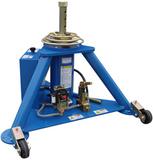
The Tronair 02-7839-0111 is a 18-Ton (36,000 lb) hydraulic aircraft tripod jack engineered to lift aircraft from the forward fuselage or main wing jacking points during maintenance, inspections, and ground operations. CE-marked for compliance with European aviation safety standards.
Standard Features
- Hand pump with built-in pressure relief valve
- Threaded rams with improved handwheel-style safety nut
- Quick-rising center extension for rapid initial lift
- Easy-access filler/breather cap
- Heavy-duty wheels for easy maneuverability
- Hydraulic fluid: MIL-PRF-5606
- ¾" (2 cm) spherical radius cup jack pad
- CE marked
- Durable powder-coat finish (Tronair Blue)
Technical Specifications
- Rated Capacity: 36,000 lbs (16329 kg)
- Operating Temperature: −4°F to 122°F (−20°C to 50°C)
- Pressure Relief Setting: 2,500 + 250/−0 PSIG (172.4 + 17.2/−0 bar)
- Hydraulic Fluid: MIL-PRF-5606
- Jack Pad: ¾" (2 cm) spherical radius cup
- Finish: Durable powder coat (Tronair Blue)
Safety Features
- Ram Lock Nut: Prevents the lowering of the ram. The ram lock nut must be lowered as the aircraft is being lifted. Ram lock nuts must be kept within 2" of the stop while raising the aircraft.
- Lock Nut Retention Ring: Prevents the lock nut from being unscrewed from the second stage.
- Pressure Relief Valve: Prevents overload during raising operations.
Aircraft Applications
The Tronair 02-7839-0111 is designed for use with a range of commercial, regional, and business aviation aircraft requiring 18-Ton tripod jack support. Specific aircraft model compatibility is defined in the Tronair Aircraft Application Guide. Always confirm jacking capacity, adapter requirements, and placement procedures with your aircraft maintenance manual before use.
Need your Tronair 02-7839-0111 18-ton tripod jack serviced, repaired, or load tested?
Pilot John is an authorized Tronair distributor and factory-authorized Tronair service center. Every jack ships new from our warehouse with Certificates of Conformance (CofC) and FAA Form 8130-3 documentation available at no additional cost. Need jack service, load-testing, or repair? Pilot John handles that too as an OEM-trained GSE service center. For more information or to request service, see our Service Center page, and see our article on why jack load testing matters. Pilot John also operates an ISO-17025 calibration center for all of your tooling and equipment calibration needs — learn more here.
Also Available
- With factory-installed air pump: Tronair 02A7839-0111
| Alternate Models | |
|---|---|
| 02-7839-0100 | Previous Part Number |
| GSB0700019 | Bombardier GSE Part Number |
| General Information | |
|---|---|
| Part # | 02-7839-0111 |
| Manufacturer | Tronair |
| Shipping Information | |
|---|---|
| Freight NMFC | 186600 |
| Schedule B | 8425420000 |
| ECCN | EAR99 |
| Spare Parts | |
|---|---|
| G-1206 | Knurled Nut |
| H-2395 | Cover |
| HJ-557 | Large Jack Pad |
| K-1001 | Pump Seal Kit |
| K-1043-28-02 | Air Pump Kit |
| K-1051 | Cylinder Seal Kit |
| K-1106 | Air Pump Manifold Kit |
| K-1685 | Air Pump Seal Kit (Hydraulic) |
| K-1686 | Air Pump Seal Kit (Pneumatic) |
| K-2433 | Casters |
| K-2783 | Release Screw |
| K-2797 | Weldment |
| K-3218 | Hand Wheel |
| R-1150 | Center Extension |
Customers also viewed
AIRCRAFT COMPATIBILITY
| Compatible Aircraft* |
|---|
PRODUCT REVIEWS
This item does not have any reviews yet.
QUESTIONS & ANSWERS
Aircraft tripod jacks are commonly used during landing gear inspections, wheel and brake servicing, structural repairs, and engine maintenance procedures that require lifting the aircraft off the ground. An 18-ton tripod jack like the Tronair 02-7839-0111 is especially useful for supporting larger business jets, regional aircraft, and military platforms that require substantial lifting capacity. Because tripod jacks lift the aircraft at designated jacking points, they provide stable support for extended maintenance events. Their tall lifting range also allows technicians to access hard-to-reach lower fuselage and landing gear components more easily.
The 170” maximum lift height of the Tronair 02-7839-0111 gives maintenance crews the ability to service aircraft with tall landing gear geometry or elevated fuselage structures. A greater lift range can also improve access for landing gear swings, wheel well inspections, and underbody maintenance. For operators working on larger aircraft, having additional extension capability helps reduce the need for supplemental lifting equipment. This versatility makes high-reach aircraft tripod jacks valuable additions to hangar operations.
The threaded handwheel-style safety nut provides a mechanical locking point that helps support the aircraft independently of hydraulic pressure. As the aircraft is raised, technicians can lower the safety nut into position to help prevent unintended lowering caused by hydraulic pressure loss or system issues. This added layer of protection is especially important during lengthy maintenance procedures where the aircraft may remain elevated for extended periods. Mechanical locking systems are considered a key safety feature on aircraft tripod jacks.
The quick-rising center extension allows technicians to rapidly position the jack closer to the aircraft jacking point before engaging the hydraulic system. This reduces the hydraulic pumping required during initial setup and improves overall maintenance efficiency. Faster positioning also minimizes setup time during multi-jack lifting operations where several tripod jacks must be aligned simultaneously. In busy maintenance environments, even small reductions in setup time can improve workflow productivity.
Stability is critical when lifting large aircraft because uneven loading or shifting weight can create dangerous conditions for both technicians and the aircraft itself. The tripod configuration distributes the load across three points, helping maintain balance during lifting operations. Combined with the jack’s heavy-duty construction and substantial 905-lb weight, the design helps minimize movement during use. Properly stabilized aircraft jacks also reduce stress on aircraft jacking points and structural components.
MIL-PRF-5606 hydraulic fluid is widely used in aviation because it offers reliable performance across a broad temperature range and maintains stable hydraulic characteristics under demanding operating conditions. Using aviation-approved hydraulic fluid also helps ensure compatibility with seals, valves, and internal jack components. This contributes to smoother lifting performance and reduced wear inside the hydraulic system. Standardized fluid specifications additionally simplify maintenance for operators managing multiple types of aviation ground support equipment.
The durable Tronair Blue powder-coat finish helps protect the tripod jack against corrosion, chemicals, hydraulic fluid exposure, and general wear encountered in hangar and ramp environments. A protective finish is especially important for large aircraft jacks that may be exposed to moisture, changing weather conditions, and frequent handling. Powder coating also helps extend the cosmetic appearance and long-term durability of the equipment. This added protection can help reduce maintenance requirements throughout the jack's life.
Heavy-duty wheels improve maneuverability when positioning a large aircraft tripod jack on the hangar floor or in a maintenance bay. Since the Tronair 02-7839-0111 weighs more than 900 lbs, durable wheels help technicians safely relocate the jack without requiring excessive effort or additional transport equipment. Smooth mobility also helps crews align the jack precisely with aircraft lifting points. Efficient positioning can save time during complex aircraft maintenance procedures.
Aircraft tripod jacks are designed to provide stable, long-duration support during inspections, repairs, and component replacements that may take several hours or even days to complete. Features such as mechanical safety nuts, sturdy steel construction, and hydraulic pressure relief systems help maintain safe lifting conditions throughout the maintenance event. Properly maintained hydraulic tripod jacks can deliver reliable performance for many years in demanding aviation environments. Their durability makes them essential pieces of ground support equipment for MRO facilities and airline maintenance departments.
Correct jack positioning helps distribute aircraft weight evenly across designated lifting points and reduces the risk of structural damage during maintenance. Technicians must ensure the tripod jack is aligned properly with the aircraft’s approved jacking locations before lifting begins. Improper positioning can create uneven loads that affect aircraft stability or damage landing gear and fuselage components. Following manufacturer-approved jacking procedures is essential for safe and effective aircraft maintenance operations.


