





Create yours now for free.

Need a Quote?
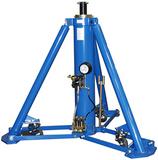
The Tronair 02A7851-0111 is a 25-Ton (50,000 lb) hydraulic aircraft tripod jack engineered to lift aircraft from the forward fuselage or main wing jacking points during maintenance, inspections, and ground operations. CE-marked for compliance with European aviation safety standards.
Standard Features
- Hand pump with built-in pressure relief valve
- Threaded rams with improved handwheel-style safety nut
- Quick-rising center extension for rapid initial lift
- Easy-access filler/breather cap
- Heavy-duty wheels for easy maneuverability
- Hydraulic fluid: MIL-PRF-5606
- ¾" (2 cm) spherical radius cup jack pad
- CE marked
- Durable powder-coat finish (Tronair Blue)
Technical Specifications
- Rated Capacity: 50,000 lbs (22680 kg)
- Operating Temperature: −4°F to 122°F (−20°C to 50°C)
- Pressure Relief Setting: 2,500 + 250/−0 PSIG (172.4 + 17.2/−0 bar)
- Hydraulic Fluid: MIL-PRF-5606
- Jack Pad: ¾" (2 cm) spherical radius cup
- Finish: Durable powder coat (Tronair Blue)
Safety Features
- Ram Lock Nut: Prevents the lowering of the ram. The ram lock nut must be lowered as the aircraft is being lifted. Ram lock nuts must be kept within 2" of the stop while raising the aircraft.
- Lock Nut Retention Ring: Prevents the lock nut from being unscrewed from the second stage.
- Pressure Relief Valve: Prevents overload during raising operations.
Aircraft Applications
The Tronair 02A7851-0111 is designed for use with a range of commercial, regional, and business aviation aircraft requiring 25-Ton tripod jack support. Specific aircraft model compatibility is defined in the Tronair Aircraft Application Guide. Always confirm jacking capacity, adapter requirements, and placement procedures with your aircraft maintenance manual before use.
Need your Tronair 02A7851-0111 25-ton tripod jack serviced, repaired, or load tested?
Pilot John is an authorized Tronair distributor and factory-authorized Tronair service center. Every jack ships new from our warehouse with Certificates of Conformance (CofC) and FAA Form 8130-3 documentation available at no additional cost. Need jack service, load-testing, or repair? Pilot John handles that too as an OEM-trained GSE service center. For more information or to request service, see our Service Center page, and see our article on why jack load testing matters. Pilot John also operates an ISO-17025 calibration center for all of your tooling and equipment calibration needs — learn more here.
Also Available
- Without air pump (hand pump only): Tronair 02-7851-0111
| General Information | |
|---|---|
| Part # | 02A7851-0111 |
| Manufacturer | Tronair |
| Shipping Information | |
|---|---|
| Freight NMFC | 186600 |
| Schedule B | 8425420000 |
| ECCN | EAR99 |
| Spare Parts | |
|---|---|
| H-2395 | Cover |
| HJ-557 | Large Jack Pad |
| K-1001 | Pump Seal Kit |
| K-1043-28-02 | Air Pump Kit |
| K-1051 | Cylinder Seal Kit |
| K-1106 | Air Pump Manifold Kit |
| K-1685 | Air Pump Seal Kit (Hydraulic) |
| K-1686 | Air Pump Seal Kit (Pneumatic) |
| K-2433 | Casters |
| K-3440 | Weldment |
| R-1150 | Center Extension |
| Z-3218 | Hand Wheel |
Customers also viewed

AIRCRAFT COMPATIBILITY
| Compatible Aircraft* |
|---|
PRODUCT REVIEWS
This item does not have any reviews yet.
QUESTIONS & ANSWERS
The Tronair 02A7851-0111 25-ton tripod jack is designed to support a wide range of aircraft maintenance tasks involving lifting points on the fuselage and wings. Maintenance crews commonly use aircraft tripod jacks during landing gear servicing, tire and brake replacement, structural inspections, and aircraft weighing procedures. Its 50,000-lb lifting capacity makes it suitable for many commercial, regional, and business aviation applications. The jack’s heavy-duty construction also helps provide stable lifting performance during demanding maintenance operations.
A 25-ton aircraft tripod jack provides the lifting capability needed to service larger aircraft while maintaining flexibility for multiple maintenance applications. High-capacity jacks can help reduce the need for multiple lifting systems in an MRO or airline maintenance facility. This can improve operational efficiency and simplify equipment management in busy hangar environments. The wide range of applications also makes the jack useful for operators maintaining mixed aircraft fleets.
The threaded ram design helps technicians achieve precise aircraft positioning during lifting and lowering operations. Once the aircraft reaches the desired height, the handwheel-style safety nut can be secured to provide additional mechanical support beneath the load. This feature helps reduce reliance on hydraulic pressure alone during maintenance procedures. Improved load stability is especially important when technicians are working around landing gear or structural components.
The quick-rising center extension helps reduce setup time by allowing technicians to position the jack closer to the aircraft jacking point before hydraulic lifting begins. A faster initial extension can improve workflow efficiency during scheduled maintenance operations. This feature is particularly useful when multiple aircraft jacks must be positioned and adjusted simultaneously. Reduced setup time can help maintenance crews complete lifting procedures more efficiently.
The pressure relief valve helps protect both the jack and the aircraft from excessive hydraulic pressure during lifting operations. By limiting overload conditions, the system helps maintain safer operating conditions for technicians and equipment. This protective feature also helps reduce stress on hydraulic components and internal seals over time. Reliable pressure control is essential when lifting large aircraft during maintenance or inspection procedures.
Heavy-duty wheels allow technicians to move the aircraft tripod jack more easily across hangar floors and maintenance areas. Improved maneuverability reduces the physical effort required to position heavy ground support equipment under aircraft jacking points. Mobile tripod jacks can also help speed up aircraft repositioning during maintenance events. Efficient jack transport is especially valuable in large maintenance facilities handling multiple aircraft per day.
MIL-PRF-5606 hydraulic fluid is widely used in aviation maintenance equipment because of its dependable low-temperature performance and compatibility with aircraft hydraulic systems. The fluid helps support smooth jack operation while protecting seals and hydraulic components from excessive wear. Aviation-approved hydraulic fluids are also formulated to perform consistently under varying environmental conditions. Using the recommended fluid helps maintain long-term reliability and safe lifting performance.
The durable powder-coat finish helps protect the jack from corrosion, chemicals, moisture, and general wear commonly found in aviation maintenance environments. Protective finishes can help extend the service life of aircraft ground support equipment that is frequently used and subject to changing environmental conditions. The Tronair Blue finish also improves equipment visibility in busy hangar settings. Long-lasting surface protection can reduce maintenance requirements and preserve the equipment's appearance over time.
CE marking indicates that the jack complies with applicable European safety and regulatory standards for industrial equipment. This certification helps operators confirm that the aircraft jack meets established requirements for safety, design, and manufacturing quality. CE-compliant equipment is especially important for international operators and maintenance facilities working under global aviation standards. The marking also demonstrates Tronair’s commitment to recognized safety practices in aviation ground support equipment.
Before lifting any aircraft, operators should confirm jacking capacity requirements, approved jack points, and any necessary adapters listed in the aircraft maintenance manual. Proper positioning on a level surface and correct use of ram lock nuts are also essential for safe operation. Technicians should inspect the jack for fluid leaks, damaged components, or excessive wear before each use. Following approved aircraft jacking procedures helps protect both maintenance personnel and aircraft structures.


