






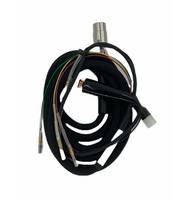
Barfield 101-00831 Adapter Cable – Converts D-Type to Round Connectors


Need a Quote?
The Barfield 101-00831 Adapter Cable is used in conjunction with the DC400A Fuel Quantity Test Set to convert D-type connectors to circular-style connectors.
| General Information | |
|---|---|
| Part # | 101-00831 |
| Manufacturer | Barfield |
| Shipping Information | |
|---|---|
| Product Weight | 0.3 lbs. |
| Product Dimensions | 8 x 2 x 1 in. |
| Schedule B | 9026107000 |
| ECCN | EAR99 |
Customers also viewed
Customers who bought this item also purchased

AIRCRAFT COMPATIBILITY
| Compatible Aircraft* |
|---|
PRODUCT REVIEWS
This item does not have any reviews yet.
QUESTIONS & ANSWERS
The 101-00831 adapter cable provides a conversion interface from 15-pin D-type connectors to circular-style connectors, allowing compatibility between Barfield DC400/DC400A fuel quantity test sets and aircraft systems that use round connector layouts. This adapter simplifies connections during fuel quantity testing by providing a plug-and-play solution, eliminating the need for custom wiring adaptors. Because a proper connector interface is crucial for accurate readings, this cable plays a key role in reliable system diagnostics.
The 101-00831 is designed to work with the Barfield DC400 and DC400A fuel quantity test sets, serving as an interface cable when the aircraft’s connection uses a circular plug instead of the standard D-type. By providing correct pin alignment and impedance matching, the adapter ensures that the test equipment performs within its calibration parameters. Using the proper adapter helps avoid mis-connector setups and preserves system accuracy.
No. This adapter cable is specifically designed for converting from the D-type connector typically used on Barfield modules to the circular style commonly found on certain aircraft wiring harnesses. Each Barfield adapter cable is engineered for a specific aircraft connector type, signal layout, and test-set interface. Substituting or mismatching cables could result in incorrect calibration, connector damage, or unreliable test results.
By providing a pre-manufactured, high-quality interface between query-type fuel quantity test sets and aircraft systems with round connectors, the cable reduces setup time, avoids on-site wiring modifications, and removes adaptor guesswork. Maintenance crews spend less time reconfiguring connectors, which helps increase workflow efficiency, reduce AOG time, and improve consistency in testing. Reliable connectivity ensures technicians can focus on calibration rather than connector issues.
Before use, inspect the adapter for damage to the connector, pin corrosion, or bent contacts. Verify continuity and shielding integrity, especially if it has been stored or previously used. Confirm that the circular connector on the aircraft and the D-type side of the cable match, and verify that the fuel quantity circuits are de-energized before connecting to the test set. Proper pre-use checks prevent signal distortions or false readings during system verification.
While the adapter cable itself does not require calibration because it is a passive interconnect, Barfield recommends verifying its electrical continuity and resistance as part of the annual calibration of the DC400/DC400A test set. Any significant deviation in impedance or continuity could impact the accuracy of fuel quantity measurement. It is prudent to treat the cable as a critical component of the test system and validate it during the calibration cycle.
Store the cable in a clean, dry environment, preferably in its original protective sleeve or case, to prevent kinks and contamination of the connectors. Avoid wrapping it too tightly and ensure it is free of abrasions or crushing. Before storage, wipe the connector contacts with a suitable contact cleaner and inspect them for debris. Consistent care helps extend the service life and ensures reliability when used in precision aircraft fuel system testing.
Typical issues include bent or broken pins, damage to the connector insert, loss of shield integrity, or internal cable fatigue resulting from repeated bending and flexing. These failures can lead to signal noise, inaccurate readings, or errors in the test set. Recognizing early signs – such as loose coupling or intermittent connectivity – helps maintenance teams replace the cable proactively, rather than risk erroneous test results.
Ensure the aircraft’s fuel-quantity system is de-powered and proper grounding is applied before connecting or disconnecting the cable. Avoid contaminating the connectors with fuel, hydraulic fluid, or debris, as this may degrade connection integrity. Secure the cable routing to prevent stress or damage during use, and follow the aircraft’s maintenance manual as well as Barfield’s user guide to maintain compliance and safety.


