






Create yours now for free.

Need a Quote?
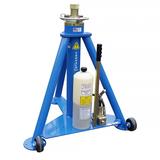
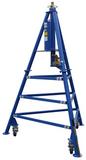
The Columbus Jack 1214-151 is a 12-ton (24,000-lb) hydraulic aircraft tripod jack engineered to lift aircraft from the forward fuselage or main wing jacking points during maintenance, inspections, and ground operations. With a 14" (35.6 cm) closed height and 40" (101.6 cm) maximum extended height, it accommodates a range of aircraft fuselage and wing jacking point heights. CE-marked for compliance with European aviation safety standards.
Standard Features
- Hand pump with built-in pressure relief valve
- Threaded rams with improved handwheel-style safety nut
- Quick-rising center extension for rapid initial lift
- Easy-access filler/breather cap
- Heavy-duty wheels for easy maneuverability
- Hydraulic fluid: MIL-PRF-5606
- ¾" (2 cm) spherical radius cup jack pad
- CE marked
Technical Specifications
- Rated Capacity: 24,000 lbs (10886 kg)
- Operating Temperature: -4°F to 122°F (-20°C to 50°C)
- Pressure Relief Setting: 2,500 + 250/-0 PSIG (172.4 + 17.2/-0 bar)
- Minimum Closed Height: 14" (35.6 cm)
- Maximum Height Obtainable: 40" (101.6 cm)
- Hydraulic Fluid: MIL-PRF-5606
- Jack Pad: ¾" (2 cm) spherical radius cup
Safety Features
- Ram Lock Nut: Prevents the ram from lowering. The ram lock nut must be lowered as the aircraft is being lifted. Ram lock nuts must be kept within 2" of the stop while raising the aircraft.
- Lock Nut Retention Ring: Prevents the lock nut from being unscrewed from the second stage.
- Pressure Relief Valve: Prevents overload during raising operations.
Aircraft Applications
The Columbus Jack 1214-151 is designed for use with a range of commercial, regional, and business aviation aircraft requiring 12-ton tripod jack support. Specific aircraft model compatibility is defined in the Columbus Jack Aircraft Application Guide. Always confirm jacking capacity, adapter requirements, and placement procedures with your aircraft maintenance manual before use.
Need your Columbus Jack 1214-151 12-ton tripod jack serviced, repaired, or load-tested?
Pilot John is an authorized Columbus Jack (Tronair) distributor and service center — one of a select group of authorized partners in North America. Our pricing on Columbus Jack jacks is competitive: PJi prices have been verified as lower than those of other major aviation supply retailers on comparable models. Every jack ships new from our North Carolina warehouse with Certificates of Conformance (CofC) and FAA Form 8130-3 documentation available at no additional cost. Need jack service, calibration, or repair? Pilot John handles that too as an authorized service center.
| General Information | |
|---|---|
| Part # | 1214-151 |
| Manufacturer | Columbus Jack |
| NSN | 1730005545436 |
| Shipping Information | |
|---|---|
| Schedule B | 8425420000 |
| ECCN | EAR99 |
Customers also viewed
AIRCRAFT COMPATIBILITY
| Compatible Aircraft* |
|---|
PRODUCT REVIEWS
This item does not have any reviews yet.
QUESTIONS & ANSWERS
The Columbus Jack 1214-151 tripod jack is designed for aircraft lifting operations during inspections, landing gear servicing, wheel and brake maintenance, and other ground support procedures. Its 24,000-lb lifting capacity makes it suitable for a wide range of commercial, regional, military, and business aviation aircraft. The jack is commonly used in hangars, MRO facilities, and military maintenance environments where dependable vertical lifting capability is required. Columbus Jack also notes its long-standing use across U.S. military and allied operations worldwide.
The multi-stage hydraulic ram system allows the aircraft tripod jack to achieve greater lifting height while maintaining a relatively compact closed height. This design helps technicians position the jack more easily under aircraft with limited ground clearance before extending to higher maintenance positions. The staged extension process also helps maintain lifting stability throughout operation. According to the operation manual, the jack uses sequential stage extension to ensure controlled lifting under load.
The 1214-151 is designed as a portable, self-contained aircraft jack that does not require external hydraulic systems or power sources. This allows maintenance technicians to move the jack between aircraft and work areas with minimal setup requirements. The integrated reservoir, pump assembly, and lifting system simplify operation while reducing the amount of support equipment needed on the hangar floor. This portability is especially valuable for flight line maintenance and military operations.
The threaded mechanical locknuts provide an additional level of safety by mechanically supporting the load after hydraulic lifting is completed. During operation, technicians lower the locknuts into position as the ram stages extend, helping reduce reliance on hydraulic pressure alone. The manual instructs operators to maintain approximately one inch of clearance between the locknut and mating surface during raising and lowering procedures. This design helps improve aircraft stability and operational safety during maintenance activities.
The integrated screw extension allows technicians to fine-tune jack height before hydraulic lifting begins. This helps reduce unnecessary hydraulic travel while improving alignment with aircraft jacking points. Columbus Jack also recommends extending the screw extension as far as practical while still allowing the jack to roll under the aircraft safely. Proper use of the screw extension can help maximize lifting height and improve operational efficiency.
Routine preventative maintenance is essential for keeping the aircraft jack operating safely and efficiently. Columbus Jack recommends inspecting for oil leaks, damaged components, worn snap ring grooves, and proper screw extension operation before use. The manufacturer also advises greasing all lube fittings every six months and performing annual jack certification procedures to verify proper load-holding capability. Following the recommended maintenance schedule can help reduce wear and improve long-term reliability.
The Columbus Jack 1214-151 is designed to operate in temperatures as low as -4°F (-20°C), making it suitable for many outdoor and cold-weather aviation maintenance environments. The manufacturer also provides winterization guidelines for extreme temperatures, including recommendations for hydraulic fluid and a kerosene mixture. For operations below -30°F (-34°C), Columbus Jack recommends using dry nitrogen instead of standard compressed air to improve pump responsiveness. These procedures help maintain reliable jack performance in demanding climates.
The built-in relief valve helps protect both the aircraft and the jack from overload conditions during lifting operations. Columbus Jack specifies that the relief valve should never exceed 10% above the rated lifting capacity to maintain safe operation. If system pressure becomes excessive, the relief valve helps prevent damage to hydraulic components and aircraft structures. This safety feature is especially important when lifting heavier business or military aircraft.
The heavy-duty caster system improves maneuverability when positioning the tripod jack around hangars and maintenance ramps. The casters are designed to support the jack’s weight while allowing the footpads to bear the aircraft load during lifting. The operation procedure also recommends rotating the jack approximately 15° before loading to help minimize caster movement. This contributes to safer and more stable aircraft lifting operations.
The manually operated hydraulic pump assembly provides dependable lifting capability without requiring electrical power or shop air connections. The pump includes both release and relief valve functionality within a single assembly, simplifying operation and maintenance. This self-contained design can be especially useful for remote maintenance environments, military applications, and backup lifting procedures. The manual also notes that no special tools are required for normal operation.


