






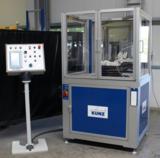
KUNZ 225.0000 Aircraft Brake Build-Up Stand (BBS)


Create yours now for free.

Need a Quote?
The KUNZ 225.0000 Aircraft Brake Build-Up Stand (BBS) is designed for the assembly and disassembly of single- and double-sided screwed aircraft brakes. The unit includes a hydraulic cylinder with foot-pump operation, an extension shaft with notches, and a clamping disc for secure brake handling. Brake-specific torque adapters (sold separately) can be mounted to the base plate, making the BBS adaptable to a wide range of aircraft brake models.
Specifications
- Dimensions: 17.7' L x 17.7" W x 63" H (45 x 45 x 160 cm)
- Weight: 198 lbs (90 kg)
- Foot Pump Pressure: 5,000 PSI (350 bar)
- Foot Pump Flow: 0.67 cu. in. (11 cu. cm) at low pressure; 0.12 cu. in. (2 cu. cm) at high pressure
- Stroke Extension Shaft: 5" (12.7 cm)
- Stroke Push-Out Plate: 2" (5 cm)
| General Information | |
|---|---|
| Part # | 225.0000 |
| Manufacturer | KUNZ |
Customers also viewed
AIRCRAFT COMPATIBILITY
| Compatible Aircraft* | |
|---|---|
| Bombardier | Challenger 300 , Challenger 600 , Global 5000 , Global 6000 , Global 7500 , Learjet 45 , Learjet 60 |
PRODUCT REVIEWS
This item does not have any reviews yet.
QUESTIONS & ANSWERS
The Brake Build-Up Stand (BBS) features a double-acting hydraulic cylinder that supports both clamping and push-out actions. Operators can control the process with a hand switch, making it easy to switch between pressing brakes together during assembly and pushing them apart for disassembly. Built-in pressure, non-return, and check valves help maintain safe, reliable hydraulic performance during brake servicing.
Yes. Each aircraft brake model requires a torque adapter to ensure proper fit and secure clamping during servicing. These adapters are mounted directly to the BBS base plate, which can be locked into position to prevent movement. Because adapters are interchangeable, technicians can quickly adjust the stand to accommodate different brake models without needing an entirely new unit.
To secure a brake, the appropriate torque adapter is mounted to the base plate and locked in place. The brake is then positioned on the adapter and extension shaft, with the clamping disc mounted on top. Once in place, the hydraulic cylinder retracts the shaft, drawing the brake hub together to prepare for nut removal or tightening.
The BBS includes a push-out plate driven by three low-profile hydraulic cylinders. After the nuts are loosened, this plate applies a uniform force to safely push the brake components apart. This design eliminates the need for excessive manual effort and reduces the risk of damaging the brake assembly during disassembly.
Yes, KUNZ recommends using the Brake Build-Up Stand in combination with the Universal Torque Tool (UTT). The UTT provides precise torque application for brake fasteners, complementing the BBS’s clamping and disassembly functions. Together, they streamline brake servicing while ensuring accuracy and safety.
Safety is built into the design through hydraulic control valves, a stable base plate, and secure locking mechanisms for adapters. The double-acting cylinder allows controlled movement in both directions, minimizing the chance of sudden or uneven force. These features ensure reliable, repeatable performance while protecting both technicians and brake components.
The Brake Build-Up Stand requires only minimal maintenance to stay in top working condition. Operators should perform routine inspections to check the hydraulic system for smooth operation and verify that adapters, discs, and the extension shaft remain in good condition. Regular cleaning and proper storage help extend the service life of the unit.
The BBS is designed as a stationary stand to provide maximum stability during brake servicing. Its solid base plate and locking system keep the brake securely in position, minimizing movement that could compromise technician safety or damage components. However, its relatively compact footprint allows it to be repositioned within a workshop if needed.
The unit incorporates a foot-pump-driven hydraulic system, which allows technicians to apply steady, controlled pressure without using their hands. This setup improves safety and efficiency during both assembly and disassembly processes. The design also reduces operator fatigue compared to manual pressing methods.
By using hydraulic clamping and push-out functions, the BBS eliminates the need for excessive manual force. The stable locking base plate and torque adapter system ensure that the brake remains secure throughout the process. These design elements reduce the risk of slippage, sudden part movement, or strain injuries during heavy-duty brake work.


