





Belly Pads vs. Flat Gear Lift Pads: Choosing the Right GA Jacks
Key Takeaways
- General aviation jacking systems come in two primary configurations: belly pad systems that contact the fuselage at the main gear bulkhead, and flat gear systems that cradle the spring-steel gear legs – the right choice depends on your aircraft's gear type and the work at hand.
- The belly pad system uniquely enables complete gear leg removal, gearbox inspection, and main gear attach bolt verification – tasks that are difficult or impossible with any other jacking method.
- The flat gear system lifts both main wheels simultaneously by clamping the spring-steel gear legs, eliminating the dangerous lateral spreading that makes single-wheel jacking on spring-gear aircraft genuinely risky.
- Both systems are available from Aircraft Jacking Solutions (AJS) as complete kits or individual components – with aircraft-specific configurations for Cessna, Van's RV, Sling, Bristell, Citabria, Pitts, Tecnam, and more.
- All AJS aviation jacks carry a 3,800-lb rated capacity and a lifetime warranty on all lift components above the floor jack – a strong long-term investment for GA maintenance operations, A&P shops, and EAA chapter tool cribs.
For light GA aircraft maintenance, single-wheel jacking is a common improvisation that ranges from inefficient to genuinely risky – especially on spring-steel gear, where lifting one wheel can cause the gear to flex and spread laterally in unpredictable ways.
Aircraft Jacking Solutions (AJS) addresses this problem with a purpose-built, modular system that offers two distinct lifting approaches: the belly pad system, which contacts the airframe at the main gear bulkhead, and the flat gear system, which raises both main wheels simultaneously by clamping the spring-steel gear legs.
Choosing between them depends on your aircraft's landing gear type and what you need to accomplish. In this article, we'll walk through how each system works, which aircraft and maintenance scenarios each one fits best, and the safety practices that apply to both.
Fuselage vs. Gear Leg: Choosing the Right Lift Point
Anyone who has worked on light GA aircraft has likely encountered improvised jacking setups – a floor jack with wooden blocks, a bottle jack wedged under one gear leg – and the instability that comes with them. The core design decision behind any aircraft jacking solution is where the jack makes contact with the airframe. Two fundamentally different contact points are available on a light GA aircraft: the gear legs themselves, or the fuselage belly at the main gear bulkhead.
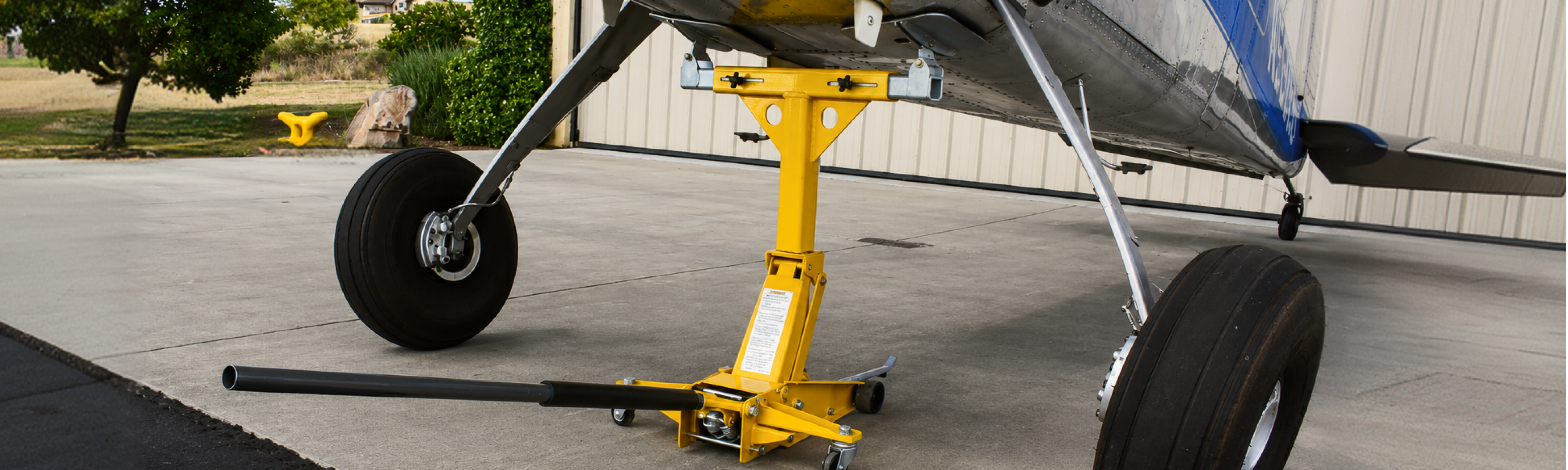
Gear leg contact – used in the AJS flat gear system – works by clamping lift pads against the spring-steel main gear legs and raising both wheels together. This approach is fast to set up, requires no fuselage contact, and eliminates the lateral spring-gear spreading problem that makes single-wheel jacking on Cessna flat gear, Van's RV series, and similar aircraft genuinely risky. The gear legs remain in place and under load throughout the lift.
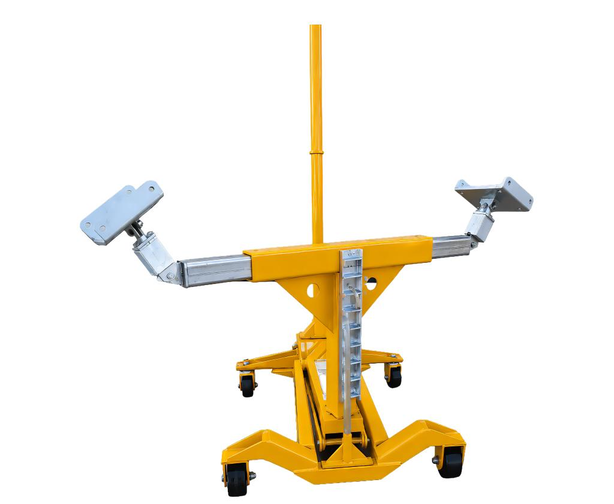
Fuselage belly contact – used in the AJS belly pad system – positions curved or flat lift pads against the aircraft's gearbox bulkhead structure: one of the most robustly built sections of any light GA airframe, specifically designed to absorb and transfer landing loads. Because the aircraft is supported from the fuselage rather than the gear legs, the gear legs are completely free during the lift. This is the defining characteristic that makes the belly pad system the choice for gear leg removal, gearbox inspection, and main gear attach bolt verification – maintenance tasks that simply aren't accessible with the gear under load.
When to Choose Aircraft Jacking Solutions' Belly Pad Systems
The belly pad system is the better choice whenever the maintenance task requires unrestricted access to the landing gear. This includes complete gear leg removal and replacement, flat gearbox casting and round gearbox bushing replacement on Cessna tailwheel models, verification of main gear attach bolt torque and gear shim security, and inspection of the gear structure itself. These tasks are either impractical or impossible to perform safely with the gear legs under load – which means they're often avoided or deferred when only conventional jacking equipment is available. The AJS belly pad system makes them practical.
The belly pad system is also the appropriate choice for aircraft whose fuselage geometry isn't suited to gear leg contact – specifically, aircraft with oleo struts, tubular legs, or bungee cord gear systems rather than flat spring-steel legs. This includes Cessna 150, 172, 182, and 206 nose gear models; Sling Aircraft (high and low wing); Bristell; Van's RV variants with flat belly profiles; and Tecnam twins. AJS offers belly pad kits for nose gear and tailwheel configurations, with curved lift plates specifically matched to the Cessna single-engine fuselage profile and flat plates for Sling, Bristell, and flat-belly RV models.
Proper belly pad placement is critical. The T-stand centerline must align with the fuselage centerline, and the pads must cover both the forward and aft gearbox bulkheads – failure to position the lift pads correctly over the bulkhead structure can damage the aircraft.
When a Flat Gear Lift Pad Fits Your Hangar Workflow
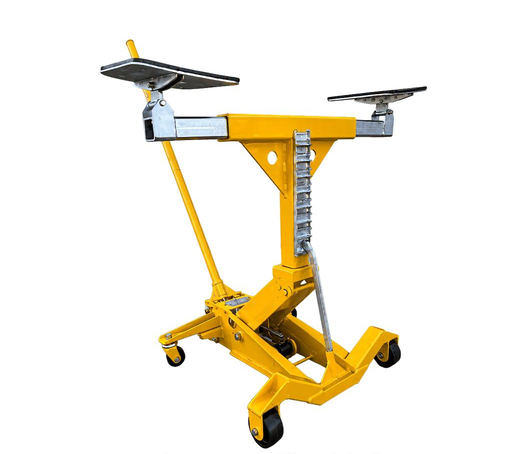
For routine wheel, tire, and brake maintenance on spring-steel gear aircraft, the flat gear system is typically the faster and simpler choice. Rather than lifting from the fuselage, the flat gear lift pads slide onto the spring-steel main gear legs and raise both wheels simultaneously – which is not just convenient, but actively safer than single-wheel lifting on this class of aircraft.
The physics matter here. Spring-steel landing gear is designed to flex under landing loads, which means it can spread laterally and unpredictably when asymmetric lifting forces are applied. Raising one wheel while the other remains on the ground puts exactly that kind of asymmetric load on the gear. The AJS flat gear system eliminates this by clamping both gear legs and lifting in a balanced, simultaneous motion that maintains the gear's natural geometry throughout the lift.
The flat gear system is the right choice for Cessna 120, 140, 150, 170, 180, 182, and 185 models with flat spring gear; Van's RV-4, -6, -7, -8, -9, and -14; Citabria, Decathlon, and Scout; Pitts Special and Pitts S-2; and the X-Cub. Flat gear kits are available for both nose gear and tailwheel configurations. The one job the flat gear system doesn't do is gear leg removal – if that's on the work order, the belly pad system is the right tool for the job.
Essential Safety Tips for GA Jacks
Regardless of which system you're using, the same core safety practices apply to every aircraft lift.
Before pumping, run a quick pre-use inspection: check for bent or stressed structural components, verify the hydraulic fluid level and top off if needed, bleed air from the hydraulic system by removing the access cover and pumping with the handle counterclockwise, inspect all welded joints for signs of fatigue cracking, and confirm the safety bar is in good condition. If you notice lifting that only occurs near the end of the pump stroke, low hydraulic fluid is typically the cause.
Position the aircraft on a level hangar floor before setup, and use both lift pads every time – the AJS system is designed for balanced loads only, and using a single pad can create uneven loading and instability that risks aircraft damage or injury. Center the T-stand directly beneath the aircraft's longitudinal centerline (a row of rivets running nose to tail usually serves as a visual guide), and extend both slide tubes equally to the hash-mark positions before pumping.
Lift only high enough to perform the required task – roughly 2” to 3” for most jobs. Once the aircraft is at working height, engage the safety stop and lower the jack slightly to confirm the stop is fully seated in the ratchet bar before beginning any work. Do not enter the aircraft while it is raised, and never position yourself under the aircraft. If one wheel lifts before the other – a common condition caused by unequal fuel loads or installed equipment – hang a counterweight from the heavier wing's tie-down ring to balance the load. When work is complete, inspect the area under the aircraft for tools, cotter pins, and hardware before lowering.
The Bottom Line
Choosing between a belly pad system and a flat gear lift pad comes down to two factors: your aircraft's landing gear type and what maintenance tasks are on your work order. Spring-steel gear aircraft doing routine tire and brake work are a natural fit for the flat gear system. Aircraft with oleo, tubular, or bungee gear, and any aircraft requiring gear leg access, need the belly pad system. For operators maintaining a mixed fleet – or who anticipate gear-level maintenance down the road – the belly pad system provides the broader long-term capability.
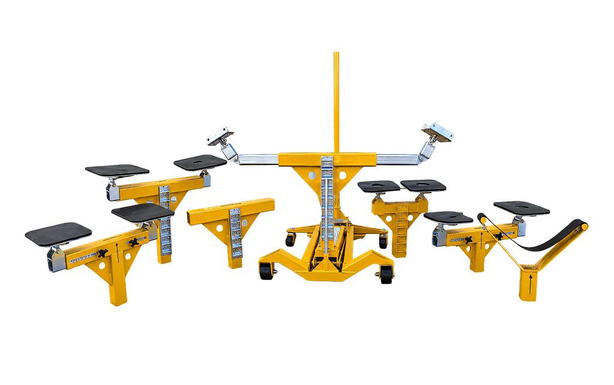
Pilot John International® (PJi®) carries the complete Aircraft Jacking Solutions lineup – including belly pad aircraft jacking systems, flat gear lift pad systems, and individual AJS components for shops and owners building out multi-aircraft capability incrementally. AJS is a trusted name in GA ground support equipment, built by an FAA-certificated A&P/IA for the demands of real-world aircraft maintenance – and every system carries the brand's lifetime warranty on all lift components above the floor jack.
Our aviation specialists are ready to help you identify the right aircraft jacking solution for your aircraft and maintenance requirements. Call, email, or chat with us today to get started.
Frequently Asked Questions
Can I use a single AJS base jack with different lift pad configurations for multiple aircraft?
Yes – the AJS system is modular by design. The hydraulic floor jack serves as the base unit and is shared across configurations; different T-stands, slide tubes, and lift pads attach to the same base to support different aircraft types. Shops and operations maintaining multiple aircraft types can start with a complete kit for their primary aircraft and add aircraft-specific pad sets or T-stands from the AJS 4361 individual component series to expand coverage incrementally, without purchasing a separate complete system for each aircraft type.
What maintenance tasks specifically require belly pad systems rather than flat gear lift pads?
The belly pad system is required for any job that needs the gear legs to be completely free of load during the lift. This includes gear leg removal and replacement, flat gearbox casting replacement, round gearbox bushing replacement, verification of main gear attach bolt torque and gear shim security, and certain structural inspections of the gear attach area. None of these tasks is practical with the flat gear system, since the flat gear lift pads contact and load the gear legs throughout the lift.
How does the AJS belly pad system protect the aircraft's fuselage skin from damage?
The belly pad lift plates use 1/4" rubber bonded to their contact surfaces to prevent metal-to-metal contact and eliminate paint scratching. The aircraft's rivet heads in the contact area provide natural grip by slightly embedding into the rubber pad surface, which also helps prevent pad slippage during the lift. The contact area itself – the main gear bulkhead – is one of the most structurally robust sections of any light GA airframe, specifically engineered to handle the compressive and shear loads of normal landing operations.
Can AJS aircraft jacking systems be used to install oversized bush tires?
Yes, with specific precautions. AJS has published a Safety Notice for installing 26" and 29" tires on Cessna 170, 180, and 185 aircraft that explicitly acknowledges this application exceeds the jack's original design limits for tire size and outlines a 10-step procedure to do it safely. Key requirements include replacing one tire at a time, using a tie-down ring counterweight to raise the opposite wheel, positioning a padded sawhorse under the rear doorpost bulkhead as secondary support, fully deflating and compressing the new tire with a motorcycle strap before installation, and minimizing required lift height throughout the process.
What is the rated capacity of AJS aviation jacks, and which aircraft does it cover?
AJS jacking systems carry a rated lifting capacity of 3,800 lbs, covering a wide range of common light GA aircraft. For reference, the maximum gross weight of the Cessna 206 – one of the heaviest singles in the Cessna lineup and the upper limit of the AJS compatibility range – is 3,300 lbs, comfortably within the system's capacity. Operators should always verify that their specific aircraft's gross weight falls within the rated limit before use and should never exceed the manufacturer's stated capacity.
What does the five-point pre-use inspection on an AJS aircraft jack involve?
AJS recommends a five-point inspection before each use: checking for any bent or stressed structural components; verifying the hydraulic fluid level and topping off if needed; bleeding trapped air from the hydraulic system by removing the access cover, turning the handle counterclockwise, and pumping; inspecting all welded joints for signs of fatigue cracking; and confirming the condition of the safety bar. This inspection takes only a few minutes and is worth performing before every lift – a hydraulic or structural issue is far easier to identify on the bench than after an aircraft is overhead.
Why does AJS specifically recommend never using just one lift pad when raising an aircraft?
The AJS system is engineered for balanced loads and is not designed for single-point asymmetric lifting. Using only one pad transfers the full aircraft weight to a single contact point, creates lateral imbalance that can cause movement or structural stress, and removes the inherent stability of the two-pad design. This restriction applies to both the belly pad and flat gear systems and is one of the few absolute operating rules in the AJS safety documentation – Aircraft Jacking Solutions specifically warns that failure to use both pads may lead to aircraft damage or personal injury.