






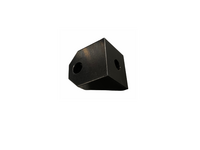
ACES Systems 69-100-0075 - 991D-1 Accelerometer Vibration Sensor, 20mV/g


Create yours now for free.

Need a Quote?
The ACES Systems 69-100-0075 is a 991D-1 Accelerometer Vibration Sensor with a sensitivity of 20mV/g.
| General Information | |
|---|---|
| Part # | 69-100-0075 |
| Manufacturer | Aces Systems |
| Shipping Information | |
|---|---|
| Product Weight | 0.08 lbs. |
| Product Dimensions | 2 x 0.5 x 0.5 in. |
| Schedule B | 9031100000 |
| ECCN | 9B990 |
Customers also viewed
Customers who bought this item also purchased

AIRCRAFT COMPATIBILITY
| Compatible Aircraft* |
|---|
PRODUCT REVIEWS
This item does not have any reviews yet.
QUESTIONS & ANSWERS
The ACES Systems 991D-1 Accelerometer Vibration Sensor is designed to measure and monitor aircraft vibration levels during maintenance and balancing operations. It provides highly accurate vibration readings that help technicians diagnose rotor imbalance, bearing issues, and other dynamic mechanical problems. Its 20mV/g sensitivity ensures precision in both low-frequency and high-frequency vibration analysis for aircraft engines and rotors.
This vibration sensor is compatible with ACES Systems analyzers, including the 2020HR, Z4041 Viper II, and 4041E Viper 2E models. It is frequently used with the ACES Gen II analyzers as part of the MORE program for PT6A turboprop engines. These systems allow real-time vibration monitoring, frequency analysis, and data recording for maintenance diagnostics.
The 20mV/g sensitivity rating indicates the output voltage per unit of acceleration (gravity). This means that for each “g” of acceleration detected, the sensor produces a 20-millivolt signal. Such sensitivity enables detailed vibration pattern recognition and helps maintenance teams detect early signs of imbalance or mechanical degradation.
By providing fast and precise vibration readings, the ACES Systems 991D-1 sensor enables maintenance teams to quickly identify issues such as rotor imbalance, misalignment, or bearing wear. This reduces troubleshooting time and supports predictive maintenance practices. Integrating this sensor into regular inspections helps prevent costly downtime and ensures smoother engine performance.
Yes. The 991D-1 sensor is approved for use under the MORE Company Service Bulletin 104 as an alternative to older Chadwick-Helmuth analyzers for vibration sensing. It works seamlessly with the ACES Gen II system and high-frequency brackets, providing enhanced accuracy in vibration measurement for PT6A turboprop engines.
Unlike older analog models, the 991D-1 sensor offers superior frequency range, accuracy, and signal stability. It supports linear frequency measurement and integrates with digital ACES Systems analyzers for simplified data interpretation. This modern sensor provides faster and more consistent readings, reducing maintenance errors associated with manual vibration tracking.
Yes. The Federal Aviation Administration (FAA) has reviewed and approved the use of the ACES Gen II vibration analysis system – which includes the 991D-1 sensor – as a functionally equivalent substitute for the Chadwick-Helmuth 192A system under MORE STCs for PT6A engines.
Vibration data collected from the 991D-1 is transmitted to compatible ACES analyzers, where it is processed into vibration frequency and amplitude readings. The data can then be exported as an ACES MORE Report for trend monitoring, maintenance recordkeeping, and FAA compliance documentation.
The 991D-1 accelerometer is typically installed using high-frequency brackets, such as part number 22-430-0057. Alternative bracket options, including 22-430-0056, are also compatible and ensure secure mounting for accurate vibration detection during engine operation.
Yes. To maintain precision, the 991D-1 vibration sensor should be periodically calibrated in accordance with manufacturer recommendations or during scheduled equipment calibration intervals. Regular calibration ensures accurate readings and compliance with FAA and OEM maintenance standards.
The ACES Systems 991D-1 is designed to withstand harsh aviation environments, including wide temperature ranges, vibration, and exposure to humidity. Its ruggedized design ensures reliable performance in field operations, whether mounted near engines or rotating assemblies during dynamic balancing.
By continuously monitoring vibration signatures, the 991D-1 accelerometer enables early detection of abnormalities such as bearing wear, misalignment, or imbalance. Maintenance teams can act on these signals before failures occur, thereby reducing repair costs and extending the service life of components.
Beyond PT6A engine maintenance, this sensor is used for rotor balancing, engine vibration surveys, and airframe vibration diagnostics. It supports both fixed-wing and rotorcraft applications, making it a versatile component in aviation maintenance programs.


