





Create yours now for free.

Need a Quote?
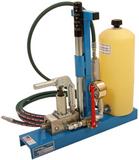
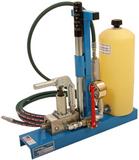
The Tronair 02-7832C0110 is a 12-Ton (24,000 lb) hydraulic aircraft axle jack engineered to lift and support one wheel/tire assembly of an aircraft at the axle during maintenance, tire changes, and landing gear servicing. With a 4" (10.2 cm) closed height and 11" (27.9 cm) maximum extended height, it accommodates a range of aircraft axle clearance requirements. CE-marked for compliance with European aviation safety standards. OEM-specified for BAe Jetstream 41.
Standard Features
- Hand pump with built-in pressure relief valve
- Easy-access filler/breather cap that can be sealed to prevent spills
- Low-profile cylinder designed for minimal axle clearance requirements
- Hydraulic fluid: MIL-PRF-5606
- CE marked
- Durable powder-coat finish (Tronair Blue)
Technical Specifications
- Rated Capacity: 24,000 lbs (10886 kg)
- Operating Temperature: −4°F to 122°F (−20°C to 50°C)
- Pressure Relief Setting: 2,500 + 250/−0 PSIG (172.4 + 17.2/−0 bar)
- Minimum Closed Height: 4" (10.2 cm)
- Maximum Height Obtainable: 11" (27.9 cm)
- Hydraulic Fluid: MIL-PRF-5606
- Jack Pad: ¾" (2 cm) spherical radius cup
- Finish: Durable powder coat (Tronair Blue)
Safety Features
- Safety Lock Valve: Prevents the jack from lowering unintentionally during lifting operations. The jack must be manually released before descending.
- Pressure Relief Valve: Prevents overload during raising operations.
- Filler Cap Seal: Easy-access filler/breather cap can be sealed to prevent hydraulic fluid spills during transport and storage.
Aircraft Applications
The 02-7832C0110 is OEM-approved for the following aircraft types:
- BAe: Jetstream 41
This list reflects aircraft for which the manufacturer has specifically approved this jack. Additional applications may be possible — always confirm jacking capacity, adapter requirements, and placement procedures with the aircraft maintenance manual before use.
Need your Tronair 02-7832C0110 12-ton axle jack serviced, repaired, or load tested?
Pilot John is an authorized Tronair distributor and factory-authorized Tronair service center. Every jack ships new from our warehouse with Certificates of Conformance (CofC) and FAA Form 8130-3 documentation available at no additional cost. Need jack service, load-testing, or repair? Pilot John handles that too as an OEM-trained GSE service center. For more information or to request service, see our Service Center page, and see our article on why jack load testing matters. Pilot John also operates an ISO-17025 calibration center for all of your tooling and equipment calibration needs — learn more here.
| General Information | |
|---|---|
| Part # | 02-7832C0110 |
| Manufacturer | Tronair |
| Shipping Information | |
|---|---|
| Shipping Weight | 44 lbs. |
| Shipping Dimensions | 26.5 x 12.5 x 11 in. |
| Schedule B | 8425420000 |
| ECCN | EAR99 |
Customers also viewed

Customers who bought this item also purchased
AIRCRAFT COMPATIBILITY
| Compatible Aircraft* | |
|---|---|
| BAe | Jetstream 41 |
PRODUCT REVIEWS
This item does not have any reviews yet.
QUESTIONS & ANSWERS
A compact axle jack design allows technicians to position the unit easily in tight spaces around landing gear assemblies. This is especially beneficial for aircraft like the BAe Jetstream 41, where clearance around jacking points can be limited. The smaller footprint improves maneuverability in hangars and on the ramp. It also helps reduce setup time during routine aircraft maintenance.
A low closed height enables the axle jack to fit under aircraft with minimal ground clearance without requiring additional lifting tools. This makes it easier to position the jack correctly at the designated lift point. It also reduces the need for unsafe adjustments or improvised setups. Improved accessibility contributes to safer and more efficient maintenance operations.
Spacer blocks allow technicians to adjust the jack's effective height to better match different aircraft configurations. This flexibility ensures proper alignment with the aircraft jacking point, a critical factor for safe lifting. They also help reduce the hydraulic extension required during operation. This can improve efficiency and provide more controlled lifting.
Correct alignment between the jack pad and the aircraft lift point is essential for stable lifting. Misalignment can lead to uneven load distribution or slippage during operation. Ensuring proper positioning helps protect both the aircraft structure and the equipment. Accurate alignment is a key factor in safe and reliable aircraft maintenance.
Clean and properly filled MIL-PRF-5606 hydraulic fluid ensures smooth operation and consistent lifting performance. Contaminated or low fluid levels can cause erratic movement or reduced lifting capacity. Regular fluid checks and replacement help maintain system efficiency. Proper hydraulic maintenance also extends the life of internal components.
Routine maintenance includes inspecting seals, checking for leaks, and ensuring all components are securely fastened. Replacing worn O-rings and keeping the hydraulic system clean helps prevent performance issues. Periodic inspections can identify problems early before they lead to failure. These practices help maintain long-term reliability in aviation maintenance environments.
The pressure relief valve protects the axle jack from being overloaded by limiting the maximum hydraulic pressure. This helps prevent damage to the jack and reduces the risk of sudden failure during lifting. It also ensures a more consistent, controlled operation. Built-in pressure protection is essential for maintaining safe working conditions.
Using the axle jack on a hard, level surface ensures proper load distribution and prevents instability. Uneven surfaces can cause the jack to shift or tilt under load, increasing the risk of accidents. Stable positioning is critical when lifting heavy aircraft components. This simple precaution significantly improves safety during maintenance tasks.
Regular inspection helps ensure that the axle jack is functioning correctly before each use. Checking for fluid leaks, damaged components, or loose fittings can prevent unexpected issues during operation. Consistent inspections support safe and efficient performance. They also help maintain compliance with aviation maintenance best practices.


