





In-Flight Lithium-Ion Battery Fires: Risks, Causes, & Containment Solutions
Key Takeaways
- Lithium-ion battery fires typically start with an internal short circuit triggered by physical damage, manufacturing defects, aging, or overcharging – and can escalate into thermal runaway, a self-sustaining chain reaction that continues generating heat even after visible flames are extinguished.
- FAA and ICAO guidance recommend keeping lithium-powered devices in the cabin rather than cargo holds, where a fire can go undetected. In the cabin, crews can intervene quickly – extinguish flames, cool the device with water, and isolate it in a fire containment bag.
- Fire containment bags are the most effective in-cabin tool for lithium-ion battery fires because they isolate the device, contain toxic smoke, molten material, and gases, and allow the thermal runaway reaction to burn out safely without releasing hazards into the cabin.
- HOT-STOP® 'L' bags are FAA burn-certified, contain 100% of toxic emissions, have no shelf-life limitations, and are sized for specific devices – phones, tablets, laptops, oversized EFBs, portable ELTs, and e-cigarettes – making it practical to equip an aircraft for the full range of PED risks.
- Crew training is essential. Knowing the early warning signs of thermal runaway – unusual odors, hissing, device swelling – and practicing bag deployment builds the muscle memory needed for a fast, coordinated response under pressure.
- PJi supplies the complete HOT-STOP® 'L' fire containment bag lineup, along with expert guidance on building the right aircraft fire containment kit for any fleet type or mission profile.
Lithium-ion batteries have transformed how we travel, work, and stay connected – but they’ve also introduced a new class of in-flight risk. Incidents involving smoking phones, laptops, and power banks in the cabin are being reported more frequently across commercial, business, and charter aviation.
When a lithium-ion battery fire occurs at altitude, crews are dealing not just with flames, but with toxic smoke, molten metal, and the potential for reignition long after the initial event. In that environment, robust fire containment and clear procedures are absolutely critical.
In this article, we’ll look at why lithium-ion battery fires happen, how they behave in aircraft, and how purpose-built fire containment bags for aircraft help keep crews and passengers safe.
Why Do Lithium-Ion Batteries Catch Fire?
A lithium-ion battery fire typically starts with an internal failure. Damage, manufacturing defects, contamination, or aging components can cause an internal short circuit between the battery’s positive and negative layers. That short generates heat, which can break down the separator and trigger a chain reaction inside the cell. External factors – such as crushed devices in seat mechanisms, improper chargers, or exposure to high temperatures – can also initiate the failure.
Once a cell overheats, it can vent flammable electrolyte and gases, which are easily ignited by nearby components or even by the hot cell itself. FAA testing on 18650 cells and other formats has shown that a relatively small ignition source can drive a cell to vent violently and feed a rapidly growing fire. In cargo compartments, a bulk-packed battery fire can increase pressure and challenge traditional halon-based suppression systems, which is one reason regulators strongly prefer personal electronic devices (PEDs) to remain in the cabin, where crews can intervene quickly.

What Is Thermal Runaway, and Why Does It Occur?
Thermal runaway is the self-feeding reaction at the heart of most lithium-ion battery fires. As a cell overheats – due to an internal short, overcharging, or exposure to external heat – its internal components begin to break down, releasing even more heat. That heat raises the cell temperature further, causing more decomposition, more gas generation, and eventually venting, flame, and sometimes small explosions.
In a multi-cell pack (like a laptop battery or power bank), one failing cell can heat its neighbors, triggering a domino effect from cell to cell. This is why lithium-ion battery fires can appear to “come back to life” after visible flames are knocked down – the internal reaction may still be progressing.
Lithium-ion battery fire suppression is challenging because traditional fire extinguishers only address surface flames; they don’t necessarily halt the thermal runaway within the pack. A sealed aircraft fire containment bag helps by isolating the device, limiting oxygen, and capturing toxic smoke and molten material while the reaction burns itself out.
What Types of Devices Increase Lithium-Ion Battery Fire Risk in Aircraft?
Nearly every passenger and crew member brings multiple lithium-powered devices onboard. Laptops, tablets, iPads, smartphones, and e-readers are prominent examples, but flight operations must also consider e-cigarettes and vapes, portable ELTs, cameras, wireless headsets, and high-capacity power banks. Each contains one or more lithium-ion cells that can fail under the right conditions.
Regulators such as the FAA, EASA, and IATA recommend that most lithium-powered devices and spare batteries be carried in the cabin rather than in checked baggage. The reasoning is straightforward: in the cabin, an overheating phone or laptop can be spotted quickly, cooled, and placed into an aviation fire containment bag.
In the cargo hold, the same event may go undetected until it has grown into a much more serious hazard. For operators, that reality makes having suitable aircraft fire containment bags – sized for phones, tablets, laptops, portable ELTs, and other high-energy devices – a core part of lithium-ion battery fire safety.
What Should Be Done If a Lithium-Ion Battery Catches Fire Inside an Aircraft?
When a device starts smoking or burning in the cabin, crews must act quickly and methodically. Current FAA and ICAO guidance is clear: first, use a standard extinguishing agent (typically a halon or halon replacement extinguisher) to extinguish any visible flames. Once the flames are out, the priority shifts to cooling the device with plenty of non-alcoholic liquid – usually water or a non-sugary drink – to reduce the risk of reignition from the lithium-ion battery fire.
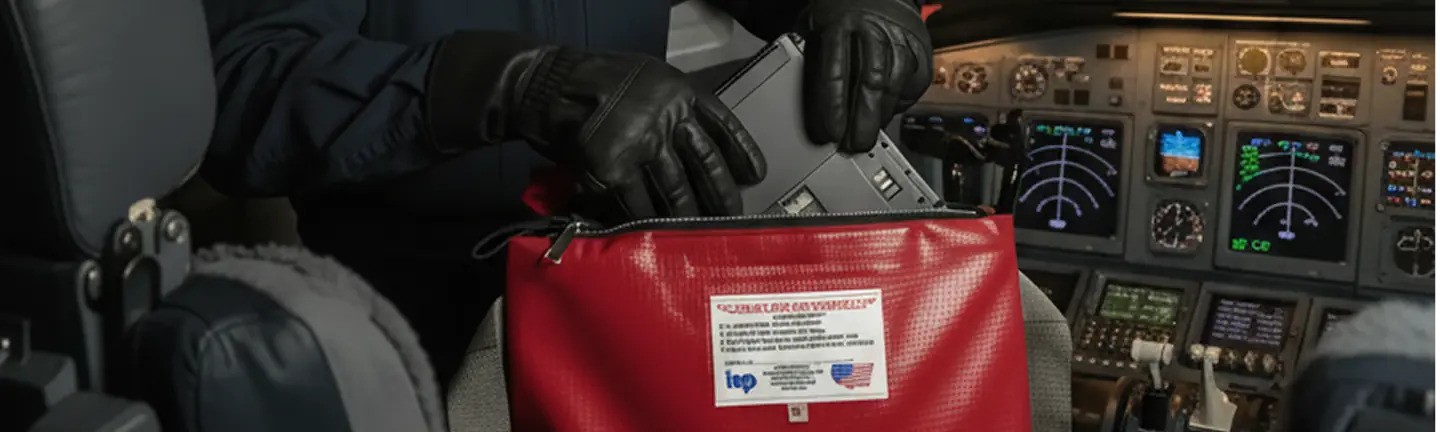
When it is safe to do so, crews should place the device in an aviation fire containment bag, designed specifically for lithium battery incidents. A dedicated fire containment kit helps trap toxic smoke, molten metal, and debris while the internal cells continue to react. The bag should remain sealed and monitored for the remainder of the flight in case of renewed smoke, heat, or odor. Throughout the event, effective communication with the cockpit, coordination with the cabin crew, and clear instructions to passengers are essential to maintaining control of the situation.
How Can Operators Mitigate Lithium-Ion Battery Fire Risk In-Flight?
Reducing the risk of lithium-ion battery fires starts long before a device overheats. Operators can implement clear policies for PED use and charging, including restrictions on e-cigarettes and guidelines for the placement of laptops and tablets during takeoff, landing, and sleep. Crew procedures should emphasize safe stowage to avoid crushing devices in seat mechanisms or galley carts, as many in-flight incidents begin with physical damage rather than a pure battery defect.
On the equipment side, having an aircraft lithium-ion battery fire suppression system strategy – including stocking the cabin with purpose-built fire containment bags – is critical. Many operators standardize on a mix of smartphone fire containment bags, tablet fire containment bags, laptop fire containment bags, and an ELT fire containment bag to cover the most likely sources of ignition.
Regular tabletop drills, updated emergency checklists, and coordination with safety management systems (SMS) help ensure crews can respond quickly and consistently. Finally, ongoing risk assessments – especially as new high-energy devices enter service – keep the operator’s fire containment posture aligned with real-world threats.

Why Is Crew Training Critical for Lithium-Ion Battery Fire Safety?
Even the best fire containment equipment is only effective if crews know how and when to use it. Training should cover early warning signs of a lithium-ion battery fire, including unusual odors, hissing sounds, popping, or visible swelling of a device. Cabin and flight crews must understand the difference between simple overheating (which might be resolved by unplugging and cooling) and a true thermal runaway event that demands a full emergency response.
Effective training also familiarizes crews with the specific steps for the lithium-ion battery fire suppression system used by their operation. This includes selecting the correct fire extinguisher, employing proper cooling techniques, utilizing fire containment bags, and minimizing exposure to toxic smoke in the event of an aircraft cabin fire.
Hands-on practice deploying a lithium-ion battery fire containment bag – including donning gloves, placing the device, sealing the bag, and stowing it – builds muscle memory for high-stress situations. The goal is a coordinated, repeatable response that protects passengers, crew, and the aircraft with minimal hesitation.
What Should Passengers Understand About Lithium-Ion Battery Fire Safety?
Passengers play a crucial role in lithium-ion battery fire safety, even if they never come into contact with a fire containment bag. Airlines and business aviation operators should clearly communicate rules on carrying spare batteries, power banks, and e-cigarettes – typically only in carry-on baggage, with terminals protected from short circuits. Travelers should avoid packing lithium batteries in checked bags and should never crush, puncture, or wedge devices into tight spaces where they can overheat.
It is equally vital that passengers recognize the warning signs of a failing battery and promptly alert the cabin crew if a device becomes unusually hot, smokes, or emits a strong chemical odor. Educating passengers to use only certified chargers and to stop using damaged devices reduces the likelihood of problems in the first place. This shared awareness between crew and passengers strengthens the overall lithium-ion battery fire safety posture onboard.
What Is the Most Effective Solution for Containing Lithium-Ion Battery Fires in Aircraft?
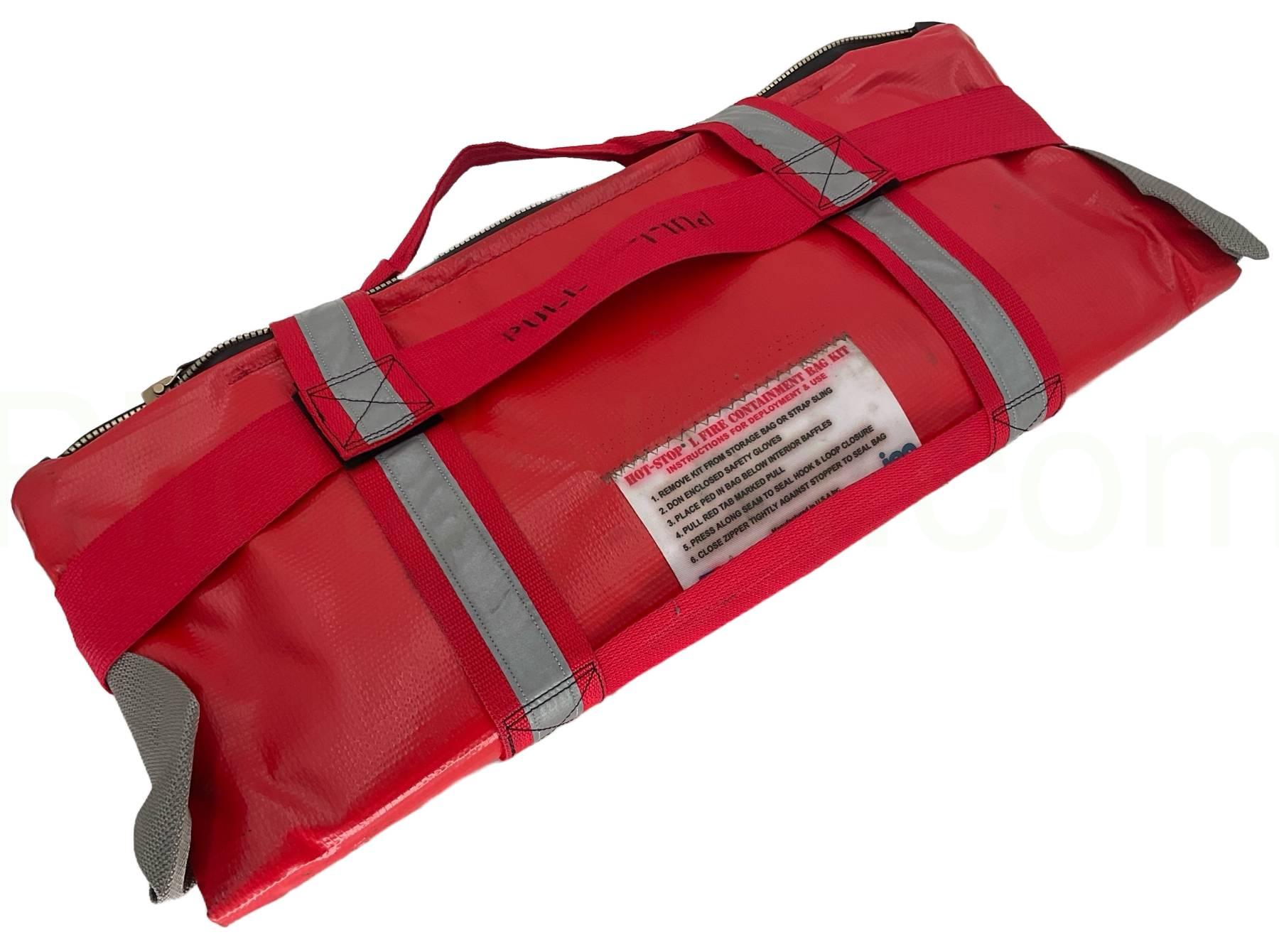
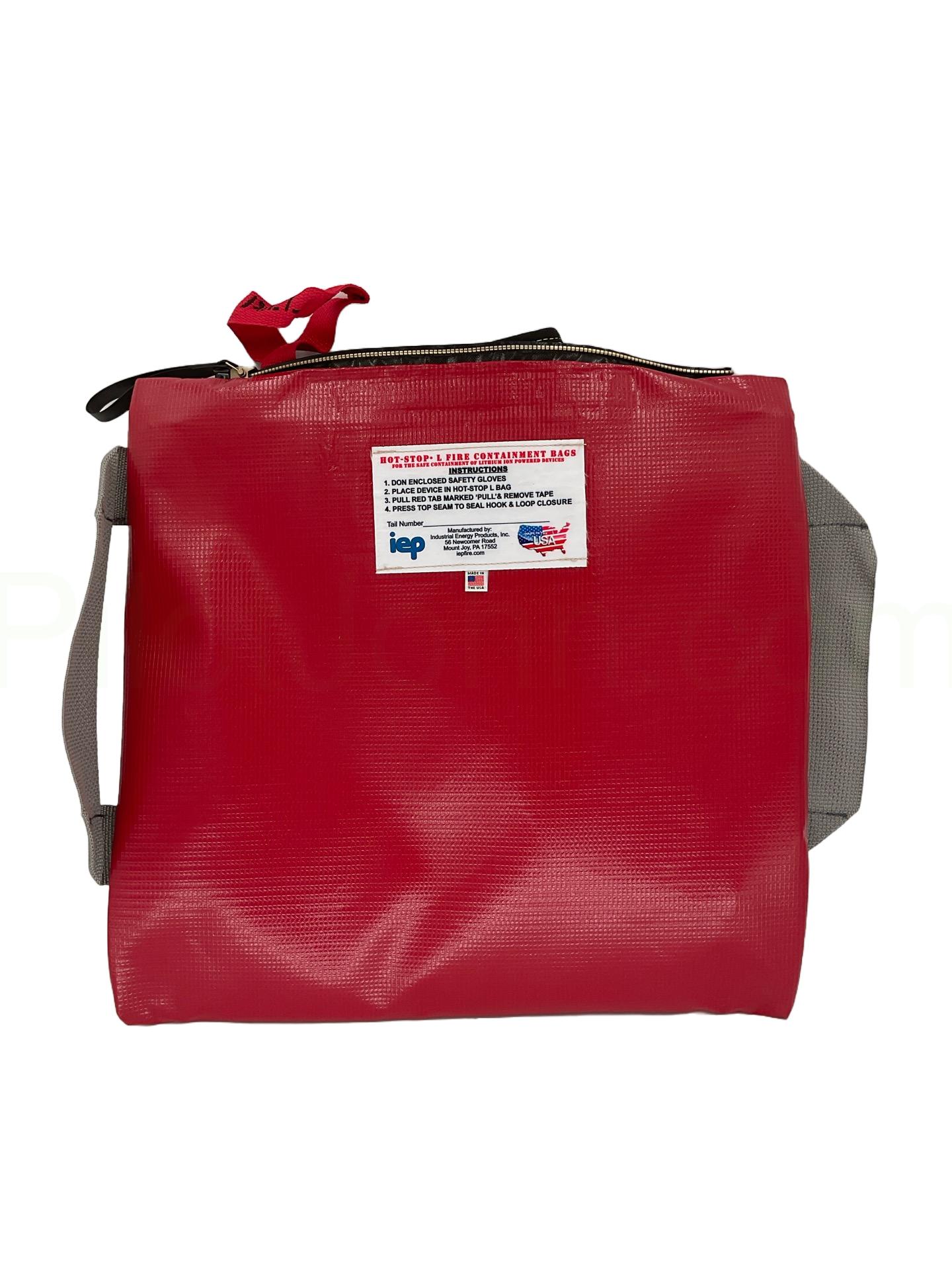
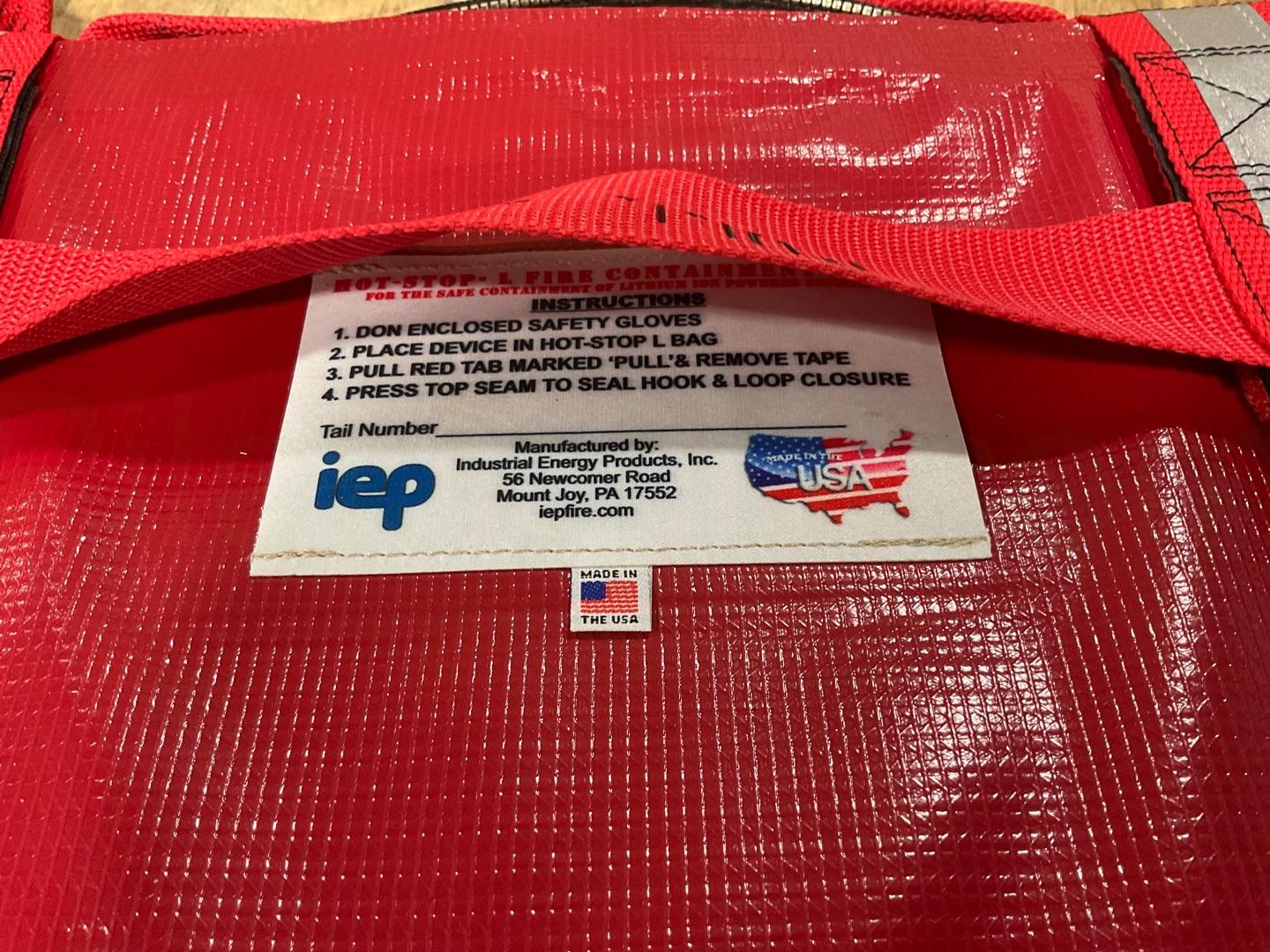
Once a device has entered thermal runaway, the most effective in-cabin solution is to isolate it in a sealed, fire-rated container designed for lithium-ion battery fires. HOT-STOP® ‘L’ fire containment bags are a leading example of this approach. Manufactured by Industrial Energy Products, these aviation fire containment bags use a fireproof vessel tested to FAA standards to contain 100% of toxic smoke, gases, fire, molten metal, and explosive shrapnel from a lithium-ion battery fire. Unlike systems that rely on venting, HOT-STOP® ‘L’ fire containment bags are designed to keep hazardous emissions inside the bag rather than releasing them into the cabin.
Each HOT-STOP® ‘L’ fire containment bag can be deployed in six quick steps and does not require water to function. However, crews may still add water, as per FAA SAFO guidance, if desired. HOT-STOP® ‘L’ products feature zero toxic smoke emissions, no shelf-life limitations, and minimal maintenance – typically just visual inspections and occasional zipper lubrication – making them a practical, long-term solution for operators. Their design supports use as a phone fire containment bag, a laptop fire containment bag, a tablet fire containment bag, or a portable ELT fire containment bag, depending on the model selected. For operators seeking a proven lithium-ion battery fire suppression solution, HOT-STOP® ‘L’ fire containment bags and aircraft fire containment kits offer a robust, field-tested solution.
Where Can Operators Find Reliable Aviation-Grade Fire Containment Bags?
Although the FAA does not mandate the use of fire containment bags on all aircraft, many operators across commercial airlines, business aviation, and helicopter fleets have adopted them voluntarily as part of their in-flight lithium-ion battery fire safety protocols. Trusted by tens of thousands of aircraft worldwide, HOT-STOP® ‘L’ fire containment bags offer 100% containment, FAA burn-certified construction, and a lifetime replacement warranty for aviation customers if a bag is deployed during a lithium-ion battery fire event (with proper incident documentation). The full line of HOT-STOP® ‘L’ fire containment bags is available through Pilot John International® (PJi®), along with additional aviation safety equipment to support a complete aircraft fire containment strategy.
Below are some of the key HOT-STOP ‘L’ models operators can source from PJi:
HOT-STOP® 'L' Fire Containment Bag for Portable ELTs
Designed as a dedicated portable ELT fire containment bag, this model provides a secure vessel for portable emergency locator transmitters that use high-energy lithium batteries. It helps ensure that an ELT battery malfunction does not escalate into an aircraft cabin fire, particularly in business jets and rotorcraft that rely on portable ELTs.
HOT-STOP® ‘L’ Fire Containment Bag for Helicopters
This helicopter fire containment bag is specifically designed for the confined cabin spaces and operational realities of rotorcraft. Its compact, flexible design makes it easier for helicopter crews to deploy quickly and stow within arm’s reach, helping manage lithium-ion battery fires in tight, high-workload environments.
HOT-STOP® ‘L’ Fire Containment Bag for iPads/Tablets
Optimized as an iPad fire containment bag, this model is sized for standard tablets commonly used as electronic flight bags (EFBs) and passenger devices. It allows crews to quickly isolate a smoking or overheating tablet without searching for an oversized solution.
HOT-STOP® ‘L’ Fire Containment Bag for Oversized Tablets
For larger devices, HOT-STOP® ‘L’ offers a model specifically designed for oversized tablets and specialty displays. This bag provides the same lithium-ion fire containment performance as the standard tablet version, with additional interior space for bulky EFBs or ruggedized tablets.
HOT-STOP® ‘L’ Fire Containment Bag for Laptops
Engineered as a laptop fire containment bag, this model is sized to handle typical business and personal laptops carried by passengers and crew. It is ideal for managing high-energy lithium-ion battery fires originating from workstations, EFB laptops, or passenger computers.
HOT-STOP® ‘L’ Fire Containment Bag for Smartphones & E-Cigarettes
This compact smartphone and e-cigarette fire containment bag is designed for smaller devices that can still pose significant hazards when batteries fail. It gives crews a convenient, quick-access option for the most common PEDs in the cabin, including phones, vapes, and small power banks.
HOT-STOP® ‘L’ Fire Containment Bag for Large Laptops, Chargers, & Other Electronics
For operators seeking maximum flexibility, this larger HOT-STOP® ‘L’ fire containment bag accommodates big laptops, external chargers, and other high-energy electronics. It is particularly useful as part of an aircraft lithium-ion battery fire containment kit for business jets and VIP aircraft, which often feature a wide variety of passenger devices.
The Bottom Line
In-flight lithium-ion battery fires are a growing operational concern, but they are not an unsolvable problem. By understanding how lithium-ion battery fires start, training crews to respond appropriately, and equipping aircraft with proven fire containment solutions, operators can dramatically reduce the risk of a serious aircraft cabin fire. Aviation fire containment bags provide a critical final layer of defense when prevention and monitoring are insufficient.
PJi proudly supplies the complete HOT-STOP® ‘L’ line of fire containment bags, along with additional aviation safety equipment designed to protect crews, passengers, and aircraft during lithium-ion battery emergencies. Whether you operate a single business jet, a mixed fleet, or a large commercial operation, we can help you create the optimal mix of aircraft fire containment kits for your mission profile.
Contact our aviation specialists today by phone, email, or live chat for expert guidance on selecting the right fire containment equipment for your operation.