






KUNZ 230.6100 – TTS Safety Tire Inflation Cage (55/27 AC)


Create yours now for free.

Need a Quote?
The KUNZ 230.6100 TTS Safety Tire Inflation Cage (55/27 AC) is specially designed for the safe inflation and deflation of aircraft tires and can easily withstand tire bursts. This ergonomic, time-saving solution is designed to inflate tires autonomously, eliminating the need for constant supervision of the inflation process. This powerful unit is capable of filling and deflating aircraft tires up to the size of the Airbus A320's main landing gear.
The Tire Test System (TTS) Safety Inflation Cage is uniquely constructed of patented air blast refraction frames. Two frames of stretch metal are welded accurately together so that the shock wave is reduced to just 10% to 15% of its original power. The air blast refraction frame design allows the operator to inspect the tire completely before it is rolled out of the cage.
The front door of the cage can be locked after the wheel has been placed inside. For convenient connection of the outlets, a sliding door is equipped at the side of the cage, and the tire can be rotated on rollers to bring it into position. Full plate frames reinforce the center of the cage to protect the operator from flying nuts and bolts in the event that a rim should split. After testing, the tire can be pushed out easily by means of a foot pedal.
Available Option – Sold Separately
Please request at the time of quote to add on to your TTS Safety Inflation Cage.
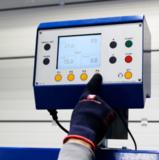
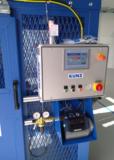
The Automatic Tire Inflator (ATI) can be installed on top or at the side of the tire cage and is controlled via touch buttons on the front panel.
Technical Specifications
- Outer Dimensions: 61" x 35" x 71" (152.8 x 87.3 x 178 cm)
- Inner Dimensions: 55" x 27" x 56" (140 x 70 x 144.5 cm)
- Weight: 948 lbs. (430 kg)
- Air Connection: 1/4” thread, Dry Air/Nitrogen
- Electrical Supply: 100V, 115V, 230V, 1-phase, 50/60 Hz, or as per specifications (at additional costs)
| General Information | |
|---|---|
| Part # | 230.6100 |
| Manufacturer | KUNZ |
| Shipping Information | |
|---|---|
| Shipping Weight | 900 lbs. |
| Shipping Dimensions | 62 x 35 x 70 in. |
Customers also viewed
Customers who bought this item also purchased

AIRCRAFT COMPATIBILITY
| Compatible Aircraft* | |
|---|---|
| Bombardier | Challenger 300 , Challenger 600 , Global 5000 , Global 6000 , Global 7500 , Learjet 45 , Learjet 60 |
PRODUCT REVIEWS
This item does not have any reviews yet.
QUESTIONS & ANSWERS
The KUNZ TTS Safety Tire Inflation Cage is designed to safely contain aircraft tires during high-pressure inflation and testing. Its robust steel enclosure minimizes the risk of injury or damage in the event of a tire failure, making it a critical safety tool in aircraft wheel and brake shops, where inflation pressures can reach dangerous levels.
The cage’s rigid construction provides a controlled environment that shields personnel from potential tire blowouts or explosive decompression events. It includes a secure clamping system and pressure monitoring interface, helping reduce the need for hands-on interaction during critical pressure changes. The design ensures maximum safety compliance with aviation maintenance standards.
Yes, the KUNZ TTS is engineered to accommodate a wide range of tire sizes from all major aircraft tire OEMs. This versatility makes it suitable for use across fleets with mixed aircraft types, including commercial, business, and military aviation applications.
The unit typically integrates with an external inflation system that regulates and monitors the pressure applied to the tire. This setup ensures precise inflation to OEM specifications and enables safe test cycles without overinflating. Many MROs pair the TTS with electronic control systems for even greater accuracy.
While specific configurations may vary, most installations of the TTS feature integrated safety deflation valves or ports. These enable quick pressure relief in case of an overpressure event and support safe deflation procedures after testing. When configuring these systems, it’s essential to follow OEM and KUNZ guidelines.
The tire is clamped or centered using robust fixtures that prevent movement during inflation. These securement systems are adjustable to suit different wheel diameters and are designed to keep the tire in optimal position, minimizing vibration and shifting.
Absolutely! The unit is suitable for use during initial tire installation to verify correct pressure and sealing, as well as for routine testing or re-certification after maintenance. This dual functionality makes it a valuable asset in both assembly and inspection workflows.
Routine inspections should include checking structural integrity, verifying the condition of pressure fittings and valves, and cleaning any debris or rubber particles. Periodic functional testing of pressure sensors and safety valves is also recommended to ensure consistent performance over time.
KUNZ aircraft maintenance equipment, including the TTS, is engineered to reduce technician workload and improve throughput without compromising safety. The system’s fast setup and compatibility with adjacent KUNZ tooling help streamline the tire service process, particularly in high-volume shops.
The TTS is used in airline maintenance facilities, MROs, OEM workshops, and military aviation depots. It supports both line maintenance and heavy maintenance operations, especially where safety compliance and equipment standardization are priorities.
Yes! This unit is often deployed alongside other KUNZ wheel and brake equipment, such as bead breakers, torque tools, and universal assembly stands. This modular compatibility ensures an efficient and cohesive workflow in comprehensive wheel and brake shops.
Yes, the KUNZ 230.6100 TTS Safety Tire Inflation Cage is certified for use up to 24 bar (approximately 348 psi) by the German Social Accident Insurance (DGUV) as of 2019. This certification verifies that the cage meets strict safety standards for high-pressure aircraft tire inflation. A copy of the official certificate is included with every unit at the time of purchase, giving operators added confidence in both compliance and performance.


