






Create yours now for free.

Need a Quote?
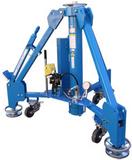
The Tronair 02A7949C0100 is a 15-Ton (30,000 lb) hydraulic aircraft tripod jack engineered to lift aircraft from the forward fuselage or main wing jacking points during maintenance, inspections, and ground operations. CE-marked for compliance with European aviation safety standards. OEM-specified for Bombardier Global 7000, Global 8000, Global 7500.
Standard Features
- Hand pump with built-in pressure relief valve
- Threaded rams with improved handwheel-style safety nut
- Quick-rising center extension for rapid initial lift
- Easy-access filler/breather cap
- Heavy-duty wheels for easy maneuverability
- Hydraulic fluid: MIL-PRF-5606
- ¾" (2 cm) spherical radius cup jack pad
- CE marked
- Durable powder-coat finish (Tronair Blue)
Technical Specifications
- Rated Capacity: 30,000 lbs (13608 kg)
- Operating Temperature: −4°F to 122°F (−20°C to 50°C)
- Pressure Relief Setting: 2,500 + 250/−0 PSIG (172.4 + 17.2/−0 bar)
- Hydraulic Fluid: MIL-PRF-5606
- Jack Pad: ¾" (2 cm) spherical radius cup
- Finish: Durable powder coat (Tronair Blue)
Safety Features
- Ram Lock Nut: Prevents the lowering of the ram. The ram lock nut must be lowered as the aircraft is being lifted. Ram lock nuts must be kept within 2" of the stop while raising the aircraft.
- Lock Nut Retention Ring: Prevents the lock nut from being unscrewed from the second stage.
- Pressure Relief Valve: Prevents overload during raising operations.
Aircraft Applications
The 02A7949C0100 is OEM-approved for the following aircraft types:
- Bombardier: Global 7000, Global 8000, Global 7500
This list reflects aircraft for which the manufacturer has specifically approved this jack. Additional applications may be possible — always confirm jacking capacity, adapter requirements, and placement procedures with the aircraft maintenance manual before use.
Need your Tronair 02A7949C0100 15-ton tripod jack serviced, repaired, or load tested?
Pilot John is an authorized Tronair distributor and factory-authorized Tronair service center. Every jack ships new from our warehouse with Certificates of Conformance (CofC) and FAA Form 8130-3 documentation available at no additional cost. Need jack service, load-testing, or repair? Pilot John handles that too as an OEM-trained GSE service center. For more information or to request service, see our Service Center page, and see our article on why jack load testing matters. Pilot John also operates an ISO-17025 calibration center for all of your tooling and equipment calibration needs — learn more here.
| General Information | |
|---|---|
| Part # | 02A7949C0100 |
| Manufacturer | Tronair |
| Manual 1 | View Tronair 02A7949C0100 Parts, Service, and Operation Manual |
| Shipping Information | |
|---|---|
| Shipping Weight | 1304 lbs. |
| Shipping Dimensions | 71 x 80 x 53 in. |
| Freight NMFC | 186600 |
| Schedule B | 8425420000 |
| ECCN | EAR99 |
| Spare Parts | |
|---|---|
| G-1100-105016 | Bolt, Hex Head Grade 5, ¼ - 20 x 1 ¾ Long |
| G-1100-105510 | Bolt HH, GR 5, ¼ - 28 |
| G-1100-106512 | Bolt, Hex Head Grade 5, 5/16 – 24 x 1 ¼ Long |
| G-1100-107010 | Bolt, Hex Head Grade 5, ⅜ - 16 x 1 Long |
| G-1100-107012 | Bolt, Hex Head Grade 5, ⅜ - 16 x 1 ¼ Long |
| G-1100-107014 | Bolt, Hex Head Grade 5, ⅜ - 16 x 1 ½ Long |
| G-1100-107044 | Bolt, Hex Head Grade 5, ⅜ - 16 x 4 ½ long |
| G-1100-109032 | Bolt, Hex Head Grade 5, ½ - 13 x 3 ¼ Long |
| G-1100-109036 | Bolt, Hex Head Grade 5, ½ - 13 x 3 ¾ Long |
| G-1100-109050 | Bolt, Hex Head Grade 5, 5 long |
| G-1151-103203 | Screw, #10 – 24 x ⅜ SHCS |
| G-1151-105006 | Screw, Hex Socket Head Cap, ¼ - 20 x ¾ Long |
| G-1151-105206 | Screw, ¼-20 x ¾ LG |
| G-1200-1075 | Nut, ⅜ - 20 Hex |
| G-1202-1065 | Stopnut, 5/16 - 24 Elastic |
| G-1202-1070 | Stopnut, ⅜ - 16 Elastic |
| G-1202-1090 | Stopnut, ½ - 13 Elastic |
| G-1250-1050N | Flatwasher, ¼ Narrow |
| G-1250-1060N | Flatwasher, 5/16 Narrow |
| G-1250-1070N | Flatwasher, ⅜ Narrow |
| G-1250-1090N | Flatwasher, ½ Narrow |
| G-1300-44160 | Pin, Roll, 7/16 x 1 ¾ Long |
| G-1310-0640 | Pin, Ball Lok-T, ⅜ x 4 |
| G-1318-0623 | Pin, 3/8 x 2.3 Long Model D |
| G-1392-125-S | Ring, External Retaining |
| G-1395-31 | Ring, External Retaining |
| G-1395-52 | Ring, External Retaining |
| G-1395-67 | Ring, External Retaining |
| G-1513-1090W | Flatwasher, ½ Thru Hard Wide |
| H-1009-01 | Assembly, Handle |
| H-1045 | Breather |
| H-1174 | Pump, Air, Haskel |
| H-1516-11 | Clamp, 2 Ear Hose |
| H-2653 | Assembly, Lanyard |
| H-2887 | Nut, 4 ½ Stop |
| H-2888 | Nut, 4 ½ Stop |
| H-3500 | Machining, Plug |
| HC-1963 | Pump, Hydraulic Hand |
| HC-2000-259 | O-Ring, Series 2 Nitrile |
| HC-2000-340 | O-Ring, Series 2 Nitrile |
| HC-2000-354 | O-Ring, Series 2 Nitrile |
| HC-2023-259 | Ring, Parbak |
| HC-2023-340 | Ring, Parbak |
| HC-2023-354 | Ring, Parbak |
| HC-2338 | Gauge, Liquid Level |
| HC-2929 | Gauge, 5000 psi / 17 T Pressure |
| J-3415-01 | Bracket, Air Pump Mounting |
| J-4645 | Pad, Polyethylene |
| J-4646-01 | Bracket |
| J-5990-01 | Bracket, Cylinder Retaining Large |
| J-5991-01 | Bracket, Cylinder Retaining Small |
| J-5995-01 | Plate, Support |
| K-1685 | Kit, Hydraulic Pump Seal |
| K-1686 | Kit, Pneumatic Pump Seal |
| N-2001-08-S-B | Elbow, Straight Thread |
| N-2002-05-S | Elbow, Swivel Nut |
| N-2005-08-S | Elbow, 90º Male, ¼ NPT, JIC 37º Fitting |
| N-2016-05-S | Tee, Run Swivel Nut |
| N-2058-03-S | Adapter, Swivel Nut Pipe |
| N-2410-05 | Elbow, 90º Male, ⅜ Hose x ⅜ NPT |
| N-2453-04 | Tee, Union |
| N-2789-04-S-B | Connector, Male Straight Thread |
| R-1963 | Pad, Jack |
| R-2213-01 | Cap, Bottom |
| R-2223-01 | Post, Jack Handle |
| R-2238 | Pad, Floor |
| R-2240 | Retaining Ring |
| R-2449 | Screw, Adjustment |
| R-2452 | Pin, Leg |
| R-2985 | Extension, Mechanical |
| TF-1043-06-25.0 | Assembly, Hose |
| TF-1043-06*25.0 | Assembly, Hose 25” Long |
| TF-1047-04-03.0 | Hose, ⅜ x 3 Long |
| TF-1047-04-09.0 | Hose, ⅜ x 9 Long |
| TF-1047-04-12.0 | Hose, ⅜ x 12 Long |
| TF-1047-04*03.0 | Hose 3/8 Push-On 3” Long |
| TF-1047-04*06.0 | Hose 3/8 Push-On 6” Long |
| TF-1047-04*12.0 | Hose 3/8 Push-On 12” Long |
| TR-1937 | Guide, 1st Stage Ram |
| TR-1940 | Guide, 2nd Stage Ram |
| TR-2403 | Ram, 1st Stage |
| TR-2405 | Bushing, 1st Stage Ram |
| TR-2406 | Bushing, 2nd Stage Ram |
| TR-2597 | Retainer, Lock Nut |
| TR-2804-01-00 | Cylinder, Machined |
| U-1136 | Caster, Spring Loaded |
| U-1137 | Plate, Swivel Lock |
| V-1001 | Label, Made In USA |
| V-1102 | Label, MIL-PRF-5606 |
| V-1198 | Label, Tronair |
| V-1775 | Label, Pump Force |
| V-1805 | Label, ISO General Danger |
| V-1852 | Label, Max Towing |
| V-2105 | Label, Jacking Instructions |
| V-2118 | Label, Serial Number (CE) |
| Z-4973 | Assembly, Blowgun |
| Z-7150 | Weldment, Adjustment Wheel |
| Z-7154-01 | Assembly, Air Pump |
| Z-7159 | Assembly, Bubble Level |
| Z-7283-01 | Weldment, Towbar |
| Z-8786 | Assembly, Cylinder |
| Z-8795-01 | Weldment, Leg |
| Z-8801-01 | Weldment, Ring |
| Z-8815 | Weldment, 2nd Stage Ram |
| Z-9442-01 | Weldment, Reservoir |
Customers also viewed
Customers who bought this item also purchased

AIRCRAFT COMPATIBILITY
| Compatible Aircraft* | |
|---|---|
| Bombardier |
Global 7000
,
Global 7500
NOTE
This jack is used on the forward fuselage of the aircraft. Control all 3 jacks with air pumps using the optional Manifold Kit (K-1106).
,
Global 8000
NOTE
This jack is used on the forward fuselage of the aircraft. Control all 3 jacks with air pumps using the optional Manifold Kit (K-1106).
|
PRODUCT REVIEWS
This item does not have any reviews yet.
QUESTIONS & ANSWERS
The Tronair 02A7949C0100 tripod jack is designed with multiple mobility features to simplify movement on the hangar floor. Its integrated tow handle and large rear wheels allow a single technician to maneuver the jack without the need for heavy equipment. The front swivel caster improves directional control, especially in tight workspaces. These features enable quick, safe, and efficient repositioning of the jack during aircraft maintenance.
A 15-ton capacity makes this jack suitable for a wide range of business jets, turboprops, and select regional aircraft. The load range supports lifting operations for aircraft with moderate gross weights that do not require heavy-duty 40-ton or 50-ton units. Maintenance shops often use this jack for landing gear work, brake service, tire changes, and routine gear inspections. Always confirm compatibility with your aircraft’s AMM before use.
The jack is engineered with a reinforced tripod structure that evenly distributes weight across three legs, reducing stress concentration and enhancing stability. Its wide stance helps minimize the risk of tipping when raising or lowering aircraft. The jack pad interface and optional extensions help ensure proper contact with OEM-approved jack points. This balanced design is essential for safe maintenance operations.
Yes, Tronair offers extensions designed to increase the effective height of the jack, allowing it to meet various aircraft jacking points. These accessories are commonly required when servicing aircraft with higher ground clearance or those that have unique maintenance procedures. Compatibility depends on the aircraft model and AMM requirements. Using OEM-approved extensions ensures safe and compliant lifting.
The mechanical lock nut provides a redundant safety layer by supporting the aircraft even if hydraulic pressure is lost. Technicians manually engage the lock by threading it down to the cylinder housing after lifting the aircraft. This prevents unintended lowering during extended maintenance operations. The lock design adheres to standard aviation safety practices commonly found in tripod jacks of this class.
Routine maintenance includes inspecting hydraulic seals, checking for fluid leaks, examining wheels and casters, and verifying the condition of the ram and lock nut threads. Lubrication points should be serviced according to Tronair’s recommended schedule. Regular cleaning also helps prevent corrosion or debris buildup around moving parts. Annual inspections are recommended to match typical hangar safety programs.
Yes, the jack is designed for one-person operation under standard maintenance conditions. Features like the tow handle, rear wheels, and smooth hydraulic pump help simplify the lifting process. However, aircraft jacking should always be performed with proper supervision and in accordance with OEM procedures. For major lifting tasks, many maintenance teams prefer two-person verification for safety.
Tronair generally specifies compatible aviation-grade hydraulic fluids that meet industry standards for tripod jacks, such as MIL-PRF-5606 or equivalent. Using the correct fluid ensures smooth jack operation, consistent pump performance, and proper seal compatibility. Always consult the Tronair service manual or decal on the jack for the exact fluid recommendation. Incorrect fluids may reduce service life or cause system damage.
The 02A7949C0100 is designed to operate reliably over a wide range of temperatures; however, hydraulic viscosity increases in cold conditions can impact pump performance. Using approved low-temperature hydraulic fluids helps maintain smooth operation during winter servicing. Technicians may need to manually cycle the pump to warm the fluid before lifting. Proper storage also helps preserve performance in harsh climates.
Technicians should always confirm jack point alignment, ensure the jack is on a level surface, and verify that chocks and restraints are in place. The mechanical lock must be engaged after lifting, especially for prolonged work. Personnel should avoid standing under or near gear doors or suspended loads during lifting operations. Following the aircraft AMM and Tronair manual is critical for safe use.
Many tripod jacks, including this model, feature built-in leveling indicators or bubble vials to assist with setup. The adjustable legs allow fine-tuning to achieve a stable platform. Proper leveling reduces side-loading on the ram and ensures smooth vertical travel. This step is essential when working on uneven hangar floors.
Lift time depends on the aircraft's weight, the required extension height, and the technician’s pump speed. For most mid-size business jets, the lifting process takes only a few minutes once the jack is positioned correctly. High-capacity hydraulic cylinders help reduce pumping effort while maintaining precision and accuracy. Safety checks typically take longer than the lifting motion itself.
Most operators include tripod jacks in their yearly ground support equipment inspections. Many MROs and fleet operators require formal load testing or functional checks per their internal safety programs. Tronair recommends periodic recertification to ensure the hydraulic system, structural components, and safety lock are all functioning correctly. This helps maintain compliance and avoid operational downtime.
The jack should be stored indoors in a clean, dry location to prevent corrosion and protect hydraulic components. Retracting the ram fully reduces exposure to contaminants and moisture. Many hangars store the jack on protective mats or designated GSE areas to avoid tire flat-spotting. Proper storage extends service life and maintains readiness for daily use.
Yes, the jack can be used on different jacking points as long as the aircraft’s AMM specifies tripod jack support for that location. Main gear lifting is more common, but many operators use 15-ton jacks at nose gear points on compatible aircraft. The ability to use the same jack across multiple points simplifies hangar operations. Always verify jacking procedures for each aircraft model.


