




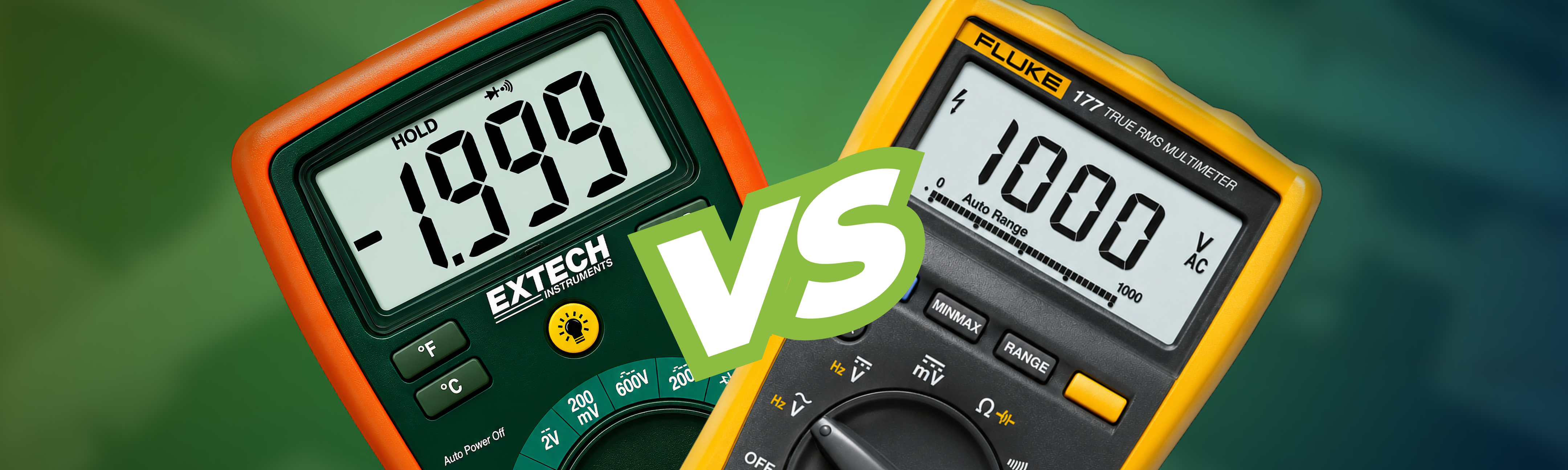
Extech vs. Fluke: Which Aviation Digital Multimeter Is Right for You?
Key Takeaways
- Fluke is the established benchmark for professional digital multimeters in industrial and aviation environments – premium-priced and deeply embedded in aviation quality programs – while Extech Instruments delivers comparable or greater feature counts at a more accessible price point, making it the credible, value-oriented alternative for technically literate technicians.
- Both brands offer True RMS digital multimeters across multiple tiers, from compact entry-level instruments for line maintenance to 50,000-count, high-accuracy models suited for avionics calibration, precision diagnostics, and regulated maintenance benches.
- CAT IV-600V safety certification – available across the Extech EX500A series and select Fluke multimeters, including the Fluke 87V, Fluke 179, and Fluke 28II – is the appropriate safety rating for work on aircraft bus systems, ground power equipment, and industrial distribution panels.
- The Extech EX500A series carries an IP67 waterproof and dustproof rating with 2-meter drop protection standard across the lineup; the Fluke 28II matches this with IP67 and 3-meter drop resistance, while most other Fluke models carry less formal environmental protection.
- NIST-traceable calibration options are available for both brands – Extech through dedicated "-NIST" models and Fluke through calibration certificate add-ons – providing the documented measurement traceability required by FAA Part 145, AS9100, and ISO 9001.
- PJi is an authorized distributor for both Extech and Fluke digital multimeters and operates an in-house ISO/IEC 17025-accredited calibration lab that can provide NIST-traceable calibration for instruments from either brand.
Two names come up consistently when aviation maintenance technicians evaluate professional test equipment: Extech and Fluke. Both brands produce professional-grade instruments built for accurate troubleshooting, field durability, and the demands of daily electrical maintenance. Pilot John International® (PJi®) supports both product lines and provides NIST-traceable calibration services through its ISO/IEC 17025-accredited calibration laboratory.
In this article, we'll compare Fluke and Extech multimeters across the features and performance characteristics that matter most in aviation maintenance, such as measurement accuracy, safety ratings, environmental protection, calibration support, and the advanced functions that separate an avionics-grade instrument from a basic field meter. The goal of this comparison isn't to declare a winner. It's to map each brand's lineup to the specific demands of aviation maintenance so technicians, shop managers, and quality teams can choose with confidence.
Two Brands, Two Market Positions – Extech and Fluke
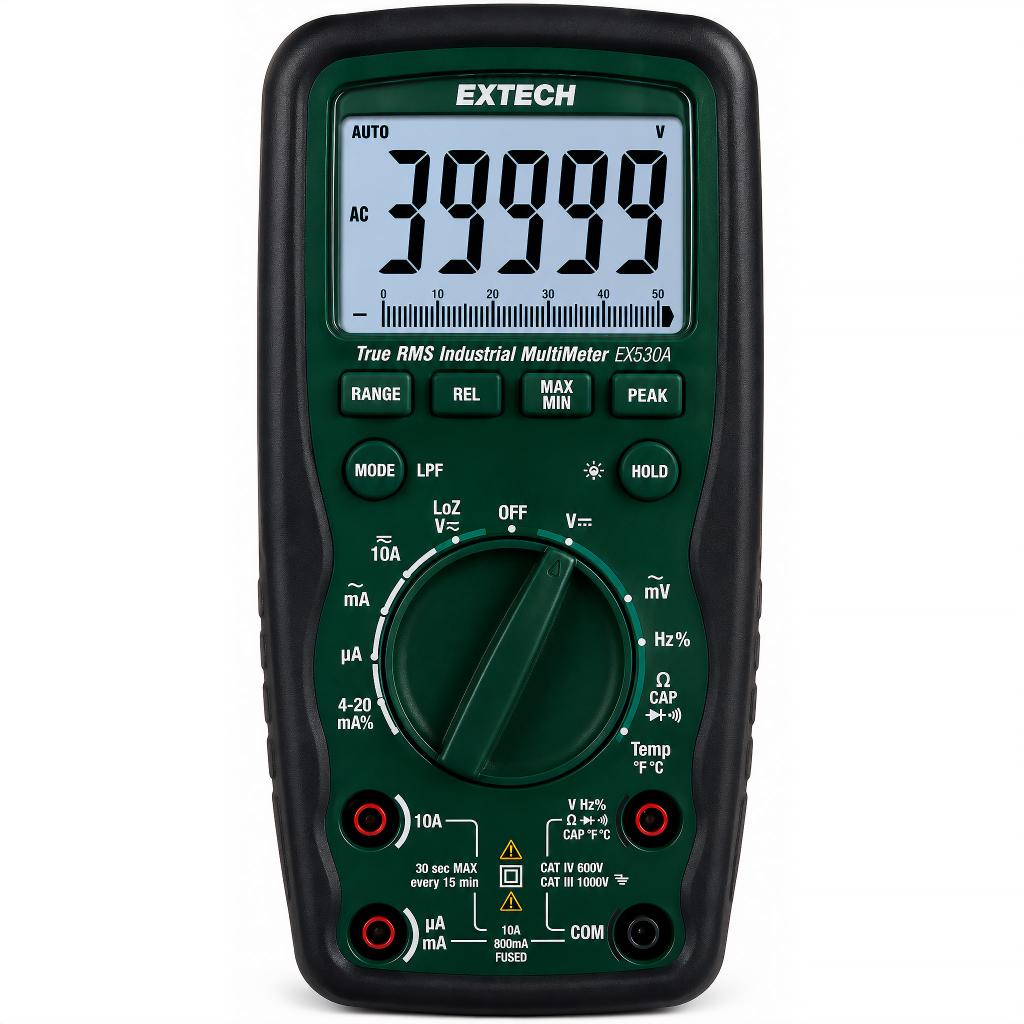
Extech Instruments, now part of Teledyne FLIR, has established itself as the feature-rich, professionally credentialed alternative for shops that prioritize capability and value. Extech multimeters bring the same professional benchmarks – CAT IV-600V safety ratings, IP67 environmental protection, True RMS measurement, and NIST-traceable calibration – at competitive price points, making high-performance measurement accessible across a broader range of operations and budgets. The Extech EX530A, for example, delivers 50,000-count resolution, ±0.06% basic DCV accuracy, and a full IP67-rated housing – a combination of precision and environmental protection well-suited for both the avionics bench and the flight line. Its dedicated NIST-calibrated variants – the EX505A-NIST, EX520A-NIST, EX530A-NIST, and EX470A-NISTL – make it a natural fit for regulated maintenance environments that require documented measurement traceability.
Fluke has been setting the benchmark for professional test and measurement instruments since 1948, and that reputation is particularly entrenched in the aviation maintenance world. Fluke digital multimeters appear on maintenance benches, in avionics shops, and on Part 145 approved equipment lists worldwide. While Fluke products often represent a larger upfront investment than comparable Extech models, many technicians and maintenance organizations view that investment as justified by the brand's long-standing reputation for quality, its extensive product ecosystem anchored by the Fluke Connect wireless platform, and its widespread acceptance throughout aviation and other highly regulated industries.
Comparing the Lineups: Extech and Fluke by Product Tier
Both brands organize their digital multimeter offerings across roughly the same tier structure, making apples-to-apples comparisons reasonably straightforward.
| Tier | Extech | Fluke |
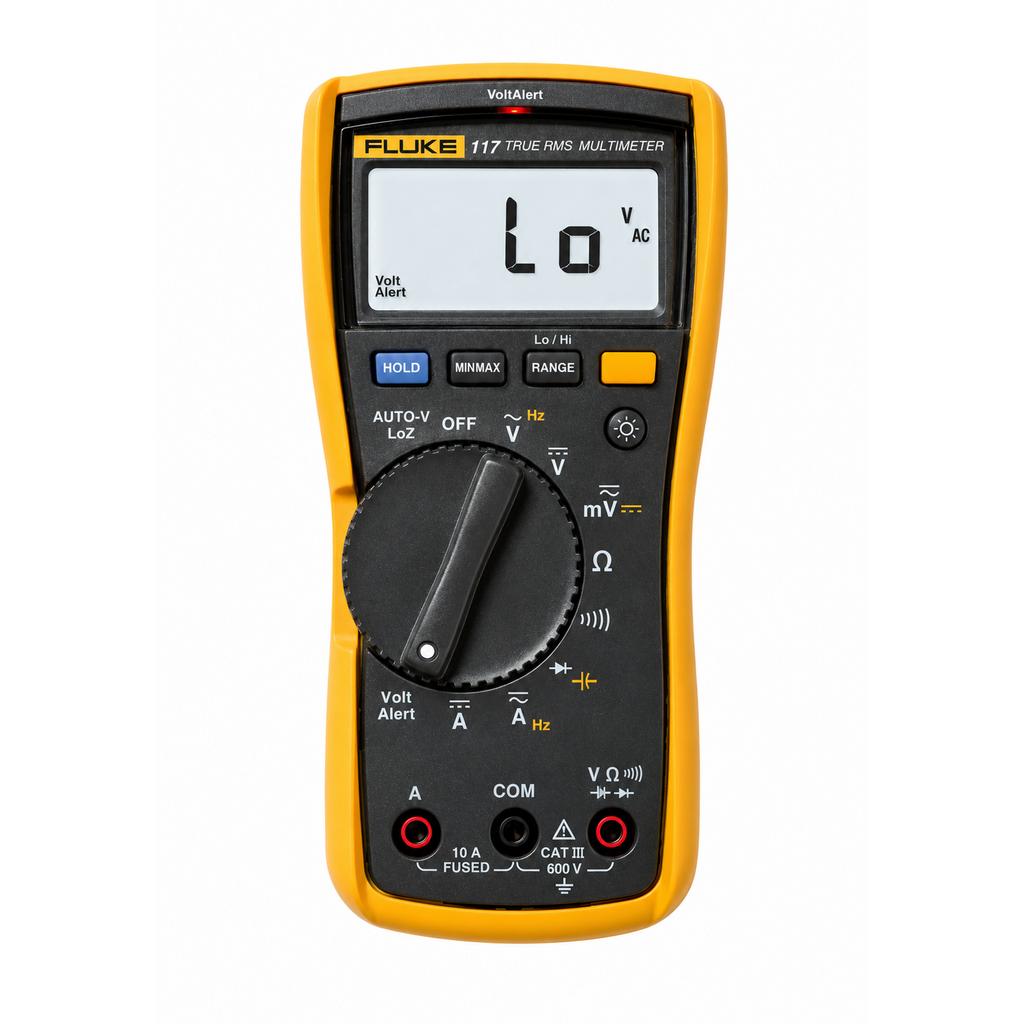
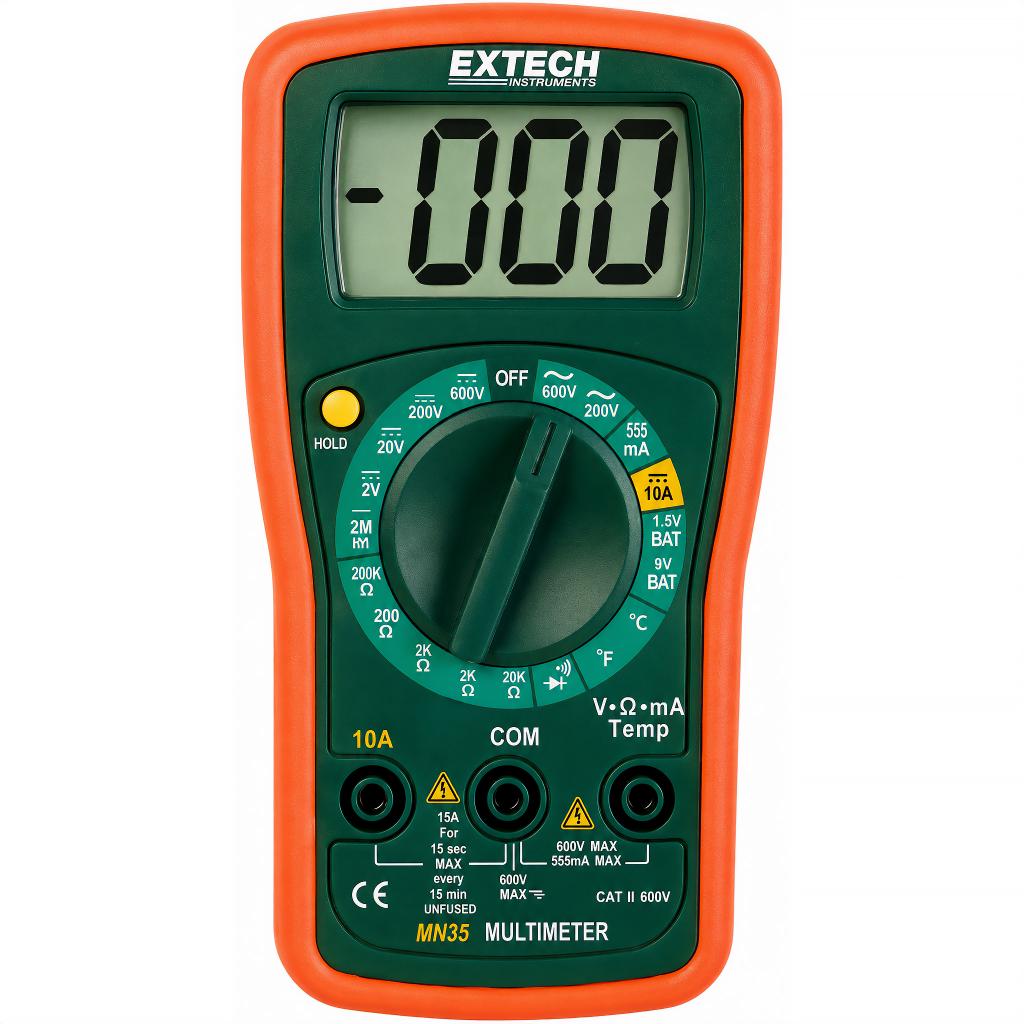
| Entry-Level / Line Use | EX310, EX330, EX350, MN35 | Fluke 115, Fluke 117 |
| Mid-Range Professional | EX410A, EX430A, EX355, MN36 | Fluke 175, Fluke 177, Fluke 179 |
| True RMS Industrial | EX505A, EX520A | Fluke 87V, Fluke 28II |
| High-Accuracy / Logging | EX530A | Fluke 287, Fluke 289 |
| NIST-Calibrated Variants | EX470A-NISTL, EX505A-NIST, EX520A-NIST, EX530A-NIST | Most models (NIST cert add-on) |
| Specialty | MG320 (insulation tester/multimeter) | Fluke 123B/124B/125B (ScopeMeter) |
The most meaningful comparison for aviation maintenance falls in the True RMS Industrial and High-Accuracy tiers, where both brands produce instruments capable of meeting the demands of the maintenance bench, the avionics bay, and the regulated shop environment.
True RMS, Accuracy, and Display Resolution: What Matters Most for Aviation Diagnostics
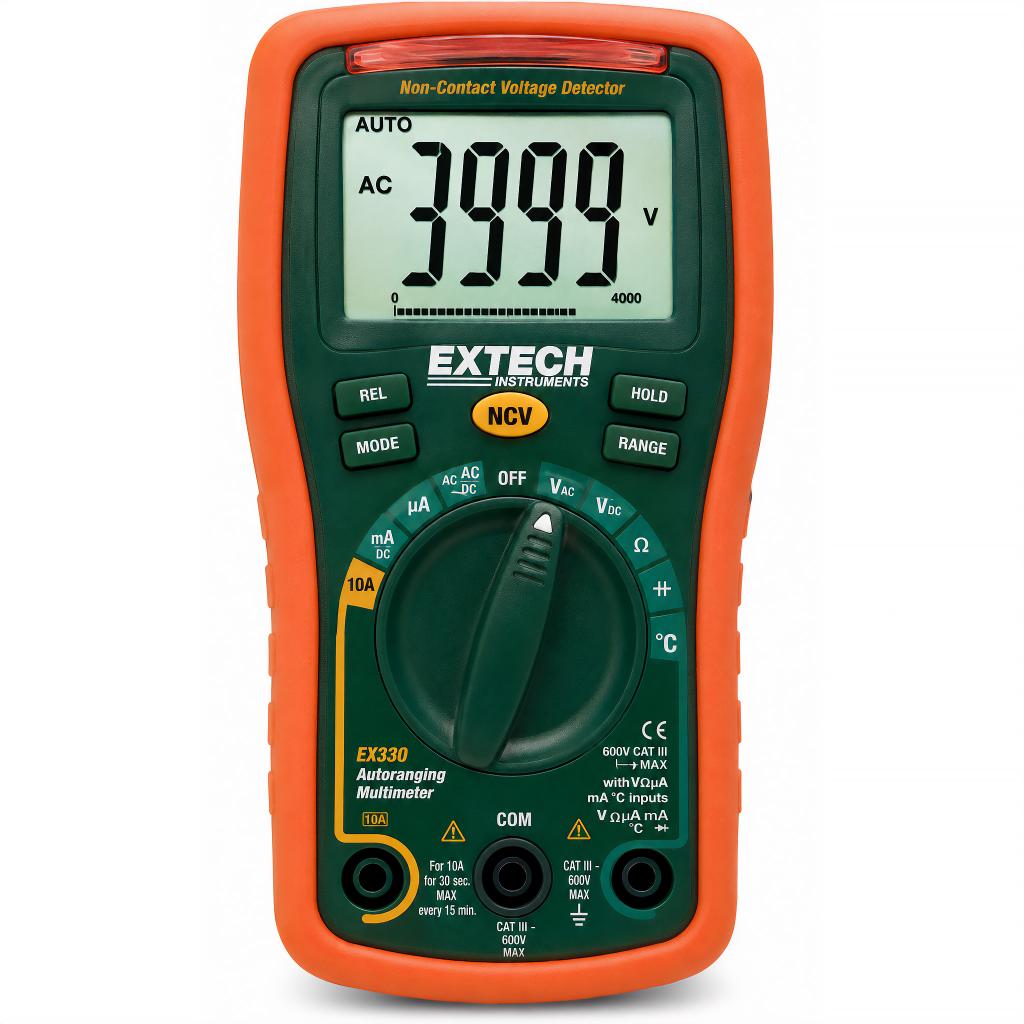
True RMS measurement is non-negotiable for any aircraft maintenance environment that includes inverter systems, variable frequency drives, switching power supplies, or other non-sinusoidal AC loads. Standard average-responding multimeters read accurately only on clean sinusoidal waveforms; on the complex waveforms produced by modern aircraft electrical systems, an average-responding meter can read significantly off from the actual value. Both brands offer True RMS starting at the mid-range tier – with one notable difference: the Fluke 117 is True RMS at the entry level, while the Extech EX330, a comparable entry-level instrument, is not. For aviation work involving inverters or VFDs, this distinction is important.
Display resolution determines how finely a meter can discriminate between closely spaced readings. Most professional Fluke and Extech models land in the 6,000-count range, which is appropriate for general electrical diagnostics, continuity checks, and most line maintenance tasks. The 50,000-count display – available on both the Extech EX530A and the Fluke 289/287 – provides significantly finer resolution: the difference between reading 14.32V and 14.317V on the same circuit. For avionics calibration, aircraft voltage standard verification, and precision power quality analysis, that resolution matters. On a routine tire pressure gauge calibration or continuity check, it doesn't.
Basic DCV accuracy at the top of each lineup tells a similar story: Fluke 87V at ±0.05%, Extech EX530A at ±0.06% – essentially equivalent for field use. The Fluke 289 pushes to ±0.025%, approaching bench-instrument territory for a handheld. Both brands offer the accuracy needed for professional aviation work across their respective professional tiers.
CAT Safety Ratings: Matching Extech and Fluke Models to the Hazard
Measurement Category (CAT) ratings define the electrical environments a meter is designed and tested to withstand safely. In aviation maintenance, the relevant categories are CAT III – covering fixed installation wiring, distribution panels, and bus systems – and CAT IV, which extends to the utility service entrance level and is required for work on aircraft power distribution systems, industrial ground power units, and high-energy transient environments.
From Extech, CAT IV-600V certification is standard across the EX500A series: the EX505A, EX520A, and EX530A are all CAT IV-600V rated. The entry-level EX330 carries a CAT III-600V rating, appropriate for most line maintenance and avionics shop work but not rated for the most demanding distribution environments.
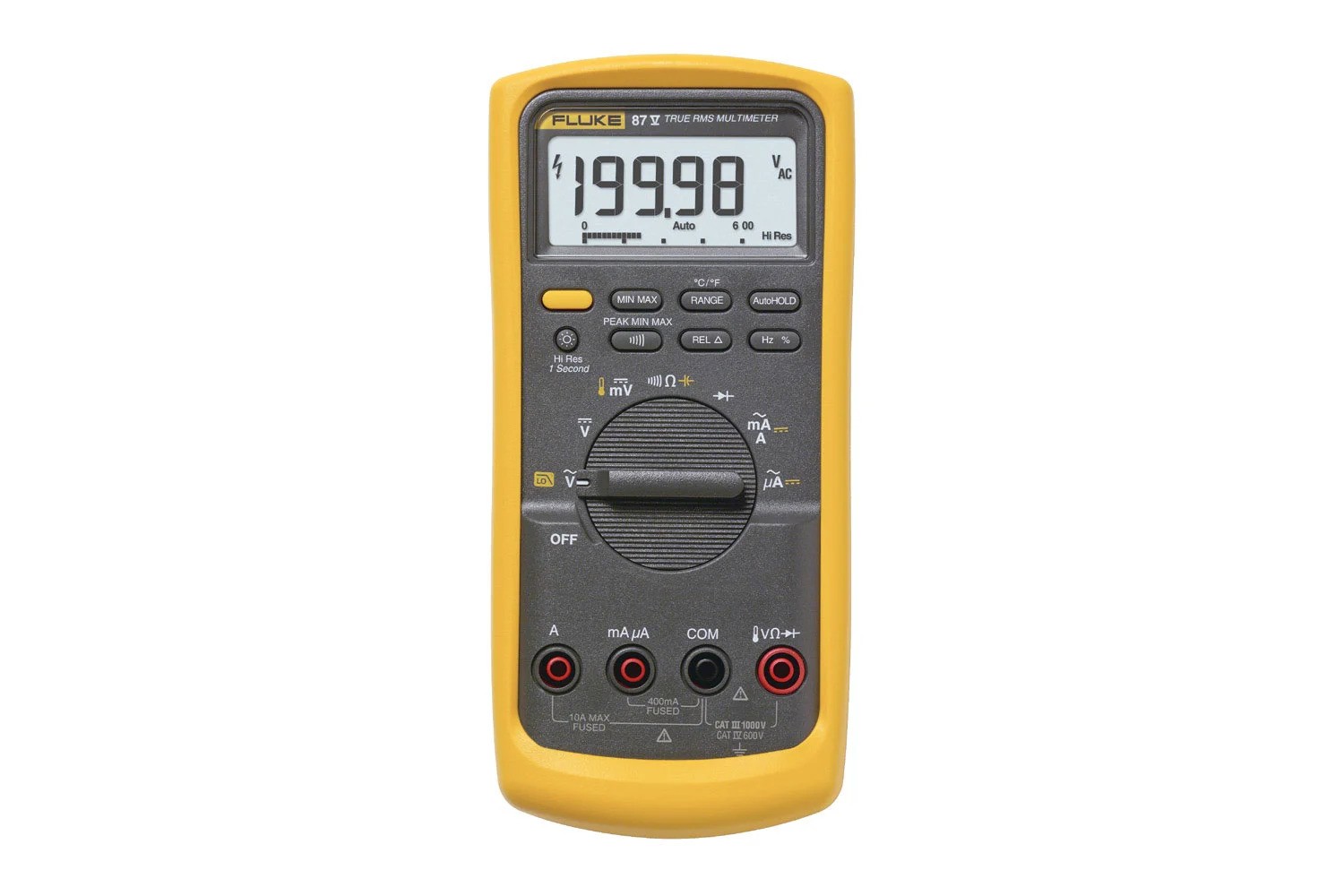
Fluke's CAT IV coverage is more selective. The Fluke 87V, Fluke 179, Fluke 177, Fluke 175, and Fluke 28II all carry CAT III-1000V / CAT IV-600V dual ratings – making them fully appropriate for high-energy aviation electrical environments. The Fluke 117, one of the most widely used electrician's multimeters, is rated CAT III-600V / CAT IV-300V, which is adequate for most line maintenance work but should be noted for higher-voltage applications.
For any shop that regularly works on aircraft bus systems, ground power equipment, or industrial power distribution, a CAT IV-600V rated instrument from either brand is the appropriate starting point.
Durability, IP Protection, and Field Readiness
For aviation maintenance work on the flight line, in hangars, or in demanding industrial MRO environments, environmental protection matters. Moisture, dust, fuel mist, hydraulic fluid, and the occasional drop onto a concrete hangar floor are realities of the working environment, and a meter that can't survive them isn't worth the purchase price.
The Extech EX500A series (EX505A, EX520A, EX530A) sets a clear standard here: all three models carry IP67 waterproof and dustproof ratings with 2-meter drop protection, double-molded housings, and double-molded test leads. This full environmental protection is standard across the series, not limited to a specialty variant.
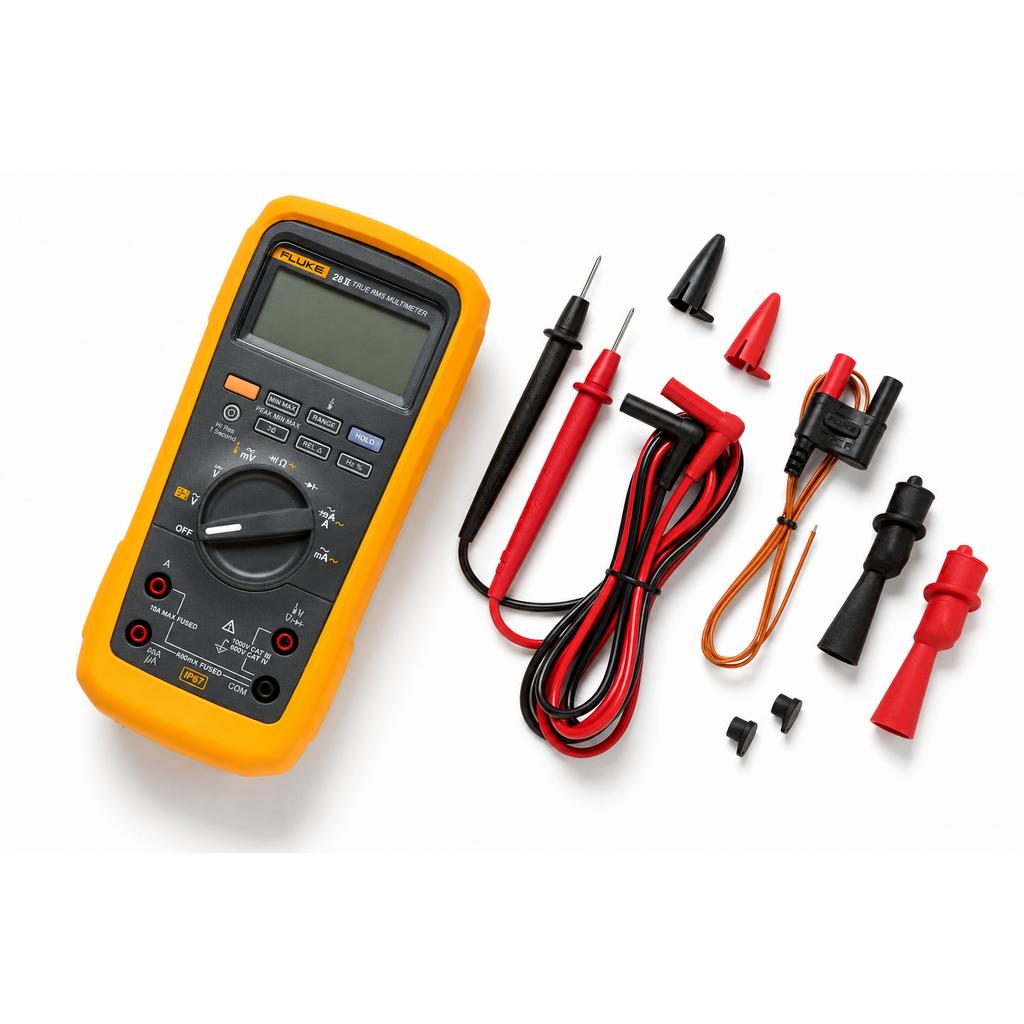
Fluke's equivalent for field-grade environmental protection is the Fluke 28II, which carries an IP67 rating with 3-meter drop resistance – the most rugged meter in the standard Fluke handheld lineup. The Fluke 87V MAX also carries IP67 protection. The standard Fluke 87V and Fluke 179, while durable and built to last, carry an IP40 classification (rubber holster, not formally sealed) – adequate for bench use and controlled shop environments but less appropriate for consistently wet or dusty flight-line conditions.
Where Extech pulls ahead is in environmental protection at the professional tier: the full EX500A series – EX505A, EX520A, and EX530A – delivers IP67 protection as standard across the entire lineup, at a price point meaningfully below the Fluke 28II, which is the only standard Fluke handheld to match that environmental spec. For bench-focused operations with less exposure to harsh environments, either brand's standard professional lineup performs reliably.
NIST Calibration and Documentation for Regulated Aviation Maintenance
For FAA Part 145 certificated repair stations, AS9100-registered maintenance organizations, and quality-managed MRO operations, calibrated test equipment isn't optional – it's a documented compliance requirement. NIST-traceable calibration confirms that an instrument's measurements connect through an unbroken chain to the National Institute of Standards and Technology's reference standards, with the measurement uncertainty documented on the calibration certificate.
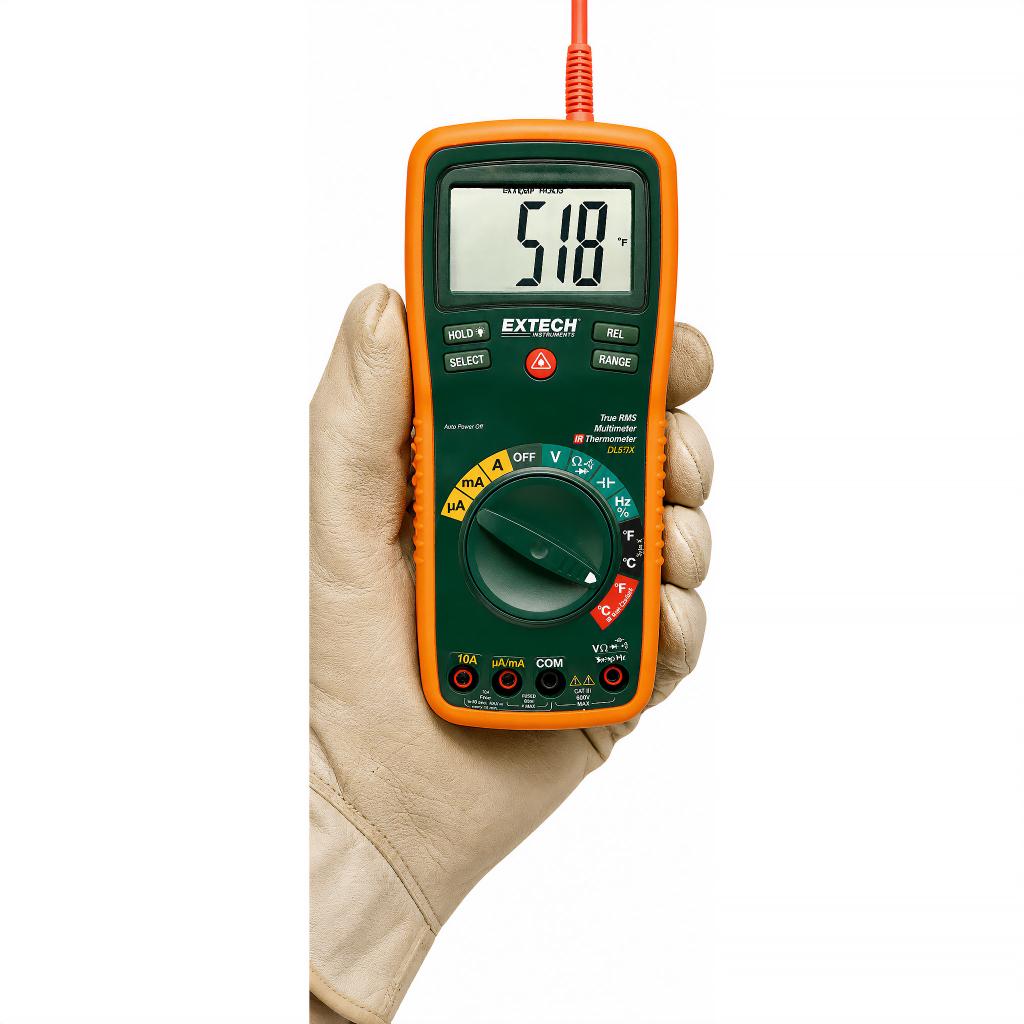
Extech offers dedicated NIST-calibrated models – the EX470A-NISTL, EX505A-NIST, EX520A-NIST, and EX530A-NIST – that ship from the factory with a NIST-traceable calibration certificate included in the original packaging. This turnkey approach is convenient for shops that need the instrument and the documentation to arrive together.
Fluke's professional multimeters don't include a calibration certificate at the standard point of purchase – it's an optional add-on that requires additional steps to arrange. For shops that need an instrument and its NIST-traceable documentation to arrive together, that distinction is worth factoring into the purchasing decision.
PJi's in-house ISO/IEC 17025-accredited calibration lab closes that gap for both brands. For either Extech or Fluke multimeters, PJi can provide NIST-traceable calibration at the time of purchase – instrument and certificate in a single transaction – or as part of a regular recalibration schedule for instruments already in service. Documentation satisfies FAA Part 145, ISO 9001, and AS9100 requirements, making PJi a practical single-source option for shops that need to maintain calibration records across either brand.
Connectivity, Logging, and Advanced Digital Multimeter Features
Where Fluke pulls ahead is in connected and logging functionality. The Fluke Connect ecosystem – including the Fluke 3000 FC wireless modules, the Fluke 283FC wireless logging multimeter, and compatible software – allows technicians to log measurements remotely, share data across a team, and document readings in real time without transcription. The Fluke 287 and Fluke 289 support 15,000-reading data logging with PC download capability, a valuable tool for trending power quality issues or documenting pre- and post-maintenance baselines over time.
Extech's professional multimeters don't offer wireless connectivity or data logging at comparable depth. The EX530A, the top of the Extech lineup, features Peak hold, MAX/MIN recording, a bar graph display, and a Relative mode – useful for in-session capture – but not the sustained logging or wireless sharing that Fluke's ecosystem enables. For shops that need to document measurements across a fleet or over extended test periods, Fluke's connected instruments offer a capability that Extech currently doesn't match.
On specialized measurement functions, the two brands converge closely. Both the Extech EX530A and the Fluke 87V include LoZ (low impedance) ghost-voltage elimination, a Low Pass Filter for VFD diagnostics, and 4-20mA loop current testing – three functions that are particularly useful for modern aircraft electrical systems. NCV (non-contact voltage) detection is available on Extech entry-level models (EX330, EX310) and on the Fluke 117, giving both brands practical options for safe pre-contact circuit identification in line maintenance and FBO work.
Choosing the Right Digital Multimeter for Your Operation
The right instrument depends on the work, the environment, and the documentation requirements – not on brand loyalty.
For line technicians and FBO service crews that need a compact, fast, daily-use meter with NCV for safe circuit identification, both the Extech EX330 and the Fluke 117 are appropriate choices. The Fluke 117 adds True RMS for a price premium; if VFD or inverter work is part of the workflow, that matters.
For A&P mechanics and general maintenance technicians working across aircraft electrical systems and ground support equipment, a True RMS, CAT IV-600V meter in the professional tier is the right baseline. The Extech EX520A and the Fluke 87V or Fluke 28II all meet this spec – with Extech offering IP67 protection at a lower price point and Fluke's 28II adding a more robust drop rating.
For avionics shops and high-precision diagnostics, the Extech EX530A and the Fluke 289 are the relevant comparison. Both offer 50,000-count resolution and precision-level accuracy. The Fluke 289 edges ahead on raw accuracy (±0.025% vs. ±0.06%) and adds data logging; the Extech EX530A offers IP67 protection and comes in at a meaningfully lower price.
For FAA Part 145 repair stations and quality-managed MRO operations, NIST-traceable calibration is required documentation. Extech's dedicated NIST models are the most straightforward out-of-the-box path – instrument and certificate together from the start. For Fluke, or for any shop that wants a consistent calibration source across both brands, PJi's calibration lab can provide NIST-traceable documentation for either brand at the time of purchase.
For operations that prioritize connectivity and data logging, Fluke's ecosystem – particularly the Fluke Connect platform and the 287/289 series – provides capabilities Extech doesn't currently match.
The Bottom Line
Extech and Fluke both belong in serious aviation maintenance operations, and the right choice between them comes down to the specific combination of accuracy requirements, environmental exposure, documentation needs, and budget constraints that defines your operation. Neither brand is uniformly superior – each has clear advantages in the right context, and the overlap between their professional-tier instruments is real.
PJi is an authorized distributor for both Extech digital multimeters and Fluke digital multimeters, carrying the full professional lineup for both brands – True RMS industrial models, high-accuracy instruments, NIST-calibrated variants, and specialty options. Whether you're equipping a line maintenance crew, stocking an avionics bench, or sourcing documented instruments for a Part 145 shop, PJi has both brands covered in one place.
For operations that need calibration at the time of purchase – or recalibration for instruments already in service – PJi's in-house ISO/IEC 17025-accredited calibration lab provides NIST-traceable calibration for Extech and Fluke digital multimeters, with documentation satisfying FAA Part 145, ISO 9001, and AS9100 requirements. It's one transaction for the instrument and the certificate, or a straightforward recalibration process for meters already in your inventory.
Our aviation specialists are ready to help you match the right instrument to your operation – whether that's an Extech or a Fluke, a single meter or a full shop inventory. Call, email, or chat with us today to get started.
Frequently Asked Questions
How does Extech compare to Fluke for professional aviation maintenance?
At the professional instrument level, Extech and Fluke are closely matched across core performance credentials – both offer True RMS measurement, CAT IV-600V safety ratings, and NIST-traceable calibration options on their upper-tier models. Extech, now part of Teledyne FLIR, delivers these benchmarks at competitive price points and provides IP67 environmental protection as standard across the full EX500A series – a specification Fluke extends to only a few models in its lineup. Fluke carries the advantage of longer market integration in aviation quality programs and a more developed wireless data logging ecosystem; Extech counters with more environmental protection per dollar across its professional tier and dedicated NIST-calibrated models that include the certificate at the standard point of purchase.
Which Fluke multimeters are most commonly used in aviation maintenance?
The Fluke 87V is the most widely referenced Fluke multimeter in aviation maintenance circles, valued for its True RMS measurement, ±0.05% basic DCV accuracy, CAT IV-600V rating, and the 4-20mA and LoZ functions that make it useful for modern aircraft electrical diagnostics. The Fluke 28II is the preferred choice when maximum environmental durability is required, adding IP67 and 3-meter drop resistance. The Fluke 117 is common in line maintenance and FBO environments due to its NCV detector and compact form factor. For high-precision avionics calibration and documented measurement workflows, the Fluke 289 is the benchmark instrument.
What is the practical difference between Extech and Fluke in terms of price and value?
Extech's value proposition centers on professional-grade credentials at accessible price points – making high-performance measurement capability available across a broader range of shops and operational budgets. The Extech EX530A, for example, bundles 50,000-count resolution, ±0.06% DCV accuracy, IP67 environmental protection, and CAT IV-600V certification into a single instrument suited for both the precision demands of the avionics bench and the rigors of daily field use. Fluke occupies a higher price tier across its lineup, but that investment reflects the brand's deep integration into regulated aviation quality programs, marginally higher accuracy at the top end, and its Fluke Connect ecosystem for wireless data logging and documentation. Both brands represent strong value at the professional tier – the right fit depends on the balance of specifications, workflow requirements, and budget considerations for your specific operation.
Are NIST-calibrated digital multimeters required for FAA Part 145 repair stations?
For FAA Part 145 repair stations, AS9100-registered maintenance organizations, and quality-managed MRO operations, calibrated test equipment is a documented compliance requirement. NIST-traceable calibration confirms that a digital multimeter’s measurements connect through an unbroken chain to recognized national standards, with measurement uncertainty documented on the calibration certificate. Extech offers dedicated NIST-calibrated models that include the instrument and certificate together, while Fluke calibration documentation typically requires an added calibration service. PJi’s in-house ISO/IEC 17025-accredited calibration lab can provide NIST-traceable calibration for both Extech and Fluke digital multimeters at the time of purchase or as part of a regular recalibration schedule, with documentation that satisfies FAA Part 145, ISO 9001, and AS9100 requirements.
What is Fluke Connect, and does Extech have a comparable wireless ecosystem?
Fluke Connect is Fluke's wireless measurement platform, compatible with a range of Fluke instruments and remote measurement modules (the 3000 FC series), that allows technicians to log measurements remotely, share data in real time, and export readings to Fluke's desktop software for documentation and trending. The Fluke 283FC is a dedicated wireless logging multimeter built for continuous remote measurement. Extech does not currently offer a comparable wireless ecosystem – its professional multimeters, including the EX530A, support manual data capture functions (MAX/MIN, Peak hold, Relative) but not continuous wireless logging or team data sharing. For operations where connected measurement workflows and remote data capture are priorities, Fluke's ecosystem is the stronger choice.
Which multimeter is better suited for aircraft with VFDs, inverters, or non-sinusoidal loads?
Any work involving variable frequency drives, inverters, or switching power supplies requires a True RMS multimeter – an average-responding meter will read inaccurately on non-sinusoidal waveforms and can lead to incorrect diagnostic conclusions. At the professional tier, both the Extech EX520A/EX530A and the Fluke 87V include a dedicated Low Pass Filter (LPF) mode specifically designed for VFD and inverter diagnostics, which filters out the high-frequency switching noise that can cause erratic readings even on True RMS meters. Both also include LoZ (low impedance) input mode, which eliminates ghost voltages on de-energized circuits – a useful first-check function in any complex aircraft electrical system.
Can PJi calibrate both Extech and Fluke multimeters?
Yes. PJi's ISO/IEC 17025-accredited calibration lab in New Bern, NC, provides NIST-traceable calibration for a broad range of electronic and electrical instruments, including digital multimeters from both Extech and Fluke. Calibration can be arranged at the time of purchase – instrument and certificate in one transaction – or for instruments already in service that are due for their scheduled recalibration interval. Documentation issued by the lab satisfies FAA Part 145, ISO 9001, and AS9100 requirements. Contact PJi's team for a calibration quote or to arrange shipping.