






12-3107-0000 - Tronair 18-4303-0000 – 4-Bottle Nitrogen Cart with High/Low-Pressure Regulators


In addition to selling this item as new, we also have used or refurbished of this item in stock (subject to prior sale).
The 12-3107-0000 is a specific part number of the series Tronair 18-4303-0000. For more generalized information on this item series or for more options, click here.

| Alternate Models | |
|---|---|
| 12-3104-0000-A8 | Previous Part Number |
| 12-3107-0000 | Previous Part Number |
| General Information | |
|---|---|
| Part # | 12-3107-0000 |
| Manufacturer | Tronair |
| Shipping Information | |
|---|---|
| Shipping Weight | 540 lbs. |
| Shipping Dimensions | 81 x 41 x 47 in. |
| Freight NMFC | 189800 |
| Schedule B | 8716390020 |
| ECCN | EAR99 |
Customers also viewed
Customers who bought this item also purchased

AIRCRAFT COMPATIBILITY
PRODUCT REVIEWS
This item does not have any reviews yet.
QUESTIONS & ANSWERS
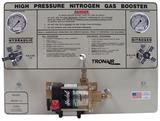
This nitrogen cart is used in aviation maintenance to service both high-pressure and low-pressure aircraft systems. It supports operations like inflating tires, charging struts, and servicing accumulators, offering regulated outputs to match each application. With dual regulators, it ensures precise control for components requiring pressures from as low as 0 to 500 PSI up to as high as 4000 PSI.
Operators must never exceed 3,000 psi inlet pressure and should not use high-pressure nitrogen on systems designed for low-pressure service, such as tires. Only trained and qualified personnel should operate or maintain the cart. Nitrogen must also be kept clean and free of contaminants at all times to avoid system damage.
The cart includes two regulators: the high-pressure regulator provides adjustable output between 25 and 4,000 PSI, while the low-pressure regulator supports 0 to 500 PSI. Each regulator has a dedicated service hose, with the high-pressure hose marked red and the low-pressure hose marked blue, making it easy to identify the correct setup for the task.
Bottles are rotated so that the manifold inlet hoses connect easily, avoiding kinks or cross-threading. If fewer than four bottles are installed, the unused inlet hoses should be capped or covered to maintain cleanliness. After securing fittings, the bottle valves can be opened for use.
For maximum efficiency, technicians should draw from the lowest-pressure bottle first. This method allows the system to extract usable nitrogen from each bottle, even those with relatively low pressure, before moving to higher-pressure bottles. It ensures minimal waste and maximizes the available gas supply.
Before connecting, all regulators must be turned down to the minimum setting and needle valves closed. The fill line is then loosely connected and purged before tightening at the aircraft connection. This prevents contamination and reduces the risk of hose whip during charging.
The red high-pressure hose is attached to the aircraft system, and the nitrogen bottle valve is opened slowly. Pressure is then adjusted using the high-pressure regulator until the desired output is reached. After servicing, the line is carefully bled and disconnected to avoid contamination.
For low-pressure tasks, such as servicing aircraft tires or certain accumulators, the blue low-pressure hose is used. Operators slowly open the nitrogen supply valve and adjust the low-pressure regulator clockwise to increase output until the required pressure is reached. Once complete, the regulator should be backed down and the line disconnected carefully.
Routine maintenance includes inspecting output and inlet hoses for cracks or kinks, checking gauges for annual calibration, and greasing wheel bearings quarterly. The entire unit should be kept clean and free of contaminants, with any leaks corrected before operation. Proper maintenance ensures accuracy, reliability, and long service life.
The cart should be stored in a clean, dry area with all hoses capped to prevent contamination. Covering the unit during storage further protects it from dirt or moisture, ensuring the system is ready for use when needed. Proper storage helps preserve the regulators, gauges, and hoses.


